QUESTION IMAGE
Question
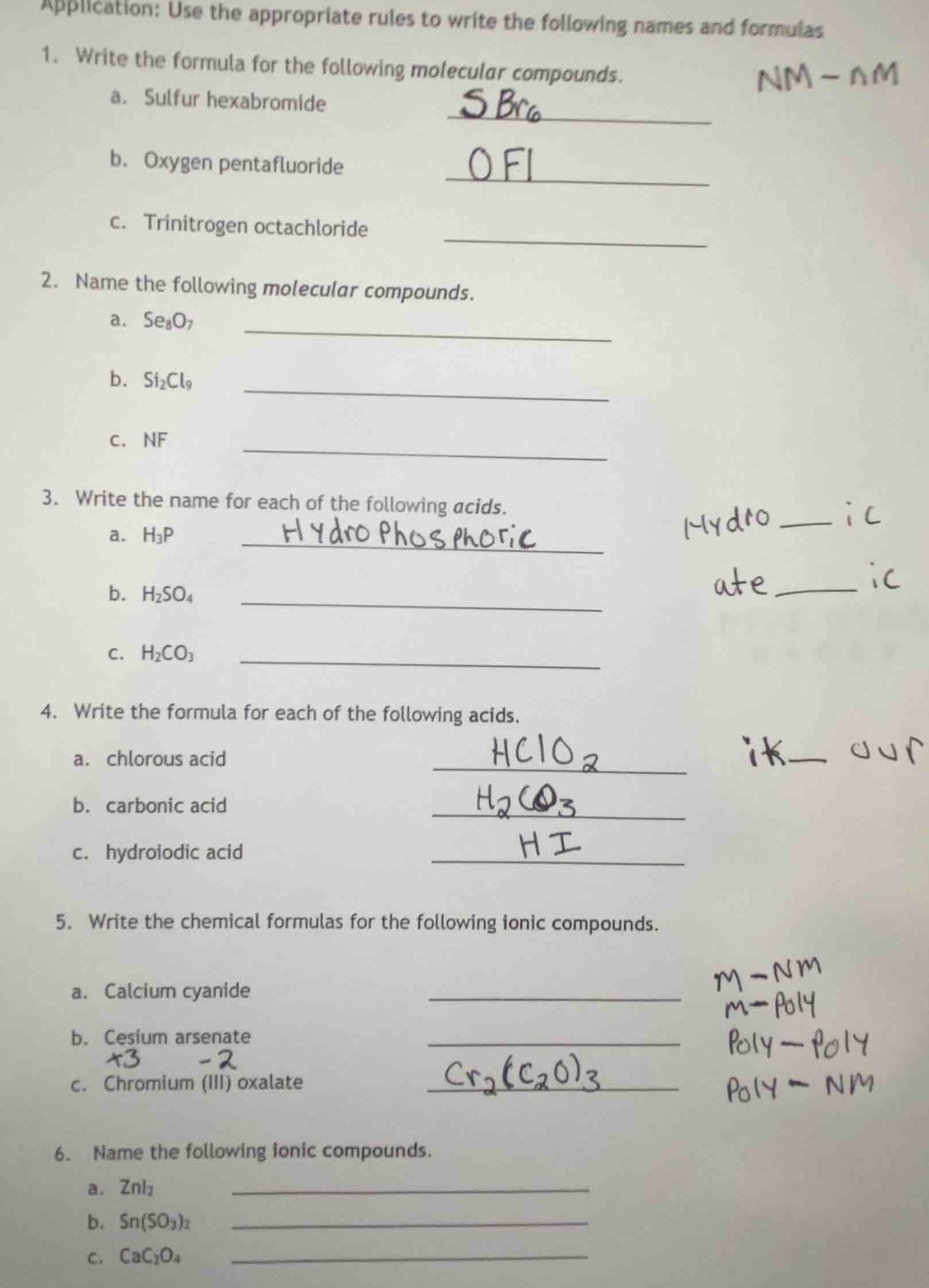
application: use the appropriate rules to write the following names and formulas
- write the formula for the following molecular compounds.
a. sulfur hexabromide
b. oxygen pentafluoride
c. trinitrogen octachloride
- name the following molecular compounds.
a. se₈o₇
b. si₂cl₉
c. nf
- write the name for each of the following acids.
a. h₃p
b. h₂so₄
c. h₂co₃
- write the formula for each of the following acids.
a. chlorous acid
b. carbonic acid
c. hydroiodic acid
- write the chemical formulas for the following ionic compounds.
a. calcium cyanide
b. cesium arsenate
c. chromium (iii) oxalate
- name the following ionic compounds.
a. zni₂
b. sn(so₃)₂
c. cac₂o₄
Problem 1
Part a
Step1: Identify elements and prefixes
Sulfur (S) has no prefix (mono), hexabromide means 6 bromine (Br) atoms.
Step2: Write formula
Combine symbols with subscripts: \( SBr_6 \) (already correct as per the handwritten, but let's confirm: sulfur is S, bromide is Br, hex- means 6, so \( SBr_6 \) is correct).
Part b
Step1: Identify elements and prefixes
Oxygen (O) has no prefix (mono), pentafluoride means 5 fluorine (F) atoms.
Step2: Write formula
Correct formula should be \( OF_5 \) (the handwritten "OFI" is incorrect; F is fluorine, so \( OF_5 \)).
Part c
Step1: Identify elements and prefixes
Trinitrogen means 3 nitrogen (N) atoms, octachloride means 8 chlorine (Cl) atoms.
Step2: Write formula
Combine: \( N_3Cl_8 \).
Problem 2
Part a

Snap & solve any problem in the app
Get step-by-step solutions on Sovi AI
Photo-based solutions with guided steps
Explore more problems and detailed explanations
Step1: Identify ions
\( CaC_2O_4 \): Calcium (Ca) has charge +2, oxalate (\( C_2O_4^{2-} \)) has charge -2.
Step2: Name the compound
Calcium oxalate (calcium has +2, oxalate -2, 1:1 ratio, so calcium oxalate).
Final Answers (Key Corrections and Confirmations)
Problem 1
a. \( \boldsymbol{SBr_6} \) (correct)
b. \( \boldsymbol{OF_5} \) (corrected from OFI)
c. \( \boldsymbol{N_3Cl_8} \)
Problem 2
a. \( \boldsymbol{Se_8O_7} \): Octaselenium heptoxide
b. \( \boldsymbol{Si_2Cl_9} \): Disilicon nonachloride
c. \( \boldsymbol{NF} \): Nitrogen monofluoride (or check formula validity, but as per given)
Problem 3
a. \( \boldsymbol{H_3P} \): Hydrophosphoric acid (corrected spelling)
b. \( \boldsymbol{H_2SO_4} \): Sulfuric acid
c. \( \boldsymbol{H_2CO_3} \): Carbonic acid
Problem 4
a. \( \boldsymbol{chlorous\ acid} \): \( HClO_2 \) (correct)
b. \( \boldsymbol{carbonic\ acid} \): \( H_2CO_3 \) (correct)
c. \( \boldsymbol{hydroiodic\ acid} \): \( HI \) (correct)
Problem 5
a. \( \boldsymbol{Calcium\ cyanide} \): \( Ca(CN)_2 \)
b. \( \boldsymbol{Cesium\ arsenate} \): \( Cs_3AsO_4 \)
c. \( \boldsymbol{Chromium\ (III)\ oxalate} \): \( Cr_2(C_2O_4)_3 \) (corrected formula)
Problem 6
a. \( \boldsymbol{ZnI_2} \): Zinc iodide
b. \( \boldsymbol{Sn(SO_3)_2} \): Tin(IV) sulfite
c. \( \boldsymbol{CaC_2O_4} \): Calcium oxalate
(Note: Some handwritten answers had typos, which are corrected above based on chemical nomenclature rules.)