QUESTION IMAGE
Question
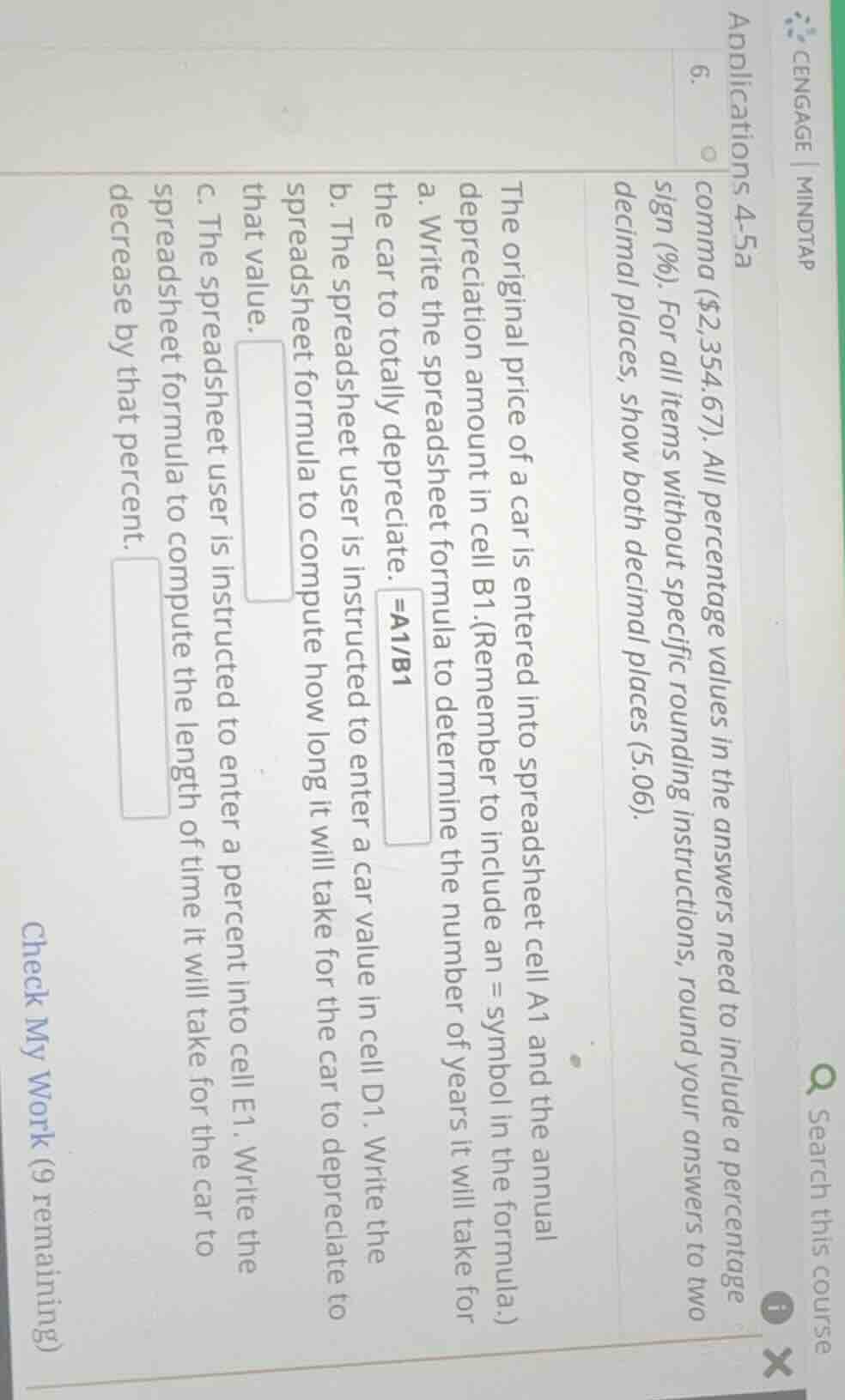
applications 4-5a 6. comma ($2,354.67). all percentage values in the answers need to include a percentage sign (%). for all items without specific rounding instructions, round your answers to two decimal places, show both decimal places (5.06). the original price of a car is entered into spreadsheet cell a1 and the annual depreciation amount in cell b1.(remember to include an = symbol in the formula.) a. write the spreadsheet formula to determine the number of years it will take for the car to totally depreciate. =a1/b1 b. the spreadsheet user is instructed to enter a car value in cell d1. write the spreadsheet formula to compute how long it will take for the car to depreciate to that value. c. the spreadsheet user is instructed to enter a percent into cell e1. write the spreadsheet formula to compute the length of time it will take for the car to decrease by that percent. check my work (9 remaining)
Part b
Step1: Recall depreciation formula
The formula for depreciation to reach a certain value involves the concept of exponential depreciation or using the formula related to the ratio of the final value to the initial value and the annual depreciation rate. If the annual depreciation amount is \( B1 \) (so the annual depreciation rate \( r=\frac{B1}{A1} \) from part a), and we want to find the time \( t \) when the value goes from \( A1 \) to \( D1 \), we can use the formula for the number of periods in depreciation. The value after \( t \) years is \( V = A1 - t\times B1 \) (straight - line depreciation, which is assumed here as we have an annual depreciation amount). We want \( V = D1 \), so \( A1 - t\times B1=D1 \). Solving for \( t \), we get \( t=\frac{A1 - D1}{B1} \). In spreadsheet terms, the formula would be \(=(A1 - D1)/B1\)
Step2: Write the spreadsheet formula
Based on the derivation, the spreadsheet formula to compute the time it takes for the car to depreciate to the value in \( D1 \) is \(=(A1 - D1)/B1\)
Step1: Recall percentage decrease formula
The formula for percentage decrease is \( \text{Percentage Decrease}=\frac{\text{Initial Value}-\text{Final Value}}{\text{Initial Value}}\times100\% \). Here, the initial value is \( A1 \), the annual depreciation amount is \( B1 \), so the amount of decrease per year is \( B1 \), and the percentage decrease rate \( r \) can be found by \( r=\frac{B1}{A1}\times100\% \). But if we want to find the time \( t \) when the value decreases by a percentage (let the percentage be in \( E1 \), so the decimal form is \( E1/100 \)), we can use the formula for the number of years. The value after \( t \) years with a percentage decrease rate \( p = E1/100 \) (where \( p \) is the decimal percentage decrease per year) is \( V = A1\times(1 - p)^t \). But since we have a straight - line depreciation (annual depreciation amount \( B1 \)), the percentage decrease per year is \( \frac{B1}{A1}\times100\% \), and we want to find \( t \) when the total percentage decrease is \( E1\% \). The total decrease in value is \( A1\times\frac{E1}{100} \), and since the annual decrease is \( B1 \), the time \( t=\frac{A1\times(E1/100)}{B1}=\frac{A1\times E1}{100\times B1} \). In spreadsheet terms, the formula is \(=(A1\times E1)/(100\times B1)\)
Step2: Write the spreadsheet formula
Based on the derivation, the spreadsheet formula to compute the time it takes for the car to decrease by the percent in \( E1 \) is \(=(A1\times E1)/(100\times B1)\) (or alternatively, if we consider the percentage decrease rate as \( E1 \) (in percentage) and the annual depreciation rate is \( B1/A1\times100\% \), we can also think of it as \(=\text{LOG}(1 - E1/100,1 - B1/A1)\) but the straight - line depreciation approach gives \(=(A1\times E1)/(100\times B1)\) for the time to reach a certain percentage decrease)

Snap & solve any problem in the app
Get step-by-step solutions on Sovi AI
Photo-based solutions with guided steps
Explore more problems and detailed explanations
\(=(A1 - D1)/B1\)