QUESTION IMAGE
Question
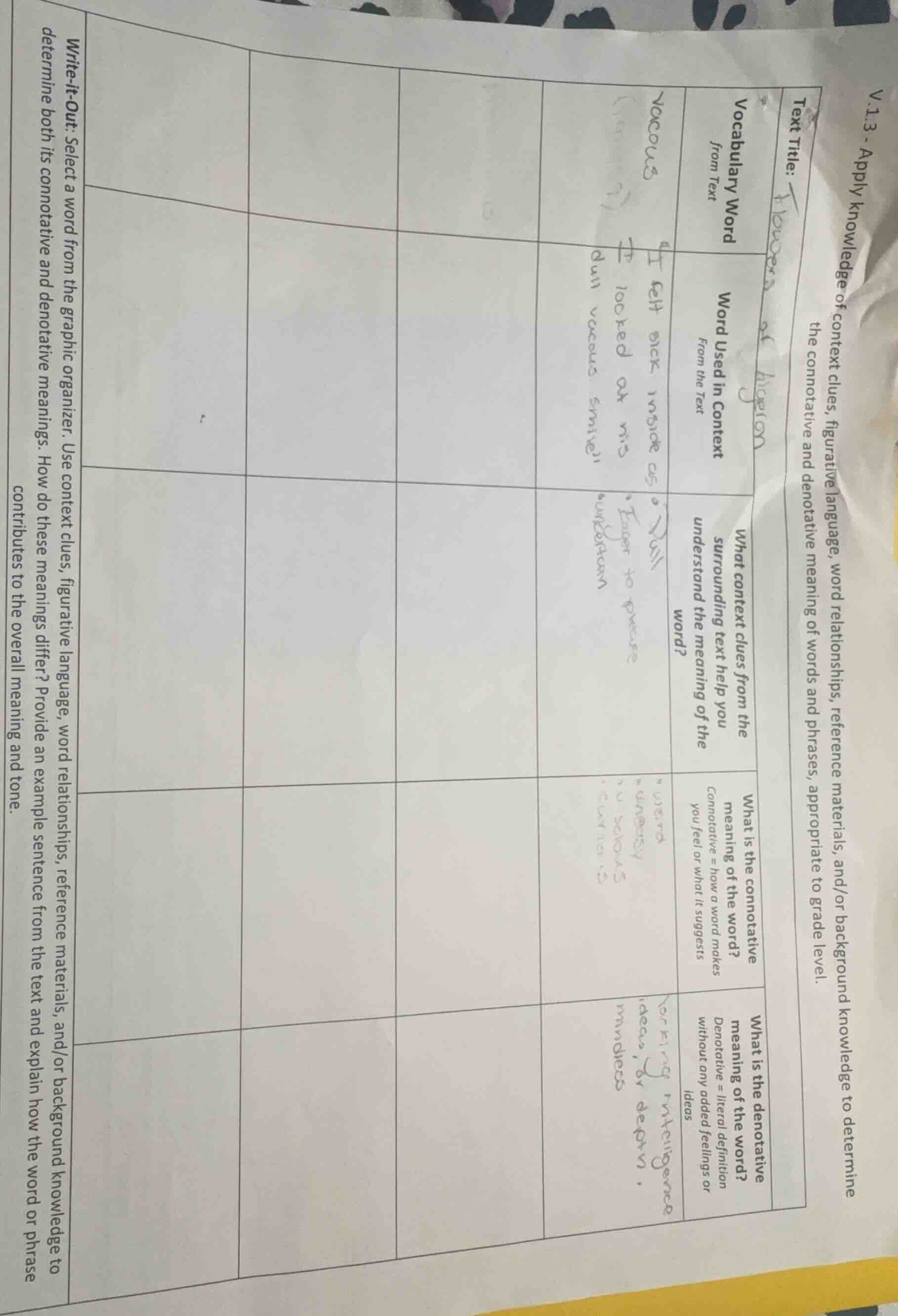
v.1.3 - apply knowledge of context clues, figurative language, word relationships, reference materials, and/or background knowledge to determine the connotative and denotative meaning of words and phrases, appropriate to grade level.
text title:
vocabulary word from text
word used in context from the text
what context clues from the surrounding text help you understand the meaning of the word?
what is the connotative meaning of the word? connotative = how a word makes you feel or what it suggests
what is the denotative meaning of the word? denotative = literal definition without any added feelings or ideas
write-it-out: select a word from the graphic organizer. use context clues, figurative language, word relationships, reference materials, and/or background knowledge to determine both its connotative and denotative meanings. how do these meanings differ? provide an example sentence from the text and explain how the word or phrase contributes to the overall meaning and tone.
To solve this, we'll analyze the word "vacuous" from the text.
Step 1: Identify Context Clues
The sentence with "vacuous" is "I get stuck inside of his locked out, his vacuous smile". Other context clues: "tower to process", "unspoken" (from surrounding text). These suggest a sense of emptiness or lack of depth in the smile.
Step 2: Determine Connotative Meaning
Connotative meaning is the emotional/suggestive sense. "Vacuous" here connotes a shallow, empty, or meaningless quality (implies the smile lacks sincerity, thought, or feeling). It evokes a negative tone (disapproval of the empty nature).
Step 3: Determine Denotative Meaning
Denotative meaning is the literal definition. "Vacuous" literally means "having no real content, significance, or intelligence; empty of thought or meaning" (dictionary definition: lacking ideas or substance).
Step 4: Explain Difference & Contribution
- Difference: Denotative is the literal "empty of ideas", connotative adds the emotional layer (negative judgment, suggesting the smile is fake or hollow).
- Contribution: The word "vacuous" shapes the tone (critical, negative) and helps readers infer the character’s smile is insincere or shallow, enhancing the text’s mood (e.g., creating a sense of unease or criticism of the character).
- Word: "vacuous"
- Context Clues: Phrases like "locked out", "tower to process", "unspoken" suggest emptiness.
- Connotative Meaning: Shallow, empty, meaningless (emotional implication: negative, insincere).
- Denotative Meaning: Literally "empty of ideas/meaning" (no added feelings).
- Difference: Denotative is literal (empty of content), connotative adds negative emotion (shallow, insincere).
- Contribution: Creates a negative tone, implies the smile is fake/hollow, enhancing the text’s mood (e.g., critical of the character).

Snap & solve any problem in the app
Get step-by-step solutions on Sovi AI
Photo-based solutions with guided steps
Explore more problems and detailed explanations
- Vocabulary Word: vacuous
- Word Used in Context: "I get stuck inside of his locked out, his vacuous smile"
- Context Clues: "locked out", "tower to process", "unspoken" (surrounding text) help infer emptiness.
- Connotative Meaning: Shallow, empty, meaningless (suggests insincerity/shallowness).
- Denotative Meaning: Having no real content, ideas, or meaning (literal: empty of thought).
- Difference & Contribution: Denotative = "empty of ideas"; Connotative = "shallow/meaningless" (adds negative tone). It enhances the text by creating a critical mood, implying the smile is fake/hollow.