QUESTION IMAGE
Question
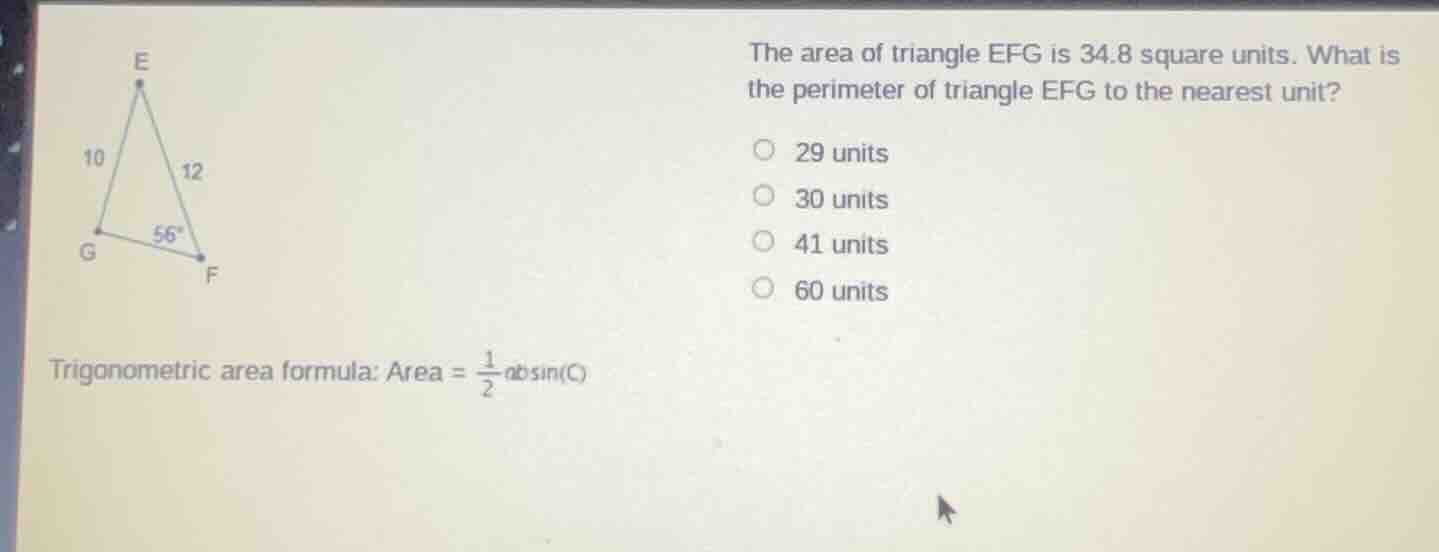
the area of triangle efg is 34.8 square units. what is the perimeter of triangle efg to the nearest unit? 29 units 30 units 41 units 60 units trigonometric area formula: area = \frac{1}{2}ab\sin(c)
Step1: Identify known values
We know the area of triangle \( EFG \) is \( 34.8 \) square units, two sides \( EF = 12 \), \( FG = 10 \), and the angle at \( F \) is \( 56^\circ \). Wait, actually, let's use the trigonometric area formula \( \text{Area} = \frac{1}{2}ab\sin(C) \) to find the missing side or confirm. Wait, maybe we need to find the length of \( EG \) first? Wait, no, let's check the sides. Wait, the two sides given are \( 10 \) and \( 12 \), and the angle between them? Wait, the trigonometric area formula is \( \frac{1}{2}ab\sin(C) \), where \( a \) and \( b \) are two sides and \( C \) is the included angle. Wait, but the area is given as \( 34.8 \). Wait, maybe we can use the formula to find the included angle? Wait, no, the angle at \( F \) is \( 56^\circ \), but let's check: if we take \( a = 10 \), \( b = 12 \), and angle \( C = 56^\circ \), then the area would be \( \frac{1}{2} \times 10 \times 12 \times \sin(56^\circ) \). Let's calculate that: \( \frac{1}{2} \times 10 \times 12 = 60 \), \( \sin(56^\circ) \approx 0.8290 \), so \( 60 \times 0.8290 \approx 49.74 \), which is more than \( 34.8 \). So maybe the included angle is not \( 56^\circ \)? Wait, maybe the sides are \( 10 \) and another side, and the angle is \( 56^\circ \). Wait, let's denote the sides: let \( FG = x \), \( EF = 12 \), angle at \( F \) is \( 56^\circ \), and area is \( 34.8 \). Then using the formula \( \text{Area} = \frac{1}{2} \times FG \times EF \times \sin(56^\circ) \). So \( 34.8 = \frac{1}{2} \times x \times 12 \times \sin(56^\circ) \). Let's solve for \( x \):
Step2: Solve for the missing side
\( 34.8 = 6x \times \sin(56^\circ) \)
\( x = \frac{34.8}{6 \times \sin(56^\circ)} \)
Calculate \( \sin(56^\circ) \approx 0.8290 \)
\( 6 \times 0.8290 \approx 4.974 \)
\( x \approx \frac{34.8}{4.974} \approx 7 \) (Wait, that can't be. Wait, maybe the sides are \( 10 \) and \( EG \), or \( 12 \) and \( EG \). Wait, maybe I mixed up the sides. Wait, the triangle has sides \( 10 \), \( 12 \), and \( EG \). Let's denote \( FG = a \), \( EF = b \), angle at \( F = C \). Then area is \( \frac{1}{2}ab\sin(C) = 34.8 \). Let's plug in \( a = 10 \), \( b = 12 \), then \( \frac{1}{2} \times 10 \times 12 \times \sin(C) = 34.8 \)
\( 60 \sin(C) = 34.8 \)
\( \sin(C) = \frac{34.8}{60} = 0.58 \)
Then \( C = \arcsin(0.58) \approx 35.5^\circ \), but the diagram shows \( 56^\circ \). Wait, maybe the sides are \( 10 \) and another side, say \( FG = 10 \), \( EF = 12 \), and angle at \( G \)? No, the diagram shows angle at \( F \) is \( 56^\circ \). Wait, maybe the problem is that we need to find the length of \( EG \) using the Law of Cosines, but first we need to confirm the included angle. Wait, maybe I made a mistake. Let's try again.
Wait, the trigonometric area formula is \( \text{Area} = \frac{1}{2}ab\sin(C) \), where \( a \) and \( b \) are two sides, and \( C \) is the included angle. Let's assume that the two sides are \( FG = 10 \) and \( EF = 12 \), and the included angle is \( \angle F \). Then:
\( 34.8 = \frac{1}{2} \times 10 \times 12 \times \sin(\angle F) \)
\( 34.8 = 60 \sin(\angle F) \)
\( \sin(\angle F) = \frac{34.8}{60} = 0.58 \)
\( \angle F \approx \arcsin(0.58) \approx 35.5^\circ \), but the diagram shows \( 56^\circ \). So maybe the sides are not \( 10 \) and \( 12 \) as the two sides with the included angle. Wait, maybe one of the sides is \( 10 \), another is \( EG \), and the included angle is \( 56^\circ \). Let's denote \( FG = 10 \), \( \angle F = 56^\circ \), and \( EF = 12 \), but that's not the included angle. Wait, may…

Snap & solve any problem in the app
Get step-by-step solutions on Sovi AI
Photo-based solutions with guided steps
Explore more problems and detailed explanations
29 units