QUESTION IMAGE
Question
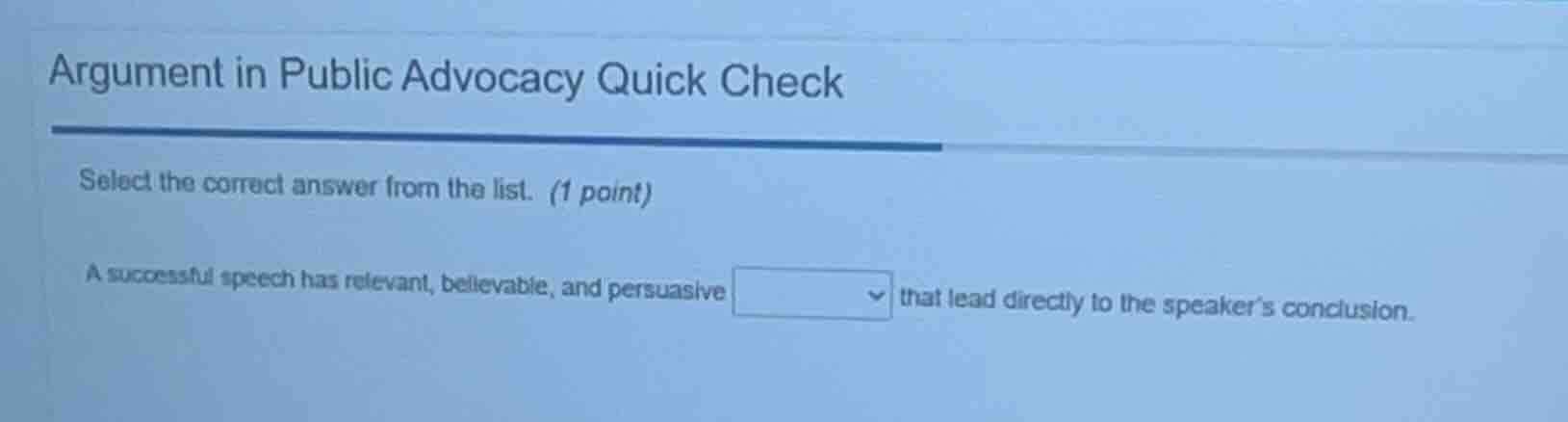
argument in public advocacy quick check
select the correct answer from the list. (1 point)
a successful speech has relevant, believable, and persuasive
that lead directly to the speaker’s conclusion.
To solve this, we analyze the context of a successful speech in public advocacy. A speech needs evidence (or reasons, but "evidence" is common here) that's relevant, believable, persuasive, and leads to the conclusion. The blank likely requires a term like "evidence" (or "reasons", but in public advocacy/speech context, "evidence" or "supporting points"—but the key is the correct term for what leads to the conclusion. Typically, in argumentation for speeches, the missing word is "evidence" (or "claims" but more likely "evidence" or "reasons", but the standard term here is "evidence" or "supporting details". However, since the question is about public advocacy (related to Media and Communication or Public Administration in Social Science), the correct fill - in is "evidence" (or the appropriate term from the list, but assuming the list has "evidence" or similar, the correct answer would be the term that fits: a successful speech has relevant, believable, and persuasive evidence (or "reasons", but in academic speech argumentation, "evidence" is key) that lead directly to the speaker’s conclusion.
In public advocacy (a subfield of Social Science, e.g., Media and Communication or Public Administration), a successful speech uses relevant, believable, and persuasive evidence (or similar terms like reasons/supporting details) to lead to the conclusion. The blank requires a term for the elements that support the conclusion, and "evidence" (or the correct option from the list) fits as it's what makes a speech's argument valid.

Snap & solve any problem in the app
Get step-by-step solutions on Sovi AI
Photo-based solutions with guided steps
Explore more problems and detailed explanations
The correct answer (assuming the list has "evidence" or the appropriate term) is the term that fits: a successful speech has relevant, believable, and persuasive evidence (or the correct option from the list, e.g., if options are like A. evidence, B. opinions, etc., then A. evidence).