QUESTION IMAGE
Question
around here
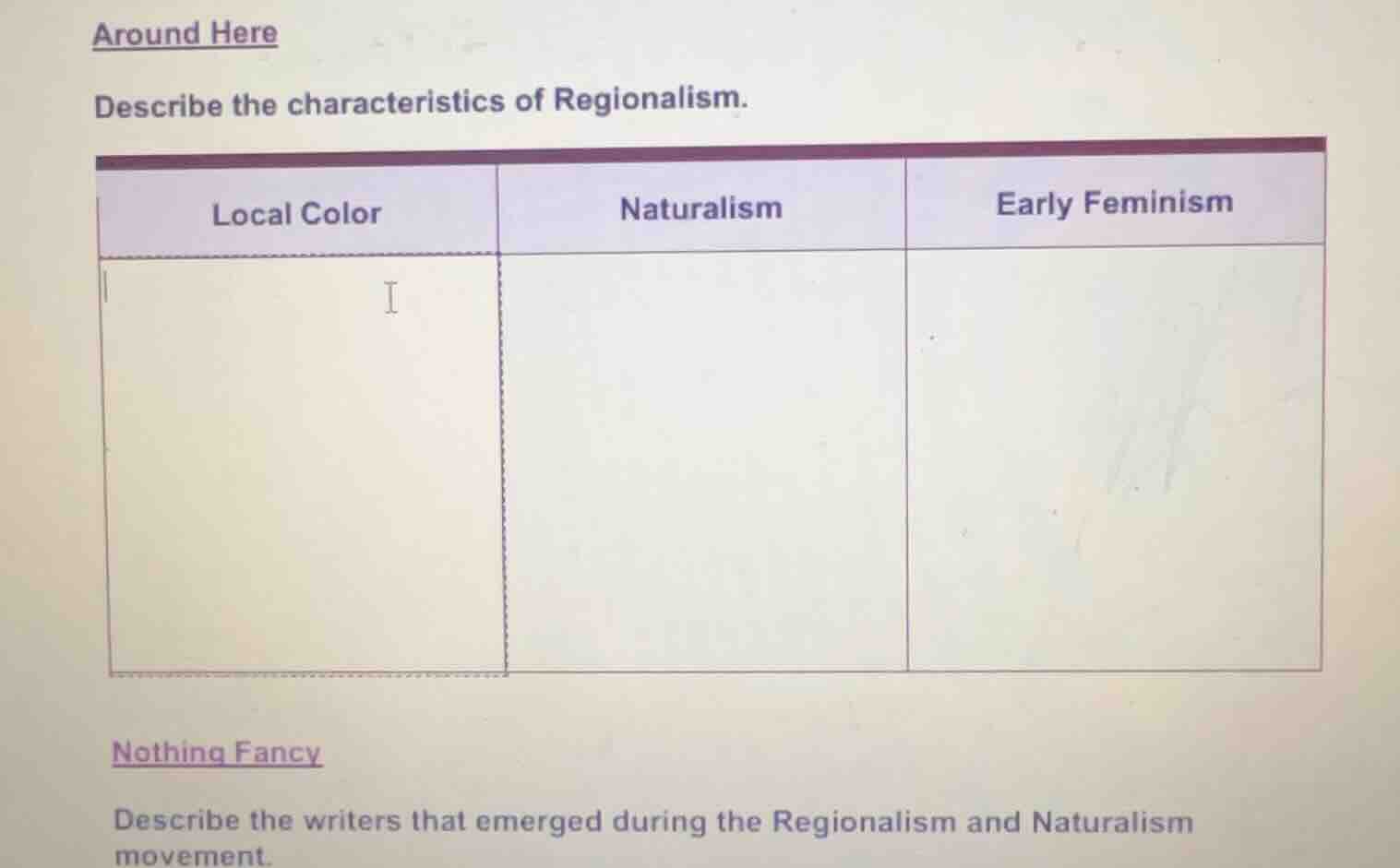
describe the characteristics of regionalism.
local color\tnaturalism\tearly feminism
nothing fancy
describe the writers that emerged during the regionalism and naturalism movement.
Brief Explanations
Local Color (part of Regionalism)
- Setting: Focuses on a specific region, emphasizing its geography, climate, landscape, and physical environment. For example, depicting the Mississippi River region in Southern US literature, with detailed descriptions of swamps, plantations, or small - town main streets.
- Culture and Customs: Highlights the unique cultural practices, traditions, folklore, and social norms of the region. This could include regional dialects (like the use of "y'all" in Southern US), local festivals, or traditional occupations (such as fishing in coastal New England or farming in the Midwest).
- Characters: Characters are often representative of the region, with their behaviors, values, and speech patterns shaped by the local environment and culture. They may be simple, rural folk or members of a close - knit community, and their actions are consistent with the regional way of life.
- Theme: Often explores the relationship between people and their local environment, the preservation of local culture in the face of external influences, or the beauty and uniqueness of a particular place.
Naturalism
- Determinism: Believes that human behavior is determined by external forces such as heredity, environment, and social conditions. Characters are seen as products of their circumstances, with little free will. For example, a character's poverty - stricken background (environment) and genetic predispositions (heredity) may lead them to a life of crime or despair.
- Scientific Approach: Emulates scientific methods in literature, treating human beings as objects of study. Authors often use detailed, objective descriptions of characters' physical and social environments, and analyze human behavior in a detached, almost clinical way.
- Pessimistic Tone: Generally presents a bleak view of human existence, with characters often struggling against overwhelming odds and failing. The natural world is often portrayed as indifferent to human suffering, and social structures are seen as oppressive.
- Lower - Class Characters: Focuses on characters from the lower classes of society, such as factory workers, prostitutes, or the urban poor, who are at the mercy of their environment and social forces.
Early Feminism
- Gender Roles: Challenges traditional gender roles of the time, which confined women to domestic spheres (such as being wives and mothers) and restricted their access to education, employment, and political rights. Early feminists advocated for women's right to work outside the home, to receive an education equal to men's, and to have a voice in public life.
- Economic Dependence: Addresses women's economic dependence on men. Many early feminist works highlight how women's lack of property rights and limited employment opportunities forced them to rely on male relatives (fathers, husbands) for financial support, leading to a lack of autonomy.
- Literary Representation: In literature, early feminist characters often seek to break free from traditional gender constraints. They may be depicted as intelligent, ambitious, and desiring more than the traditional female roles. Female authors of this period also began to write about women's experiences from a female perspective, giving voice to issues that had been previously overlooked.
Writers of Regionalism and Naturalism
Regionalist Writers
- Mark Twain (Samuel Clemens): Known for his depictions of the Mississippi River region. In works like "The Adventures of Huckleberry Finn", he uses local color to vividly portray…

Snap & solve any problem in the app
Get step-by-step solutions on Sovi AI
Photo-based solutions with guided steps
Explore more problems and detailed explanations
Characteristics of Regionalism (by sub - category)
Local Color
- Setting: Specific region's geography, climate, landscape.
- Culture: Unique traditions, folklore, social norms, dialects.
- Characters: Representative of region, behavior shaped by local life.
- Theme: Relationship between people and local environment, cultural preservation.
Naturalism
- Determinism: Behavior determined by heredity, environment, social conditions.
- Scientific Approach: Objective, detached study of human behavior.
- Pessimistic Tone: Bleak view of human existence, struggle against odds.
- Characters: Lower - class, at mercy of external forces.
Early Feminism
- Gender Roles: Challenges traditional female domestic roles, advocates for equal rights (education, employment, political).
- Economic Dependence: Addresses women's financial reliance on men, lack of autonomy.
- Literary Representation: Female characters seek freedom from gender constraints, female authors write women's experiences.
Writers of Regionalism and Naturalism
Regionalist Writers
- Mark Twain: Depicts Mississippi River region, e.g., "The Adventures of Huckleberry Finn".
- Sarah Orne Jewett: Portrays New England, e.g., "The Country of the Pointed Firs".
- Bret Harte: Writes about American West mining camps, e.g., "The Luck of Roaring Camp".
Naturalist Writers
- Stephen Crane: "Maggie: A Girl of the Streets", "The Red Badge of Courage".
- Theodore Dreiser: "Sister Carrie", "An American Tragedy".
- Jack London: "The Call of the Wild", explores human/natural struggle.