QUESTION IMAGE
Question
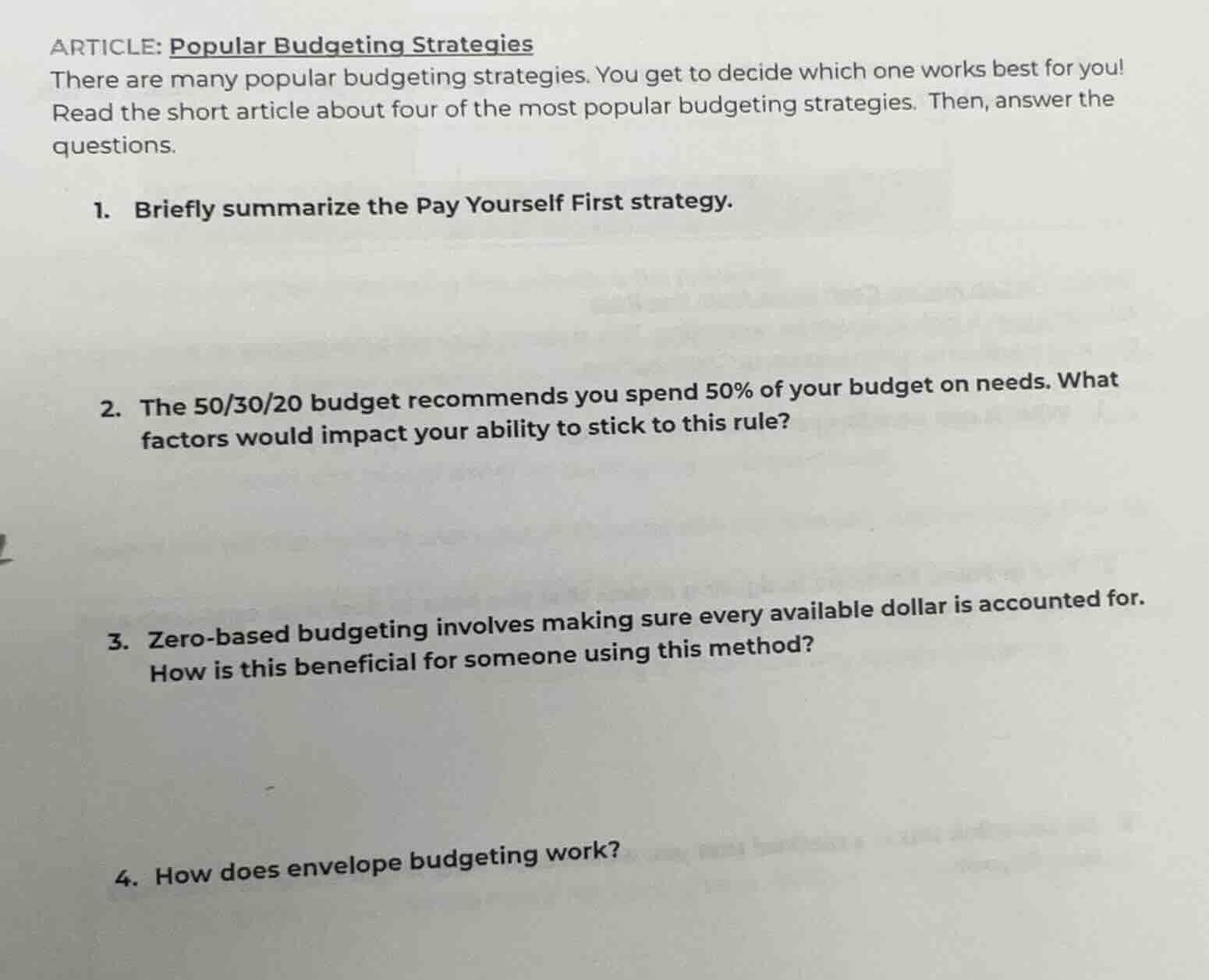
article: popular budgeting strategies
there are many popular budgeting strategies. you get to decide which one works best for you!
read the short article about four of the most popular budgeting strategies. then, answer the
questions.
- briefly summarize the pay yourself first strategy.
- the 50/30/20 budget recommends you spend 50% of your budget on needs. what
factors would impact your ability to stick to this rule?
- zero - based budgeting involves making sure every available dollar is accounted for.
how is this beneficial for someone using this method?
- how does envelope budgeting work?
Brief Explanations
- The Pay Yourself First strategy prioritizes allocating a fixed portion of your income to savings, investments, or retirement accounts before paying regular bills or discretionary expenses, ensuring long-term financial goals are prioritized.
- Factors impacting adherence to the 50% needs rule include local cost of living (e.g., high rent/mortgage), income level, family size, unexpected essential expenses (e.g., medical bills), and existing debt obligations (e.g., student loans).
- Zero-based budgeting ensures every dollar is assigned a purpose, eliminating wasteful spending, increasing awareness of cash flow, making it easier to track expenses, and helping to prioritize financial goals by avoiding unaccounted-for funds.
- Envelope budgeting involves dividing physical or digital envelopes into pre-set spending categories (e.g., groceries, entertainment). You allocate a specific amount of cash to each envelope at the start of a budget period, and once an envelope is empty, you cannot spend more in that category until the next period.

Snap & solve any problem in the app
Get step-by-step solutions on Sovi AI
Photo-based solutions with guided steps
Explore more problems and detailed explanations
- A budgeting strategy where you allocate a set portion of your income to savings/investments before paying other expenses, prioritizing long-term financial goals.
- Key factors: local cost of living, total income, family size, unexpected essential costs, and existing debt payments.
- Benefits[LLM SSE On Failure]