QUESTION IMAGE
Question
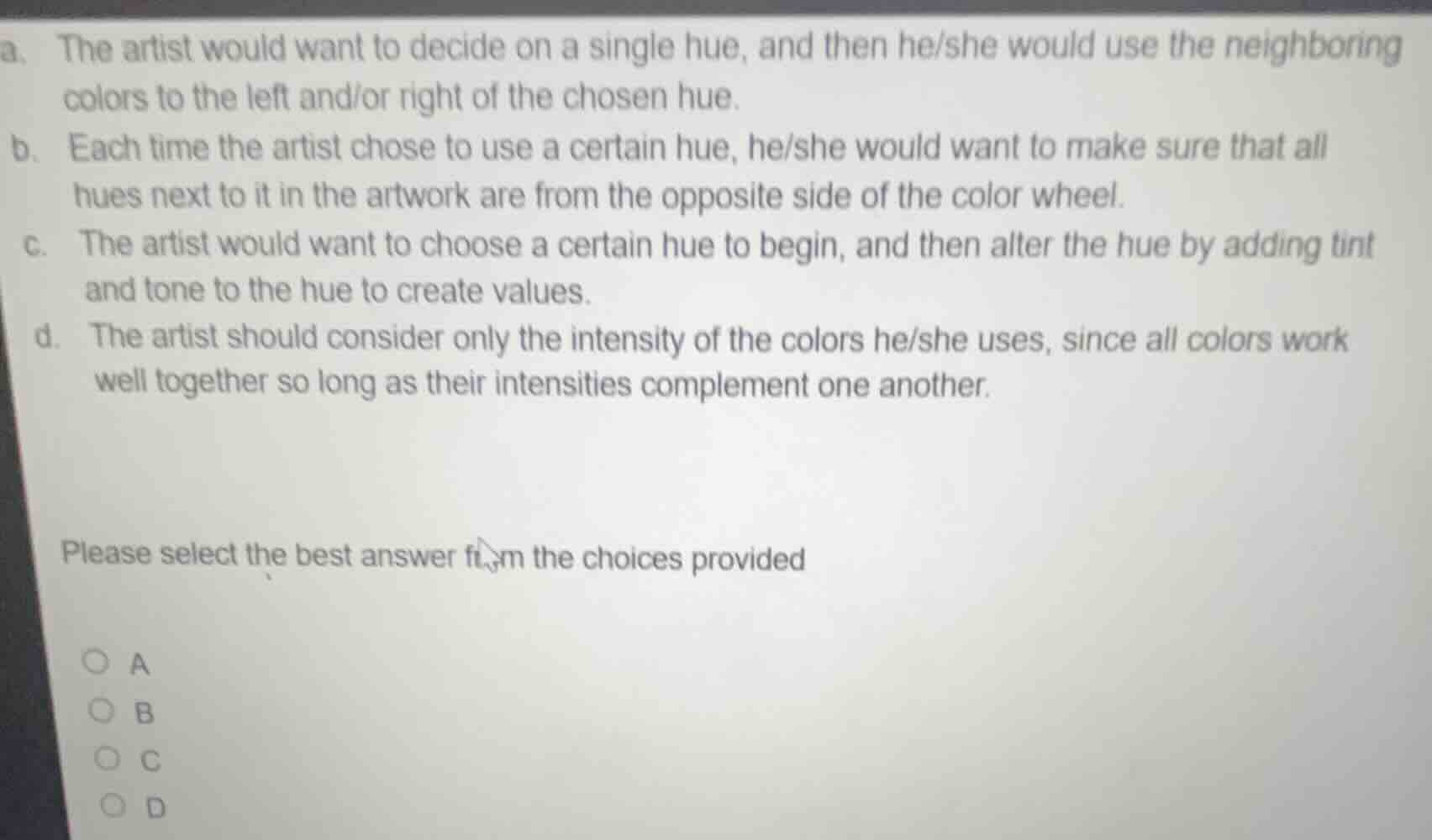
a. the artist would want to decide on a single hue, and then he/she would use the neighboring colors to the left and/or right of the chosen hue.
b. each time the artist chose to use a certain hue, he/she would want to make sure that all hues next to it in the artwork are from the opposite side of the color wheel.
c. the artist would want to choose a certain hue to begin, and then alter the hue by adding tint and tone to the hue to create values.
d. the artist should consider only the intensity of the colors he/she uses, since all colors work well together so long as their intensities complement one another.
please select the best answer from the choices provided
a
b
c
d
To determine the best answer, we analyze each option:
- Option A: Using a single hue and its neighboring colors on the color wheel is the definition of an analogous color scheme, a valid color selection method for artists.
- Option B: Using only opposite - side (complementary) colors would be a complementary scheme, but the statement says "all" hues next to it should be complementary, which is too restrictive and not a typical general approach for color selection.
- Option C: Adding tint and tone to create values is about value modification, not color selection (hue choice) as the question implies.
- Option D: Claiming all colors work well together as long as intensities complement is incorrect, as hue compatibility also matters.
So, Option A is the best.

Snap & solve any problem in the app
Get step-by-step solutions on Sovi AI
Photo-based solutions with guided steps
Explore more problems and detailed explanations
A. The artist would want to decide on a single hue, and then he/she would use the neighboring colors to the left and/or right of the chosen hue.