QUESTION IMAGE
Question
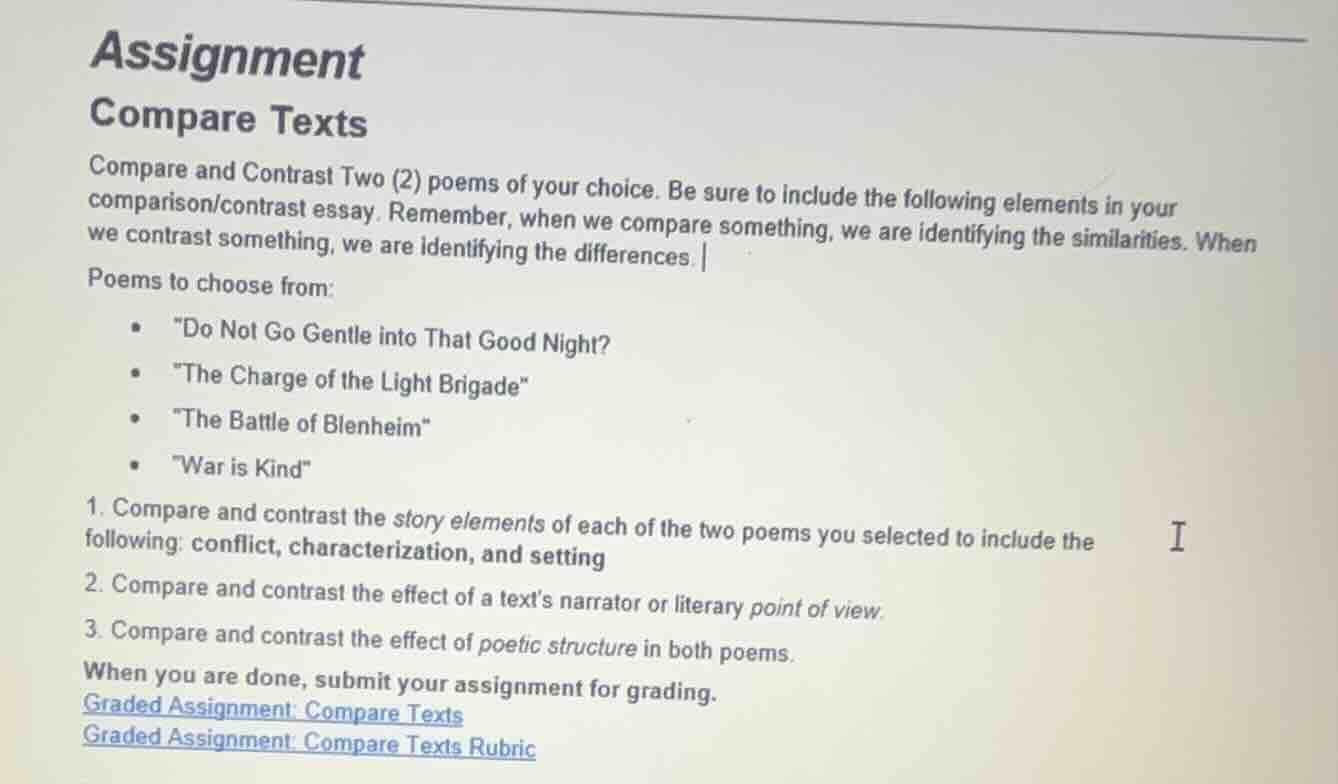
assignment
compare texts
compare and contrast two (2) poems of your choice. be sure to include the following elements in your comparison/contrast essay. remember, when we compare something, we are identifying the similarities. when we contrast something, we are identifying the differences.
poems to choose from:
- \do not go gentle into that good night?
- \the charge of the light brigade\
- \the battle of blenheim\
- \war is kind\
- compare and contrast the story elements of each of the two poems you selected to include the following: conflict, characterization, and setting
- compare and contrast the effect of a texts narrator or literary point of view.
- compare and contrast the effect of poetic structure in both poems.
when you are done, submit your assignment for grading.
graded assignment: compare texts
graded assignment: compare texts rubric
The analysis selects two war-themed poems with contrasting tones and focuses. For story elements, it highlights differences in conflict scope, character focus, and setting range. For point of view, it contrasts the reverent, tragic narrator of "The Charge of the Light Brigade" with the sarcastic, critical narrator of "War is Kind". For poetic structure, it links form to thematic purpose: the structured meter of the first poem mirrors military order, while the free verse of the second underscores war's chaotic, senseless nature.

Snap & solve any problem in the app
Get step-by-step solutions on Sovi AI
Photo-based solutions with guided steps
Explore more problems and detailed explanations
(Selected poems: "The Charge of the Light Brigade" and "War is Kind")
- Story Elements Comparison & Contrast:
- Conflict: Both center on the trauma of war; "The Charge of the Light Brigade" focuses on a single, catastrophic military blunder in battle, while "War is Kind" critiques the senseless, universal waste of war across multiple lost lives.
- Characterization: "The Charge of the Light Brigade" depicts a unified, brave military unit (the 600) following an order; "War is Kind" humanizes individual casualties (a soldier, a father, a lover) and their grieving families.
- Setting: "The Charge of the Light Brigade" is set in the immediate chaos of the Crimean War's battlefield; "War is Kind" shifts between battlefields and the home front where survivors mourn.
- Narrator/Point of View Comparison & Contrast:
- "The Charge of the Light Brigade" uses a third-person omniscient narrator that celebrates the soldiers' bravery while mourning their futile sacrifice, adopting a respectful, tragic tone.
- "War is Kind" uses a sarcastic, ironic third-person narrator that directly addresses grieving loved ones with the bitter refrain "Do not weep, War is kind," criticizing the glorification of war rather than honoring soldiers.
- Poetic Structure Comparison & Contrast:
- "The Charge of the Light Brigade" uses a strict, repetitive trochaic meter that mirrors the rhythmic gallop of cavalry horses, with short, staccato lines to build tension during the charge. It has a consistent stanza structure and a memorable, refrained line ("Into the valley of Death").
- "War is Kind" uses free verse with irregular line lengths and stanzas. It relies on a blunt, ironic refrain ("War is kind") that contrasts with the brutal imagery of death, emphasizing the dissonance between war's glorification and its reality.