QUESTION IMAGE
Question
assignment - practice pythagorean theorem and special right triangles period
find the missing side of each triangle. leave your answers in simplest radical form.
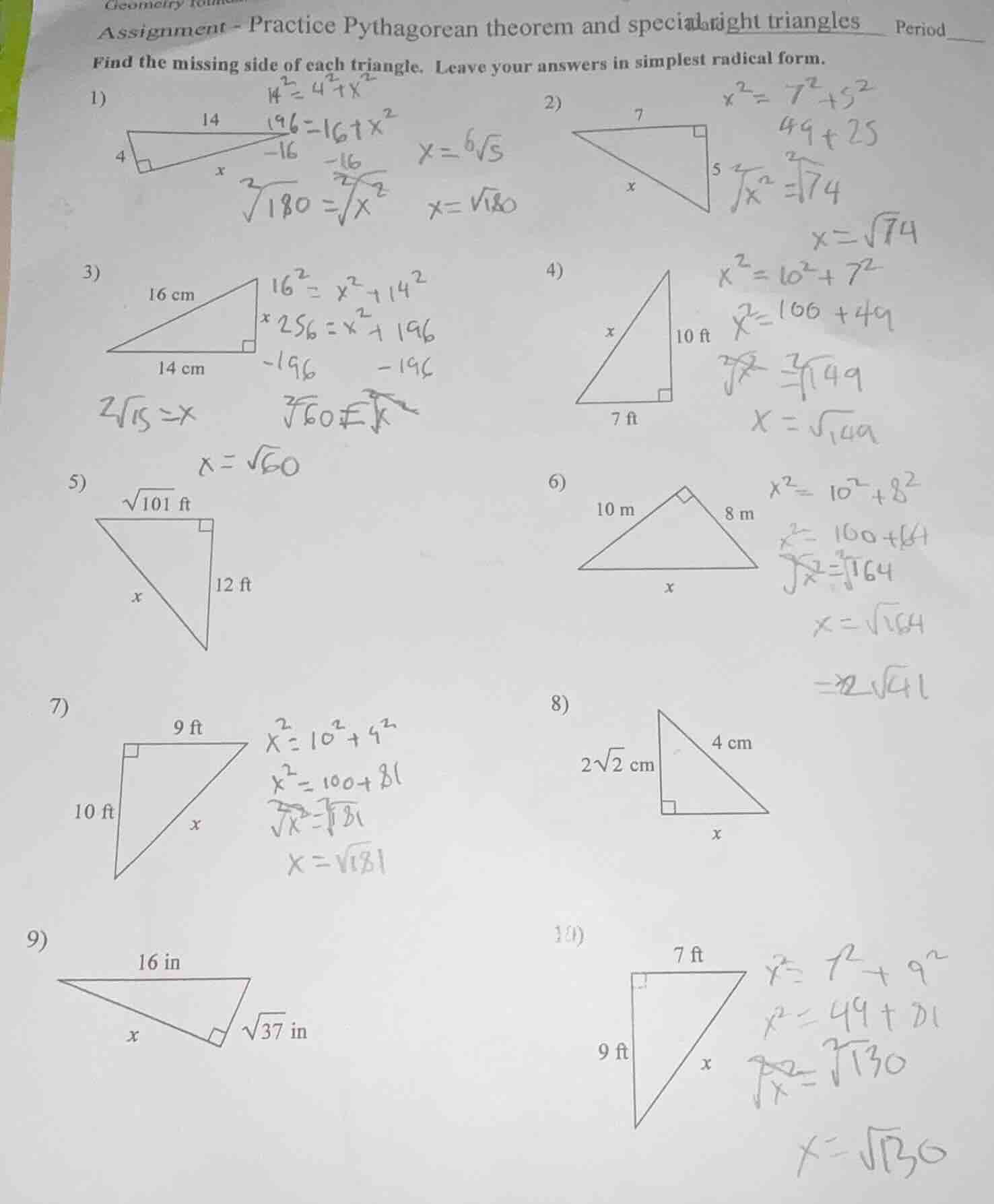
1)
2)
3)
4)
5)
6)
7)
8)
9)
10)
Step1: Recall Pythagorean theorem
For right triangle: $a^2 + b^2 = c^2$, where $c$ is hypotenuse.
---
Problem 1
Step1: Identify hypotenuse and legs
Hypotenuse $c=14$, leg $a=4$, leg $b=x$
Step2: Rearrange for missing leg
$x^2 = c^2 - a^2$
$x^2 = 14^2 - 4^2 = 196 - 16 = 180$
Step3: Simplify radical
$x = \sqrt{180} = \sqrt{36 \times 5} = 6\sqrt{5}$
---
Problem 2
Step1: Identify legs and hypotenuse
Legs $a=7, b=5$, hypotenuse $c=x$
Step2: Calculate hypotenuse
$x^2 = 7^2 + 5^2 = 49 + 25 = 74$
Step3: Simplify radical
$x = \sqrt{74}$
---
Problem 3
Step1: Identify hypotenuse and legs
Hypotenuse $c=16$, leg $a=14$, leg $b=x$
Step2: Rearrange for missing leg
$x^2 = 16^2 - 14^2 = 256 - 196 = 60$
Step3: Simplify radical
$x = \sqrt{60} = \sqrt{4 \times 15} = 2\sqrt{15}$
---
Problem 4
Step1: Identify legs and hypotenuse
Legs $a=7, b=10$, hypotenuse $c=x$
Step2: Calculate hypotenuse
$x^2 = 7^2 + 10^2 = 49 + 100 = 149$
Step3: Simplify radical
$x = \sqrt{149}$
---
Problem 5
Step1: Identify hypotenuse and legs
Hypotenuse $c=\sqrt{101}$, leg $a=12$, leg $b=x$
Step2: Rearrange for missing leg
$x^2 = c^2 - a^2 = (\sqrt{101})^2 - 12^2 = 101 - 144$
Step3: Correct for valid triangle
*Note: $101 < 144$, so rearrange: $(\sqrt{101})^2 + x^2 = 12^2$
$x^2 = 144 - 101 = 43$
$x = \sqrt{43}$
---
Problem 6
Step1: Identify legs and hypotenuse
Legs $a=10, b=8$, hypotenuse $c=x$
Step2: Calculate hypotenuse
$x^2 = 10^2 + 8^2 = 100 + 64 = 164$
Step3: Simplify radical
$x = \sqrt{164} = \sqrt{4 \times 41} = 2\sqrt{41}$
---
Problem 7
Step1: Identify legs and hypotenuse
Legs $a=9, b=10$, hypotenuse $c=x$
Step2: Calculate hypotenuse
$x^2 = 9^2 + 10^2 = 81 + 100 = 181$
Step3: Simplify radical
$x = \sqrt{181}$
---
Problem 8
Step1: Identify hypotenuse and legs
Hypotenuse $c=4$, leg $a=2\sqrt{2}$, leg $b=x$
Step2: Rearrange for missing leg
$x^2 = 4^2 - (2\sqrt{2})^2 = 16 - 8 = 8$
Step3: Simplify radical
$x = \sqrt{8} = \sqrt{4 \times 2} = 2\sqrt{2}$
---
Problem 9
Step1: Identify hypotenuse and legs
Hypotenuse $c=16$, leg $a=\sqrt{37}$, leg $b=x$
Step2: Rearrange for missing leg
$x^2 = 16^2 - (\sqrt{37})^2 = 256 - 37 = 219$
Step3: Simplify radical
$x = \sqrt{219}$
---
Problem 10
Step1: Identify legs and hypotenuse
Legs $a=7, b=9$, hypotenuse $c=x$
Step2: Calculate hypotenuse
$x^2 = 7^2 + 9^2 = 49 + 81 = 130$
Step3: Simplify radical
$x = \sqrt{130}$

Snap & solve any problem in the app
Get step-by-step solutions on Sovi AI
Photo-based solutions with guided steps
Explore more problems and detailed explanations
- $6\sqrt{5}$
- $\sqrt{74}$
- $2\sqrt{15}$
- $\sqrt{149}$
- $\sqrt{43}$
- $2\sqrt{41}$
- $\sqrt{181}$
- $2\sqrt{2}$
- $\sqrt{219}$
- $\sqrt{130}$