QUESTION IMAGE
Question
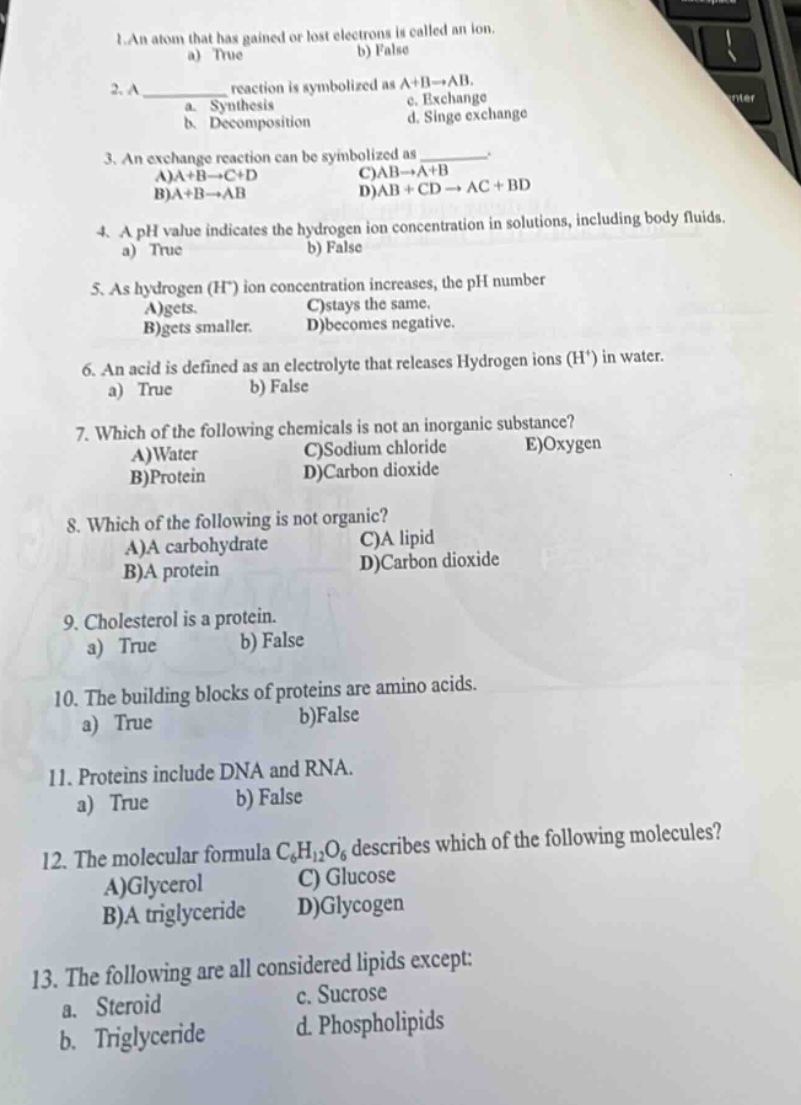
- an atom that has gained or lost electrons is called an ion.
a) true
b) false
- a ______ reaction is symbolized as a+b→ab.
a. synthesis
c. exchange
b. decomposition
d. singe exchange
- an exchange reaction can be symbolized as ______.
a)a+b→c+d
c)ab→a+b
b)a+b→ab
d)ab + cd → ac + bd
- a ph value indicates the hydrogen ion concentration in solutions, including body fluids.
a) true
b) false
- as hydrogen (h⁺) ion concentration increases, the ph number
a)gets.
c)stays the same.
b)gets smaller.
d)becomes negative.
- an acid is defined as an electrolyte that releases hydrogen ions (h⁺) in water.
a) true
b) false
- which of the following chemicals is not an inorganic substance?
a)water
c)sodium chloride
e)oxygen
b)protein
d)carbon dioxide
- which of the following is not organic?
a)a carbohydrate
c)a lipid
b)a protein
d)carbon dioxide
- cholesterol is a protein.
a) true
b) false
- the building blocks of proteins are amino acids.
a) true
b)false
- proteins include dna and rna.
a) true
b) false
- the molecular formula $c_6h_{12}o_6$ describes which of the following molecules?
a)glycerol
c) glucose
b)a triglyceride
d)glycogen
- the following are all considered lipids except:
a. steroid
c. sucrose
b. triglyceride
d. phospholipids
Brief Explanations
- An ion is defined as an atom/molecule with a net charge from electron gain/loss.
- Synthesis reactions combine two substances into one, matching A+B→AB.
- Exchange reactions swap components between two compounds, matching AB + CD → AC + BD.
- pH is a measure of hydrogen ion concentration in aqueous solutions, including body fluids.
- pH is logarithmic: higher [H⁺] means lower pH value.
- The Arrhenius definition states acids release H⁺ in water.
- Proteins are organic (contain carbon-hydrogen bonds); others are inorganic.
- Carbon dioxide lacks C-H bonds, so it is inorganic; others are organic biomolecules.
- Cholesterol is a steroid lipid, not a protein.
- Amino acids are the monomer units that form protein polymers.
- DNA and RNA are nucleic acids, not proteins.
- $C_6H_{12}O_6$ is the molecular formula for glucose.
- Sucrose is a disaccharide (carbohydrate); others are lipid classes.

Snap & solve any problem in the app
Get step-by-step solutions on Sovi AI
Photo-based solutions with guided steps
Explore more problems and detailed explanations
- a) True
- a. Synthesis
- D)AB + CD → AC + BD
- a) True
- B)gets smaller.
- a) True
- B)Protein
- D)Carbon dioxide
- b) False
- a) True
- b) False
- C) Glucose
- c. Sucrose