QUESTION IMAGE
Question
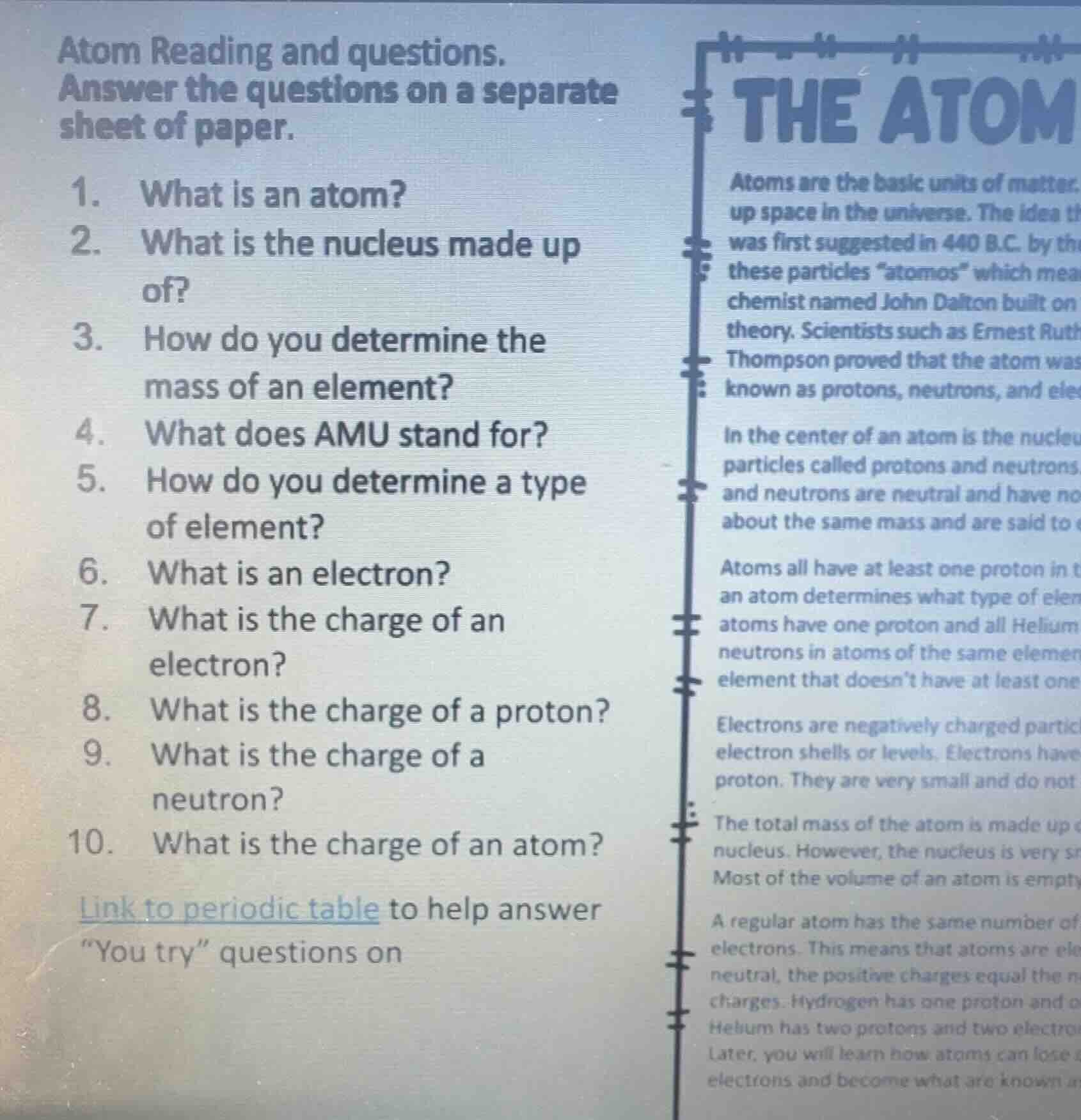
atom reading and questions. answer the questions on a separate sheet of paper. 1. what is an atom? 2. what is the nucleus made up of? 3. how do you determine the mass of an element? 4. what does amu stand for? 5. how do you determine a type of element? 6. what is an electron? 7. what is the charge of an electron? 8. what is the charge of a proton? 9. what is the charge of a neutron? 10. what is the charge of an atom? link to periodic table to help answer \you try\ questions on the atom atoms are the basic units of matter. up space in the universe. the idea th was first suggested in 440 b.c. by th these particles \atomos\ which mea chemist named john dalton built on theory. scientists such as ernest ruth thompson proved that the atom was known as protons, neutrons, and ele in the center of an atom is the nucle particles called protons and neutrons and neutrons are neutral and have no about the same mass and are said to atoms all have at least one proton in t an atom determines what type of ele atoms have one proton and all helium neutrons in atoms of the same elemen element that doesnt have at least one electrons are negatively charged partic electron shells or levels. electrons have proton. they are very small and do not the total mass of the atom is made up nucleus. however, the nucleus is very s most of the volume of an atom is empty a regular atom has the same number of electrons. this means that atoms are ele neutral, the positive charges equal the charges. hydrogen has one proton and o helium has two protons and two electror later, you will learn how atoms can lose electrons and become what are known a
Question 1: What is an atom?
From the text, atoms are the basic units of matter that make up space in the universe. The concept was first suggested in 440 B.C., and later scientists like John Dalton, Ernest Rutherford, and J.J. Thompson contributed to understanding them as having protons, neutrons, and electrons.
The text states that in the center of an atom is the nucleus, which is made up of particles called protons and neutrons.
The text says the total mass of the atom is made up of the mass of the nucleus (since electrons have negligible mass). The nucleus's mass comes from protons and neutrons, so the mass of an element's atom is determined by the sum of the masses of its protons and neutrons (as electrons contribute little to the overall mass).

Snap & solve any problem in the app
Get step-by-step solutions on Sovi AI
Photo-based solutions with guided steps
Explore more problems and detailed explanations
Atoms are the basic units of matter that make up all the space in the universe. The idea of atoms was first suggested in 440 B.C., and they are composed of protons, neutrons, and electrons (with contributions from scientists like John Dalton, Ernest Rutherford, and J.J. Thompson to our understanding of their structure).