QUESTION IMAGE
Question
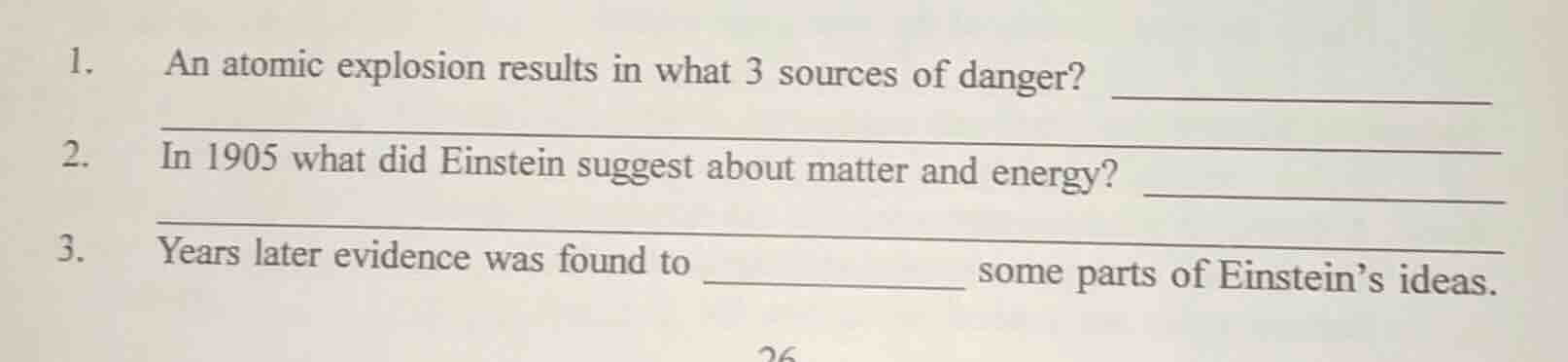
- an atomic explosion results in what 3 sources of danger?
- in 1905 what did einstein suggest about matter and energy?
- years later evidence was found to __________ some parts of einstein’s ideas.
Question 1
An atomic explosion (like a nuclear explosion) has three main danger sources: the blast wave (which causes physical destruction from the shockwave), thermal radiation (intense heat that can cause burns and start fires), and ionizing radiation (including initial nuclear radiation like gamma rays and neutrons, and residual radiation from fallout which can cause long - term health issues like cancer and genetic damage).
In 1905, Einstein put forward the mass - energy equivalence principle, which is mathematically expressed as $E = mc^{2}$, where $E$ is energy, $m$ is mass, and $c$ is the speed of light in a vacuum. This principle suggests that matter and energy are interchangeable; a small amount of mass can be converted into a large amount of energy, and vice versa.
Years after Einstein proposed his ideas, evidence was found to support (or confirm) some parts of his ideas. For example, in nuclear reactions (like fission and fusion), the mass defect is observed, and the energy released can be calculated using $E = mc^{2}$, which confirms the mass - energy equivalence part of his theory. Also, experiments related to the photoelectric effect (another 1905 work of Einstein) and later tests of special relativity (which is related to his ideas on space - time and energy - mass) provided evidence that supported aspects of his theories.

Snap & solve any problem in the app
Get step-by-step solutions on Sovi AI
Photo-based solutions with guided steps
Explore more problems and detailed explanations
The three sources of danger from an atomic explosion are the blast (shockwave), thermal (heat) radiation, and nuclear (ionizing) radiation (including fallout - related radiation).