QUESTION IMAGE
Question
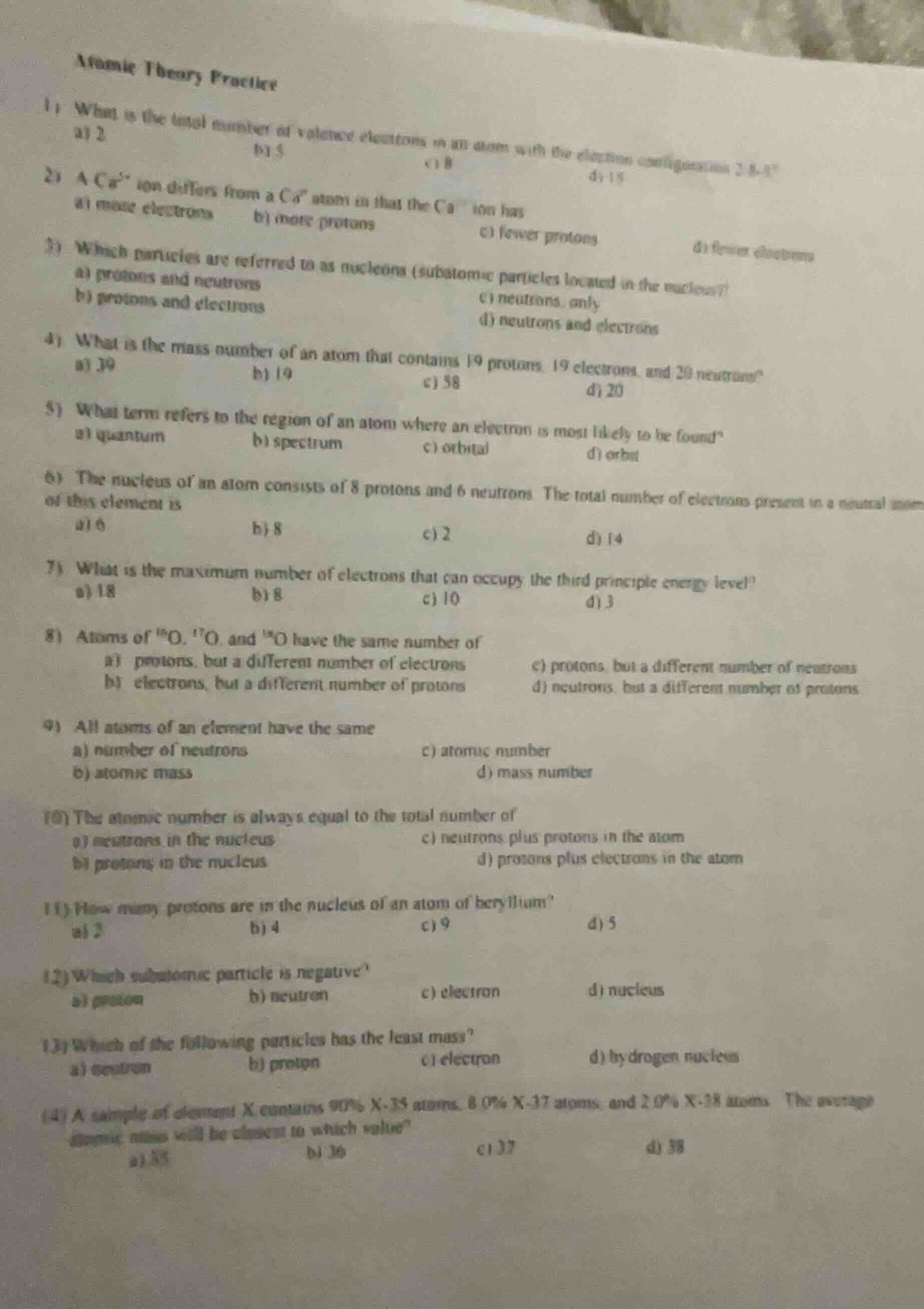
atomic theory practice
- what is the total number of valence electrons in an atom with the electron configuration 2-8-5?
a) 2 b) 5 c) 8 d) 15
- a ca²⁺ ion differs from a ca atom in that the ca²⁺ ion has
a) more electrons b) more protons c) fewer protons d) fewer electrons
- which particles are referred to as nucleons (subatomic particles located in the nucleus)?
a) protons and neutrons b) protons and electrons c) neutrons only d) neutrons and electrons
- what is the mass number of an atom that contains 19 protons, 19 electrons, and 20 neutrons?
a) 39 b) 19 c) 58 d) 20
- what term refers to the region of an atom where an electron is most likely to be found?
a) quantum b) spectrum c) orbital d) orbit
- the nucleus of an atom consists of 8 protons and 6 neutrons. the total number of electrons present in a neutral atom of this element is
a) 6 b) 8 c) 2 d) 14
- what is the maximum number of electrons that can occupy the third principle energy level?
a) 18 b) 8 c) 10 d) 3
- atoms of ¹⁶o, ¹⁷o, and ¹⁸o have the same number of
a) protons, but a different number of electrons b) electrons, but a different number of protons
c) protons, but a different number of neutrons d) neutrons, but a different number of protons
- all atoms of an element have the same
a) number of neutrons b) atomic mass c) atomic number d) mass number
- the atomic number is always equal to the total number of
a) neutrons in the nucleus b) protons in the nucleus
c) neutrons plus protons in the atom d) protons plus electrons in the atom
- how many protons are in the nucleus of an atom of beryllium?
a) 2 b) 4 c) 9 d) 5
- which subatomic particle is negative?
a) proton b) neutron c) electron d) nucleus
- which of the following particles has the least mass?
a) neutron b) proton c) electron d) hydrogen nucleus
- a sample of element x contains 90% x-35 atoms, 8.0% x-37 atoms, and 2.0% x-38 atoms. the average atomic mass will be closest to which value?
a) 35 b) 36 c) 37 d) 38
- Valence electrons are in the outermost shell; configuration 2-8-7 has 7 outer electrons.
- A cation loses electrons; Ca²⁺ has 2 fewer electrons than neutral Ca.
- Nucleons are the particles that make up the atomic nucleus: protons and neutrons.
- Mass number = protons + neutrons = 19 + 20 = 39.
- An orbital is the region where an electron is most likely to be found.
- Neutral atoms have equal protons and electrons; 8 protons mean 8 electrons.
- Maximum electrons in energy level n is $2n^2$; for n=3, $2(3)^2=18$.
- Isotopes have the same number of protons but different neutrons; these are oxygen isotopes.
- All atoms of an element share the same atomic number (proton count).
- Atomic number is defined as the number of protons in the nucleus.
- Beryllium has an atomic number of 4, so it has 4 protons.
- Electrons are the negatively charged subatomic particles.
- Electrons have a much smaller mass than neutrons, protons, or hydrogen nuclei.
- Average atomic mass = (0.90×35)+(0.08×37)+(0.02×38) = 31.5 + 2.96 + 0.76 = 35.22, closest to 35.

Snap & solve any problem in the app
Get step-by-step solutions on Sovi AI
Photo-based solutions with guided steps
Explore more problems and detailed explanations
- b) 7
- d) fewer electrons
- a) protons and neutrons
- a) 39
- c) orbital
- b) 8
- a) 18
- c) protons, but a different number of neutrons
- c) atomic number
- b) protons in the nucleus
- b) 4
- c) electron
- c) electron
- a) 35