QUESTION IMAGE
Question
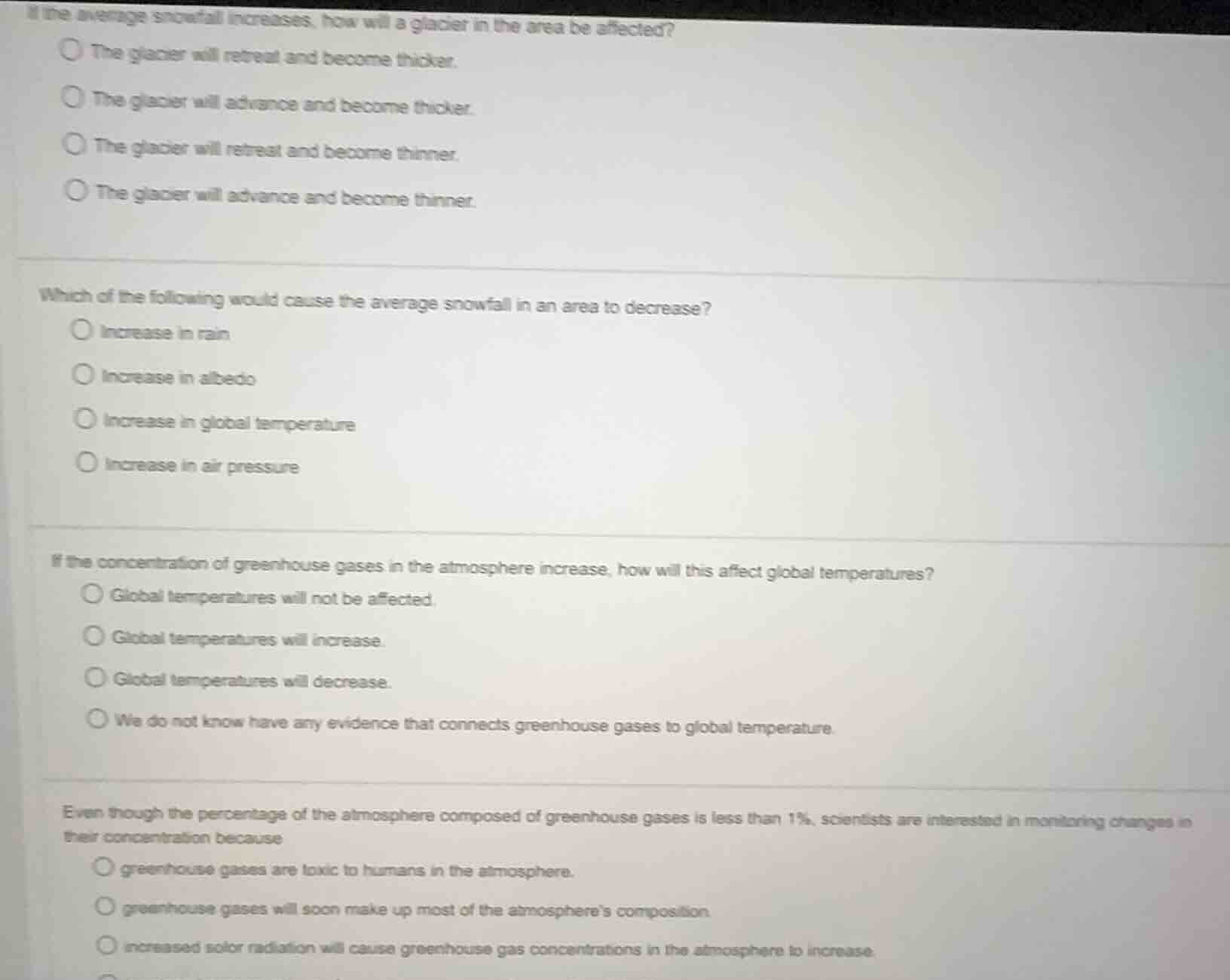
if the average snowfall increases, how will a glacier in the area be affected?
the glacier will retreat and become thicker.
the glacier will advance and become thicker.
the glacier will retreat and become thinner.
the glacier will advance and become thinner.
which of the following would cause the average snowfall in an area to decrease?
increase in rain
increase in albedo
increase in global temperature
increase in air pressure
if the concentration of greenhouse gases in the atmosphere increase, how will this affect global temperatures?
global temperatures will not be affected.
global temperatures will increase.
global temperatures will decrease.
we do not know have any evidence that connects greenhouse gases to global temperature.
even though the percentage of the atmosphere composed of greenhouse gases is less than 1%, scientists are interested in monitoring changes in their concentration because
greenhouse gases are toxic to humans in the atmosphere.
greenhouse gases will soon make up most of the atmosphere’s composition.
increased solar radiation will cause greenhouse gas concentrations in the atmosphere to increase.
First Question:
Glaciers form and grow when snow accumulation exceeds melting. If average snowfall increases, more snow accumulates, adding mass to the glacier. This extra mass causes the glacier to advance (move forward) and become thicker as the snow compacts over time.
An increase in global temperature leads to warmer conditions. Warmer temperatures mean that precipitation that would have fallen as snow (in areas where snow is typical) is more likely to fall as rain instead. Also, warmer air can hold more moisture, but the type of precipitation shifts away from snow. An increase in rain doesn't directly decrease snowfall (it's a different form), albedo (reflectivity) doesn't directly reduce snowfall, and air pressure changes don't have a direct link to reducing snowfall in this context.
Greenhouse gases (like CO₂, methane) trap heat in the atmosphere through the greenhouse effect. As their concentration increases, more heat is trapped, leading to a rise in global temperatures. There is extensive scientific evidence linking greenhouse gas concentrations to global temperature changes (e.g., ice core data, temperature records, climate models).

Snap & solve any problem in the app
Get step-by-step solutions on Sovi AI
Photo-based solutions with guided steps
Explore more problems and detailed explanations
The glacier will advance and become thicker.