QUESTION IMAGE
Question
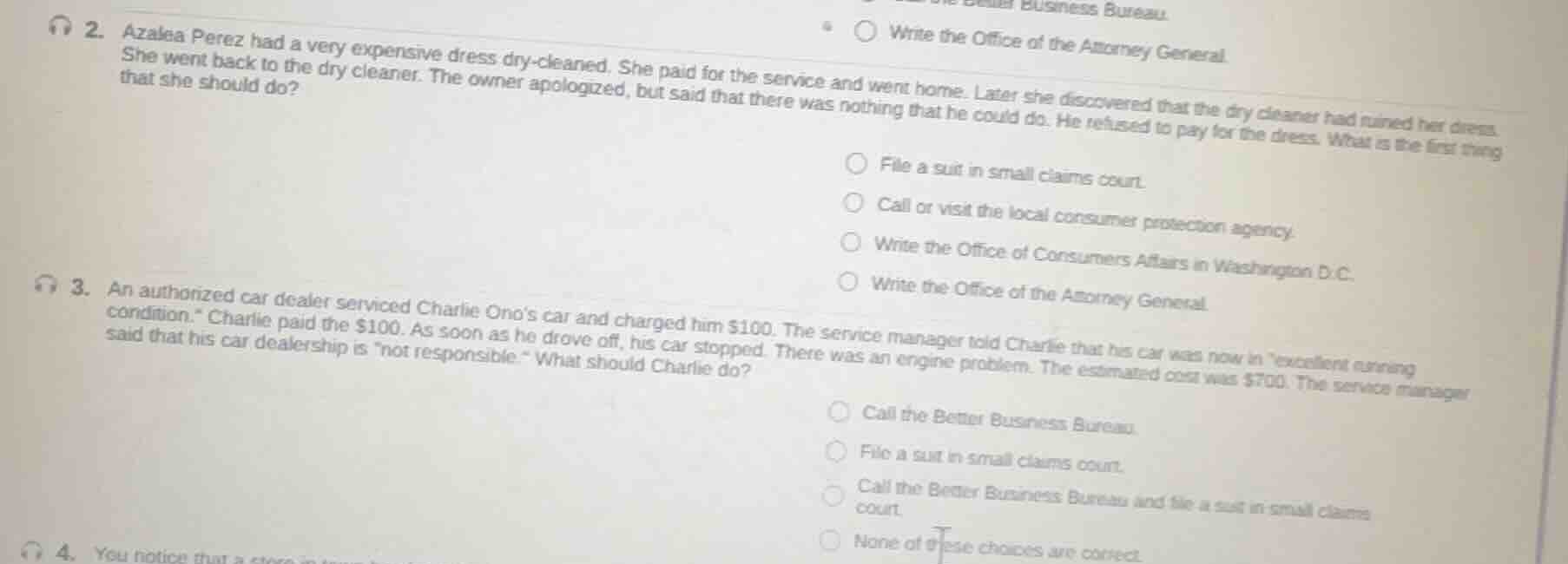
- azalea perez had a very expensive dress dry - cleaned. she paid for the service and went home. later she discovered that the dry cleaner had ruined her dress. she went back to the dry cleaner. the owner apologized, but said that there was nothing that he could do. he refused to pay for the dress. what is the first thing that she should do?
○ file a suit in small claims court.
○ call or visit the local consumer protection agency.
○ write the office of consumers affairs in washington d.c.
○ write the office of the attorney general.
- an authorized car dealer serviced charlie onos car and charged him $100. the service manager told charlie that his car was now in excellent running condition. charlie paid the $100. as soon as he drove off, his car stopped. there was an engine problem. the estimated cost was $700. the service manager said that his car dealership is not responsible. what should charlie do?
○ call the better business bureau.
○ file a suit in small claims court.
○ call the better business bureau and file a suit in small claims court.
○ none of these choices are correct.
- you notice that a store
Question 2
When a consumer has a dispute with a business (like a dry cleaner ruining a dress and refusing to compensate), the first step is usually to contact the local consumer protection agency. Filing a lawsuit (small claims court) is a later step, and writing to national or state attorney general/consumer affairs offices is also not the first action. Local consumer protection agencies handle such local disputes initially.
For a dispute with a car dealership over faulty service, the Better Business Bureau (BBB) is a common first step to resolve business - consumer disputes. Filing a lawsuit is a more advanced step, and "None of these" is incorrect as calling the BBB is a valid first action.

Snap & solve any problem in the app
Get step-by-step solutions on Sovi AI
Photo-based solutions with guided steps
Explore more problems and detailed explanations
Call or visit the local consumer protection agency.