QUESTION IMAGE
Question
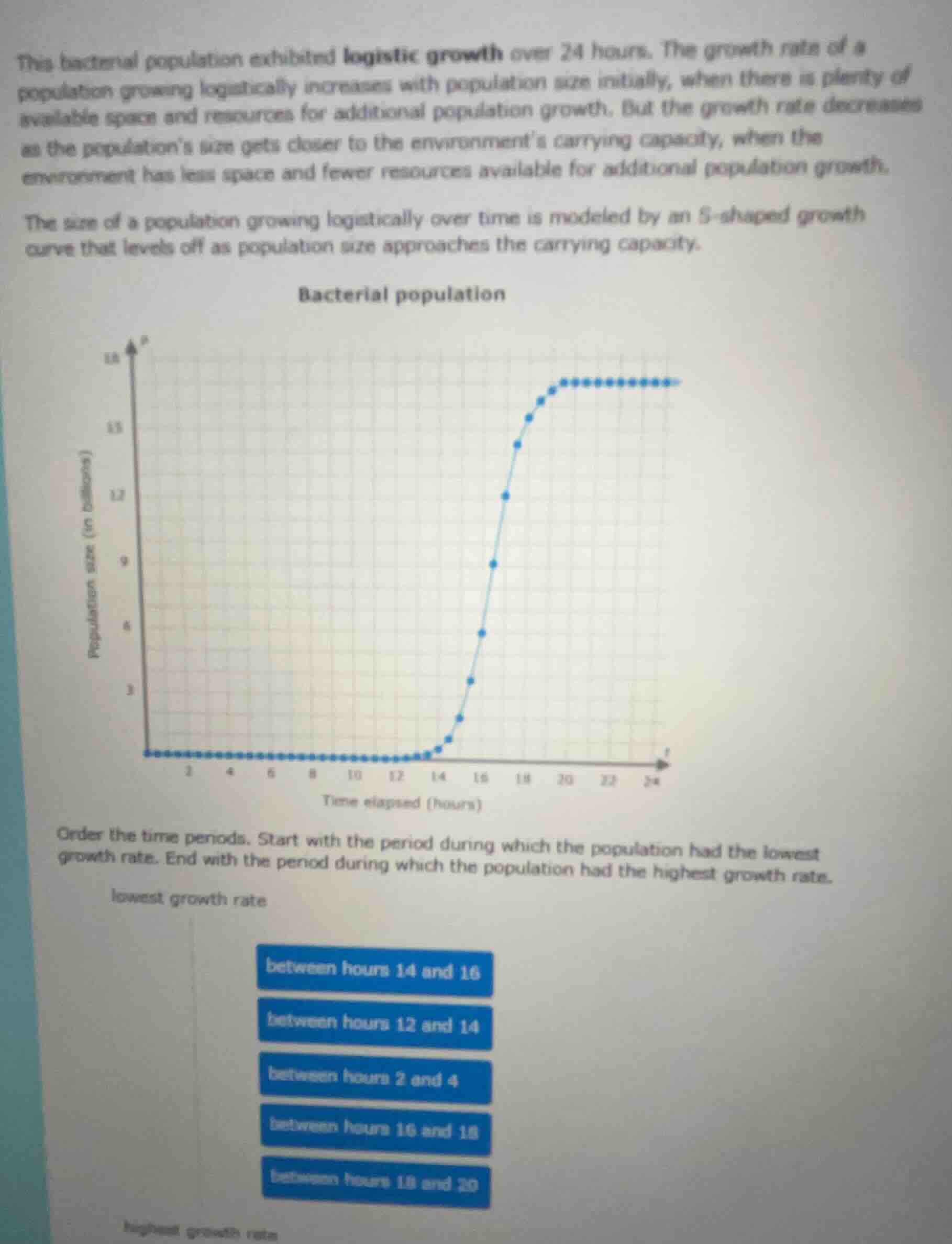
this bacterial population exhibited logistic growth over 24 hours. the growth rate of a population growing logistically increases with population size initially, when there is plenty of available space and resources for additional population growth. but the growth rate decreases as the populations size gets closer to the environments carrying capacity, when the environment has less space and fewer resources available for additional population growth.the size of a population growing logistically over time is modeled by an s-shaped growth curve that levels off as population size approaches the carrying capacity.bacterial populationorder the time periods. start with the period during which the population had the lowest growth rate. end with the period during which the population had the highest growth rate.lowest growth ratebetween hours 14 and 16between hours 12 and 14between hours 2 and 4between hours 16 and 18between hours 18 and 20highest growth rate
Logistic growth rate is lowest when the curve is flattest (near start/end, little population change) and highest when the curve is steepest (greatest population change over time).
- Between hours 2 and 4: The curve is nearly flat, minimal population growth (lowest rate).
- Between hours 12 and 14: Very small population increase, low growth rate.
- Between hours 18 and 20: The curve starts leveling off, growth rate slows.
- Between hours 14 and 16: Steeper curve, noticeable population growth.
- Between hours 16 and 18: The steepest part of the curve, largest population increase over time (highest growth rate).

Snap & solve any problem in the app
Get step-by-step solutions on Sovi AI
Photo-based solutions with guided steps
Explore more problems and detailed explanations
- between hours 2 and 4
- between hours 12 and 14
- between hours 18 and 20
- between hours 14 and 16
- between hours 16 and 18