QUESTION IMAGE
Question
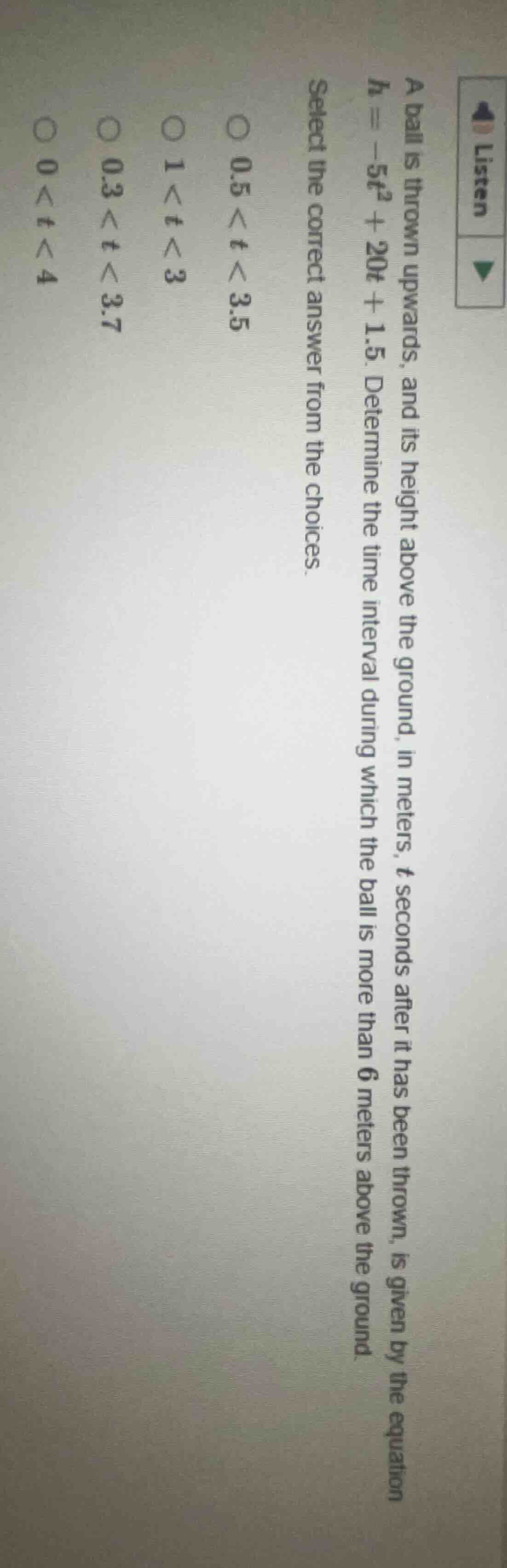
a ball is thrown upwards, and its height above the ground, in meters, t seconds after it has been thrown, is given by the equation ( h = -5t^2 + 20t + 1.5 ). determine the time interval during which the ball is more than 6 meters above the ground. select the correct answer from the choices. ( 0.5 < t < 3.5 ) ( 1 < t < 3 ) ( 0.3 < t < 3.7 ) ( 0 < t < 4 )
Step1: Set up inequality for height
$h > 6$ so substitute $h=-5t^2+20t+1.5$:
$$-5t^2 + 20t + 1.5 > 6$$
Step2: Rearrange to standard quadratic form
Subtract 6 from both sides:
$$-5t^2 + 20t - 4.5 > 0$$
Multiply by -1 (reverse inequality):
$$5t^2 - 20t + 4.5 < 0$$
Step3: Solve quadratic equation $5t^2-20t+4.5=0$
Use quadratic formula $t=\frac{-b\pm\sqrt{b^2-4ac}}{2a}$, where $a=5$, $b=-20$, $c=4.5$:
$$t=\frac{20\pm\sqrt{(-20)^2-4(5)(4.5)}}{2(5)}$$
$$t=\frac{20\pm\sqrt{400-90}}{10}$$
$$t=\frac{20\pm\sqrt{310}}{10}$$
Calculate approximate values:
$\sqrt{310}\approx17.607$, so
$t_1=\frac{20-17.607}{10}\approx0.239$, $t_2=\frac{20+17.607}{10}\approx3.761$
Step4: Identify valid interval
Quadratic $5t^2-20t+4.5$ opens upwards, so it is less than 0 between roots:
$0.239 < t < 3.761$, which rounds to $0.3 < t < 3.7$

Snap & solve any problem in the app
Get step-by-step solutions on Sovi AI
Photo-based solutions with guided steps
Explore more problems and detailed explanations
0.3 < t < 3.7