QUESTION IMAGE
Question
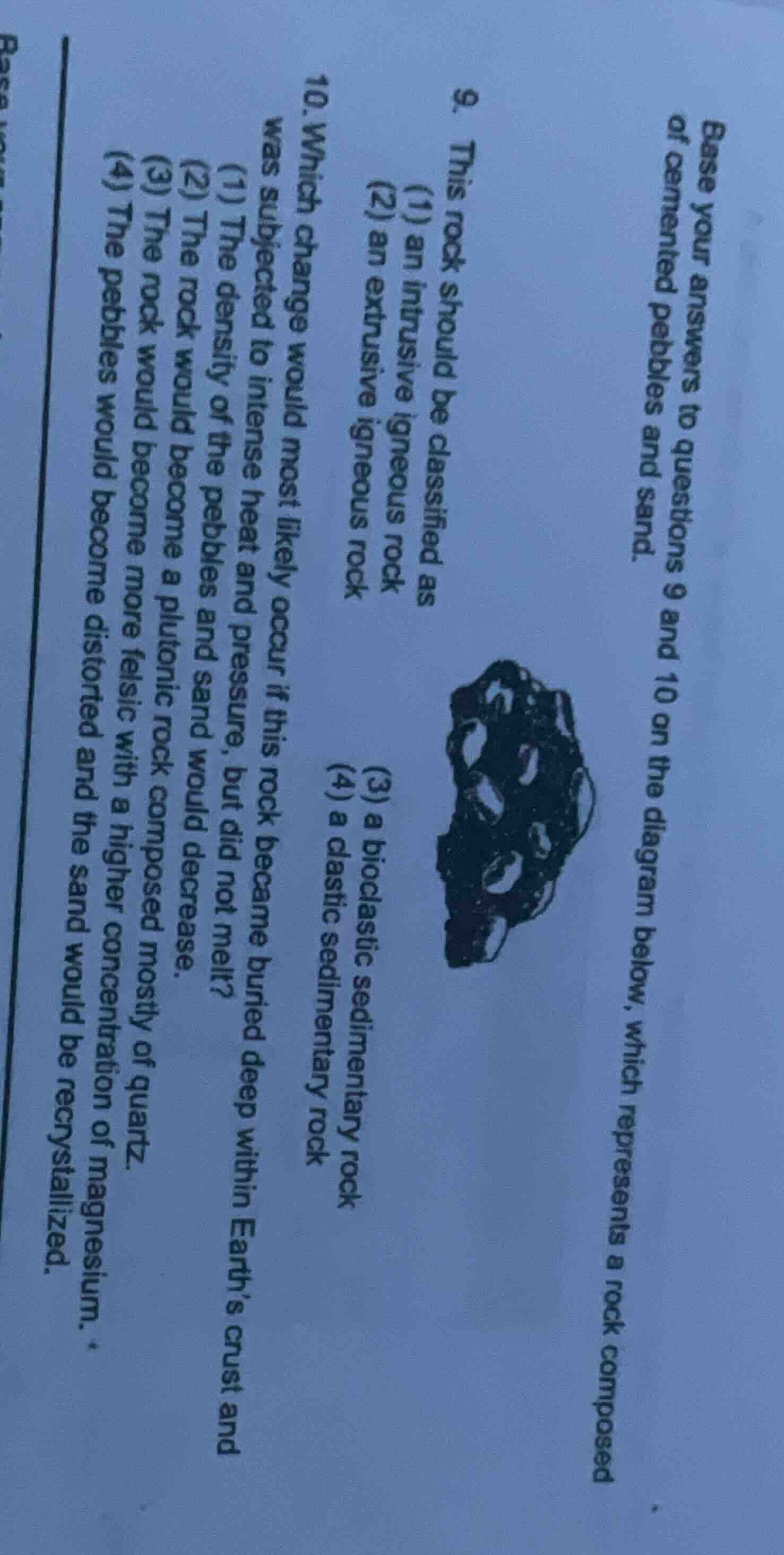
base your answers to questions 9 and 10 on the diagram below, which represents a rock composed of cemented pebbles and sand.
- this rock should be classified as
(1) an intrusive igneous rock
(2) an extrusive igneous rock
(3) a bioclastic sedimentary rock
(4) a clastic sedimentary rock
- which change would most likely occur if this rock became buried deep within earth’s crust and was subjected to intense heat and pressure, but did not melt?
(1) the density of the pebbles and sand would decrease.
(2) the rock would become a plutonic rock composed mostly of quartz.
(3) the rock would become more felsic with a higher concentration of magnesium.
(4) the pebbles would become distorted and the sand would be recrystallized.
Para la pregunta 9: La roca está formada por guijarros y arena cementados, lo que la clasifica como roca sedimentaria clástica (formada por fragmentos de rocas preexistentes). Las rocas ígneas se forman por enfriamiento de magma, y las bioclásticas por restos orgánicos, por lo que no aplican.
Para la pregunta 10: Cuando una roca sedimentaria clástica se somete a calor y presión intensos sin fundirse, sufre metamorfismo: los guijarros se distorsionan y el material fino (arena) se recristaliza. Las otras opciones no describen el cambio metamórfico correcto.

Snap & solve any problem in the app
Get step-by-step solutions on Sovi AI
Photo-based solutions with guided steps
Explore more problems and detailed explanations
- (4) a clastic sedimentary rock
- (4) The pebbles would become distorted and the sand would be recrystallized.