QUESTION IMAGE
Question
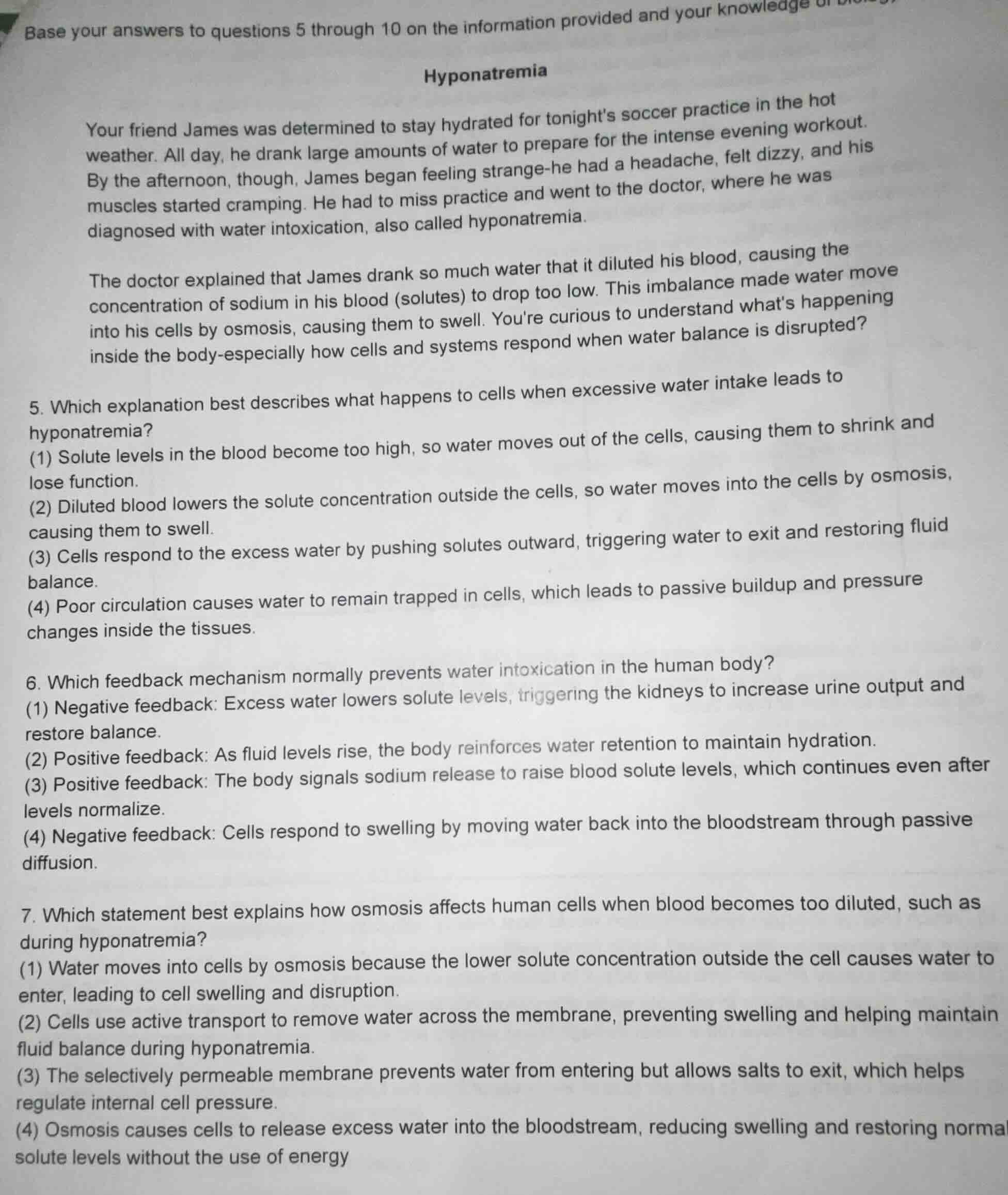
base your answers to questions 5 through 10 on the information provided and your knowledge of biology.
hyponatremia
your friend james was determined to stay hydrated for tonights soccer practice in the hot weather. all day, he drank large amounts of water to prepare for the intense evening workout. by the afternoon, though, james began feeling strange - he had a headache, felt dizzy, and his muscles started cramping. he had to miss practice and went to the doctor, where he was diagnosed with water intoxication, also called hyponatremia.
the doctor explained that james drank so much water that it diluted his blood, causing the concentration of sodium in his blood (solutes) to drop too low. this imbalance made water move into his cells by osmosis, causing them to swell. youre curious to understand whats happening inside the body - especially how cells and systems respond when water balance is disrupted?
- which explanation best describes what happens to cells when excessive water intake leads to hyponatremia?
(1) solute levels in the blood become too high, so water moves out of the cells, causing them to shrink and lose function.
(2) diluted blood lowers the solute concentration outside the cells, so water moves into the cells by osmosis, causing them to swell.
(3) cells respond to the excess water by pushing solutes outward, triggering water to exit and restoring fluid balance.
(4) poor circulation causes water to remain trapped in cells, which leads to passive buildup and pressure changes inside the tissues.
- which feedback mechanism normally prevents water intoxication in the human body?
(1) negative feedback: excess water lowers solute levels, triggering the kidneys to increase urine output and restore balance.
(2) positive feedback: as fluid levels rise, the body reinforces water retention to maintain hydration.
(3) positive feedback: the body signals sodium release to raise blood solute levels, which continues even after levels normalize.
(4) negative feedback: cells respond to swelling by moving water back into the bloodstream through passive diffusion.
- which statement best explains how osmosis affects human cells when blood becomes too diluted, such as during hyponatremia?
(1) water moves into cells by osmosis because the lower solute concentration outside the cell causes water to enter, leading to cell swelling and disruption.
(2) cells use active transport to remove water across the membrane, preventing swelling and helping maintain fluid balance during hyponatremia.
(3) the selectively permeable membrane prevents water from entering but allows salts to exit, which helps regulate internal cell pressure.
(4) osmosis causes cells to release excess water into the bloodstream, reducing swelling and restoring normal solute levels without the use of energy
Question 5
The passage states excess water dilutes blood, lowering blood sodium (solute) levels. Osmosis moves water from an area of lower solute concentration (diluted blood outside cells) to higher solute concentration (inside cells), causing cells to swell. This matches option (2).
Question 6
Negative feedback mechanisms reverse deviations from normal balance. When there is excess water, the body triggers kidneys to increase urine output to eliminate excess water and restore solute-water balance, which is negative feedback. This matches option (1).
Question 7
Osmosis is the passive movement of water across a semipermeable membrane from an area of lower solute concentration to higher solute concentration. When blood is diluted (lower solute outside cells), water moves into cells, causing swelling and disruption, which matches option (1).

Snap & solve any problem in the app
Get step-by-step solutions on Sovi AI
Photo-based solutions with guided steps
Explore more problems and detailed explanations
- (2) Diluted blood lowers the solute concentration outside the cells, so water moves into the cells by osmosis, causing them to swell.
- (1) Negative feedback: Excess water lowers solute levels, triggering the kidneys to increase urine output and restore balance.
- (1) Water moves into cells by osmosis because the lower solute concentration outside the cell causes water to enter, leading to cell swelling and disruption.