QUESTION IMAGE
Question
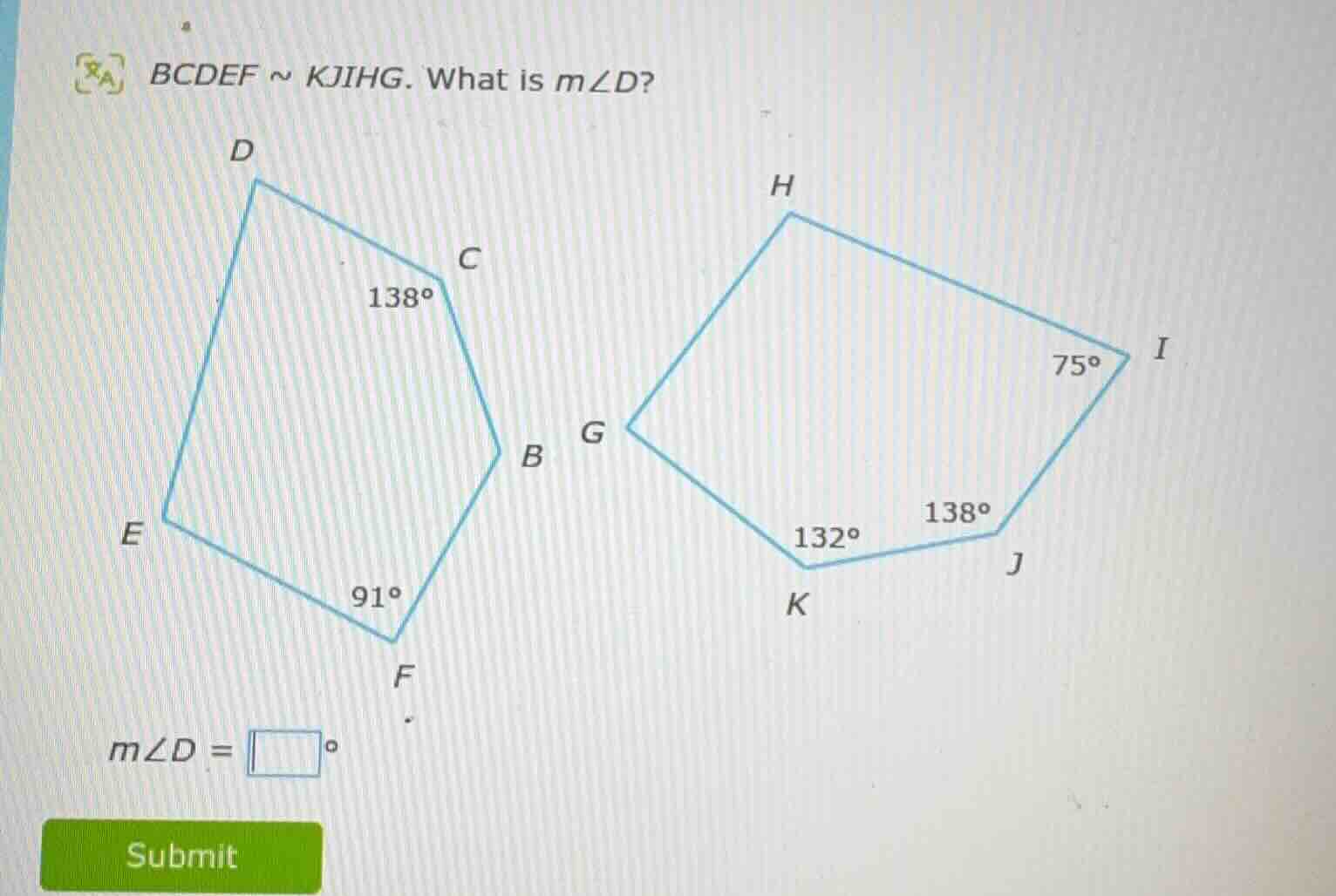
bcdef ~ kjihg. what is ( mangle d )? ( mangle d = square^circ )
Step1: Recall sum of interior angles of a hexagon? Wait, no, B C D E F and K J I H G – wait, the figures: B C D E F – let's count the sides. Wait, B C D E F – that's 5 sides? Wait, no, the first figure: points B, C, D, E, F – so pentagon? Wait, B C D E F: 5 vertices, so pentagon. Similarly, K J I H G: 5 vertices, pentagon. So both are pentagons. Sum of interior angles of a pentagon is (5 - 2)*180° = 540°.
Step2: Find corresponding angles. Since B C D E F ~ K J I H G, the order of the letters matters. So B corresponds to J, C to I? Wait, no, the similarity is B C D E F ~ K J I H G. So B ↔ K? Wait, no, the notation: B C D E F ~ K J I H G, so the order is B→K, C→J, D→I, E→H, F→G? Wait, no, let's check the angles. In the second pentagon (K J I H G), angles are at K: 132°, J: 138°, I: 75°, H:?, G:? Wait, no, the first pentagon: B C D E F, angles at C: 138°, F: 91°, and we need angle D. The second pentagon: K J I H G, angles at K: 132°, J: 138°, I: 75°, and we can find the other angles.
Wait, sum of interior angles of pentagon is 540°. Let's calculate the sum of known angles in the second pentagon (K J I H G): 132° (K) + 138° (J) + 75° (I) +? (H) +? (G)? Wait, no, maybe the first pentagon: B C D E F, angles at C: 138°, F: 91°, and we need angle D. The second pentagon: K J I H G, angles at K: 132°, J: 138°, I: 75°, and let's find the missing angles. Wait, maybe the correspondence is B ↔ J, C ↔ I, D ↔ H, E ↔ K, F ↔ G? Wait, no, let's list the angles.
Wait, first pentagon (B C D E F): angles at C: 138°, F: 91°, and we need angle D. Second pentagon (K J I H G): angles at K: 132°, J: 138°, I: 75°, and let's compute the sum. Sum is 540°. So in the second pentagon, sum of known angles: 132 (K) + 138 (J) + 75 (I) +? (H) +? (G)? Wait, no, maybe the first pentagon's angles: let's denote the angles as ∠B, ∠C, ∠D, ∠E, ∠F. Second pentagon: ∠K, ∠J, ∠I, ∠H, ∠G. Since they are similar, corresponding angles are equal. So let's find the correspondence.
Looking at the angles: ∠C in first pentagon is 138°, ∠J in second is 138°, so C ↔ J. ∠F in first is 91°, maybe ∠G in second? Wait, no, let's calculate the sum for the second pentagon. Let's assume the second pentagon has angles: K:132, J:138, I:75, H:?, G:?. Sum is 132 + 138 + 75 + H + G = 540. So 132+138=270, 270+75=345. So H + G = 540 - 345 = 195. Now, the first pentagon: angles at C:138 (corresponds to J:138), F:91, and we need angle D. Let's see the first pentagon's angles: ∠B, ∠C=138, ∠D, ∠E, ∠F=91. Sum is 540. So ∠B + 138 + ∠D + ∠E + 91 = 540 → ∠B + ∠D + ∠E = 540 - 138 - 91 = 311.
Now, in the second pentagon, ∠K=132, ∠J=138, ∠I=75, so ∠H and ∠G. Wait, maybe the correspondence is B ↔ K, C ↔ J, D ↔ I, E ↔ H, F ↔ G. So ∠B corresponds to ∠K=132°, ∠C=138° corresponds to ∠J=138°, ∠D corresponds to ∠I=75°? No, that can't be, because in the first pentagon, angle at F is 91°, maybe ∠F corresponds to ∠G. Wait, let's check the sum again.
Wait, maybe I made a mistake. Let's re-express:
First pentagon (B C D E F): vertices B, C, D, E, F (order matters for similarity).
Second pentagon (K J I H G): vertices K, J, I, H, G.
So similarity: B ↔ K, C ↔ J, D ↔ I, E ↔ H, F ↔ G.
Therefore, ∠B = ∠K = 132°, ∠C = ∠J = 138°, ∠D = ∠I = 75°? Wait, no, ∠I is 75°, but in the first pentagon, angle at F is 91°, so ∠F = ∠G. Let's calculate sum for first pentagon:
∠B (K's angle:132°) + ∠C (138°) + ∠D (?) + ∠E (H's angle) + ∠F (91°) = 540°.
Sum of known angles in first pentagon: 132 + 138 + 91 = 361. So ∠D + ∠E = 540 - 361 = 179.
In the second pentagon: ∠K=132, ∠J=138, ∠I=75, ∠H=?, ∠G=91 (since ∠F=91 and F↔G). So sum of…

Snap & solve any problem in the app
Get step-by-step solutions on Sovi AI
Photo-based solutions with guided steps
Explore more problems and detailed explanations
75