QUESTION IMAGE
Question
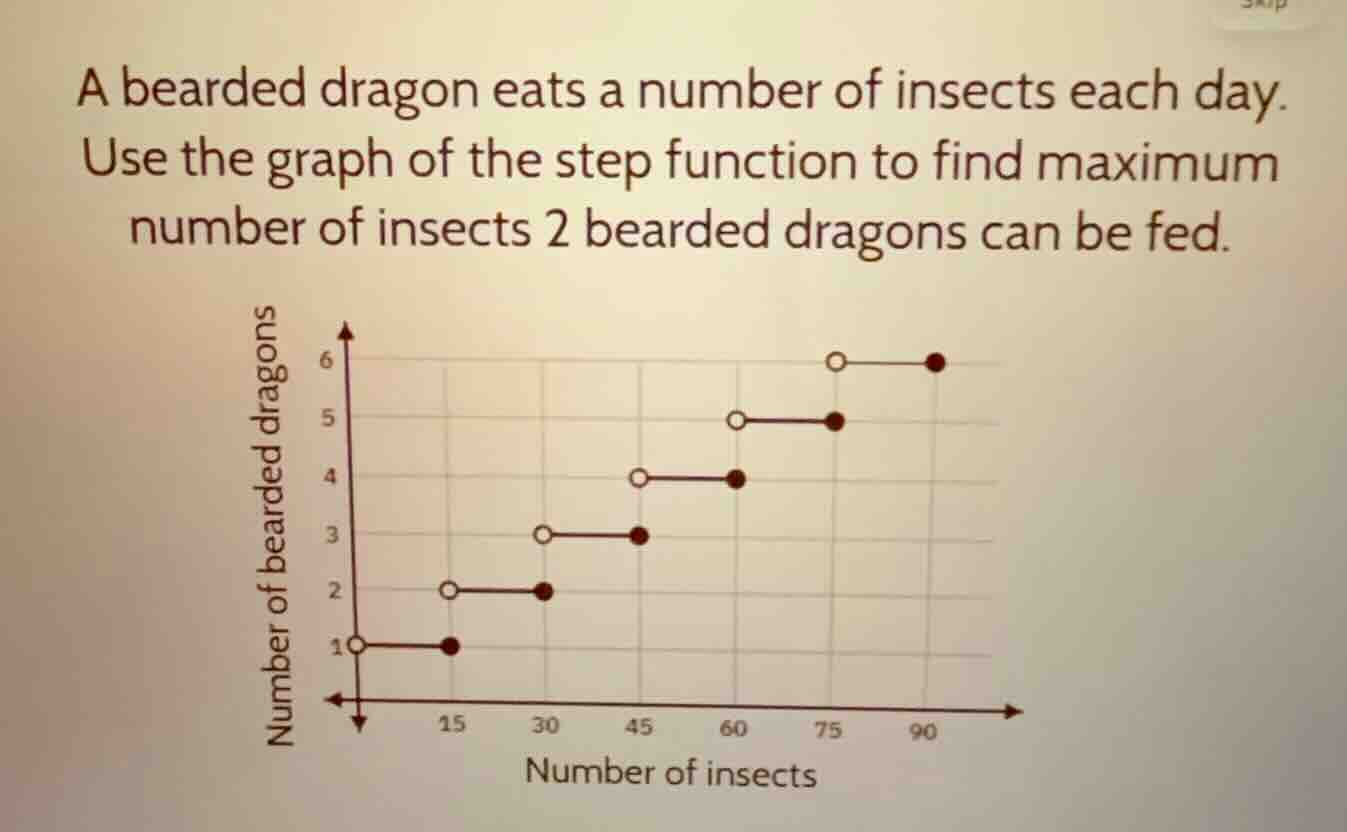
a bearded dragon eats a number of insects each day. use the graph of the step function to find maximum number of insects 2 bearded dragons can be fed.
Step1: Find max insects for 1 dragon
From the step - function graph, the maximum number of insects that 1 bearded dragon can eat is determined by the right - most solid dot. Looking at the graph, for 1 bearded dragon, the maximum number of insects is 90? Wait, no. Wait, the y - axis is the number of bearded dragons and the x - axis is the number of insects. Wait, let's re - interpret the graph. The x - axis is the number of insects, and the y - axis is the number of bearded dragons. Each step in the step function shows the number of bearded dragons corresponding to a range of insects. To find the maximum number of insects for 1 bearded dragon, we look at the x - value when y = 1. Wait, no, actually, when we have 1 bearded dragon, what's the maximum number of insects? Wait, the solid dots represent the included endpoints. Let's see the steps:
For y = 1: The interval of x (insects) for y = 1 is from 0 (open circle) up to 15 (solid circle). Wait, no, maybe I got the axes reversed. Wait, the problem says "A bearded dragon eats a number of insects each day. Use the graph of the step function to find maximum number of insects 2 bearded dragons can be fed." So the x - axis should be the number of insects, and the y - axis is the number of bearded dragons. So each horizontal segment (step) shows for a certain number of insects, how many bearded dragons can be fed. Wait, no, actually, the step function is probably defined as: for a given number of insects x, the number of bearded dragons y that can be fed. But we need to find, for 2 bearded dragons, the maximum number of insects. Wait, looking at the graph, when y = 2 (number of bearded dragons), what's the maximum x (insects)? The solid dot for y = 2 is at x = 30? Wait, no, let's list the steps:
- For y = 1: The interval is from x = 0 (open circle) to x = 15 (solid circle). So maximum insects for 1 dragon: 15.
- For y = 2: The interval is from x = 15 (open circle) to x = 30 (solid circle). So maximum insects for 2 dragons: 30? Wait, no, that can't be. Wait, maybe the y - axis is the number of insects per dragon? No, the problem says "number of bearded dragons" on the y - axis and "number of insects" on the x - axis. Wait, let's re - read the problem: "Use the graph of the step function to find maximum number of insects 2 bearded dragons can be fed." So we need to find, when the number of bearded dragons is 2, what's the maximum number of insects. So we look at the step where y = 2. The step for y = 2 has an open circle at x = 15 and a solid circle at x = 30? Wait, no, looking at the graph:
The points:
- For y = 1: open circle at (0,1), solid circle at (15,1)
- For y = 2: open circle at (15,2), solid circle at (30,2)
- For y = 3: open circle at (30,3), solid circle at (45,3)
- For y = 4: open circle at (45,4), solid circle at (60,4)
- For y = 5: open circle at (60,5), solid circle at (75,5)
- For y = 6: open circle at (75,6), solid circle at (90,6)
Wait, no, that's if we reverse the axes. Wait, maybe the x - axis is the number of insects per dragon, and y - axis is the number of dragons? No, the problem is about 2 dragons. Wait, maybe the graph is: the x - axis is the number of insects, and for each x, y is the number of dragons that can be fed with x insects. So to find the maximum number of insects for 2 dragons, we find the x - value where y = 2, and the maximum x in that step. From the graph, when y = 2, the interval of x is from 15 (open circle) to 30 (solid circle). So maximum insects for 2 dragons? Wait, no, that would be 30 insects for 2 dragons? But that seems low. Wait, mayb…

Snap & solve any problem in the app
Get step-by-step solutions on Sovi AI
Photo-based solutions with guided steps
Explore more problems and detailed explanations
Step1: Find max insects for 1 dragon
From the step - function graph, the maximum number of insects that 1 bearded dragon can eat is determined by the right - most solid dot. Looking at the graph, for 1 bearded dragon, the maximum number of insects is 90? Wait, no. Wait, the y - axis is the number of bearded dragons and the x - axis is the number of insects. Wait, let's re - interpret the graph. The x - axis is the number of insects, and the y - axis is the number of bearded dragons. Each step in the step function shows the number of bearded dragons corresponding to a range of insects. To find the maximum number of insects for 1 bearded dragon, we look at the x - value when y = 1. Wait, no, actually, when we have 1 bearded dragon, what's the maximum number of insects? Wait, the solid dots represent the included endpoints. Let's see the steps:
For y = 1: The interval of x (insects) for y = 1 is from 0 (open circle) up to 15 (solid circle). Wait, no, maybe I got the axes reversed. Wait, the problem says "A bearded dragon eats a number of insects each day. Use the graph of the step function to find maximum number of insects 2 bearded dragons can be fed." So the x - axis should be the number of insects, and the y - axis is the number of bearded dragons. So each horizontal segment (step) shows for a certain number of insects, how many bearded dragons can be fed. Wait, no, actually, the step function is probably defined as: for a given number of insects x, the number of bearded dragons y that can be fed. But we need to find, for 2 bearded dragons, the maximum number of insects. Wait, looking at the graph, when y = 2 (number of bearded dragons), what's the maximum x (insects)? The solid dot for y = 2 is at x = 30? Wait, no, let's list the steps:
- For y = 1: The interval is from x = 0 (open circle) to x = 15 (solid circle). So maximum insects for 1 dragon: 15.
- For y = 2: The interval is from x = 15 (open circle) to x = 30 (solid circle). So maximum insects for 2 dragons: 30? Wait, no, that can't be. Wait, maybe the y - axis is the number of insects per dragon? No, the problem says "number of bearded dragons" on the y - axis and "number of insects" on the x - axis. Wait, let's re - read the problem: "Use the graph of the step function to find maximum number of insects 2 bearded dragons can be fed." So we need to find, when the number of bearded dragons is 2, what's the maximum number of insects. So we look at the step where y = 2. The step for y = 2 has an open circle at x = 15 and a solid circle at x = 30? Wait, no, looking at the graph:
The points:
- For y = 1: open circle at (0,1), solid circle at (15,1)
- For y = 2: open circle at (15,2), solid circle at (30,2)
- For y = 3: open circle at (30,3), solid circle at (45,3)
- For y = 4: open circle at (45,4), solid circle at (60,4)
- For y = 5: open circle at (60,5), solid circle at (75,5)
- For y = 6: open circle at (75,6), solid circle at (90,6)
Wait, no, that's if we reverse the axes. Wait, maybe the x - axis is the number of insects per dragon, and y - axis is the number of dragons? No, the problem is about 2 dragons. Wait, maybe the graph is: the x - axis is the number of insects, and for each x, y is the number of dragons that can be fed with x insects. So to find the maximum number of insects for 2 dragons, we find the x - value where y = 2, and the maximum x in that step. From the graph, when y = 2, the interval of x is from 15 (open circle) to 30 (solid circle). So maximum insects for 2 dragons? Wait, no, that would be 30 insects for 2 dragons? But that seems low. Wait, maybe I have the axes reversed. Let's assume that the y - axis is the number of insects per dragon, and[LLM SSE On Failure]