QUESTION IMAGE
Question
..because:
openscied.org lesson 8 - 5/2/25
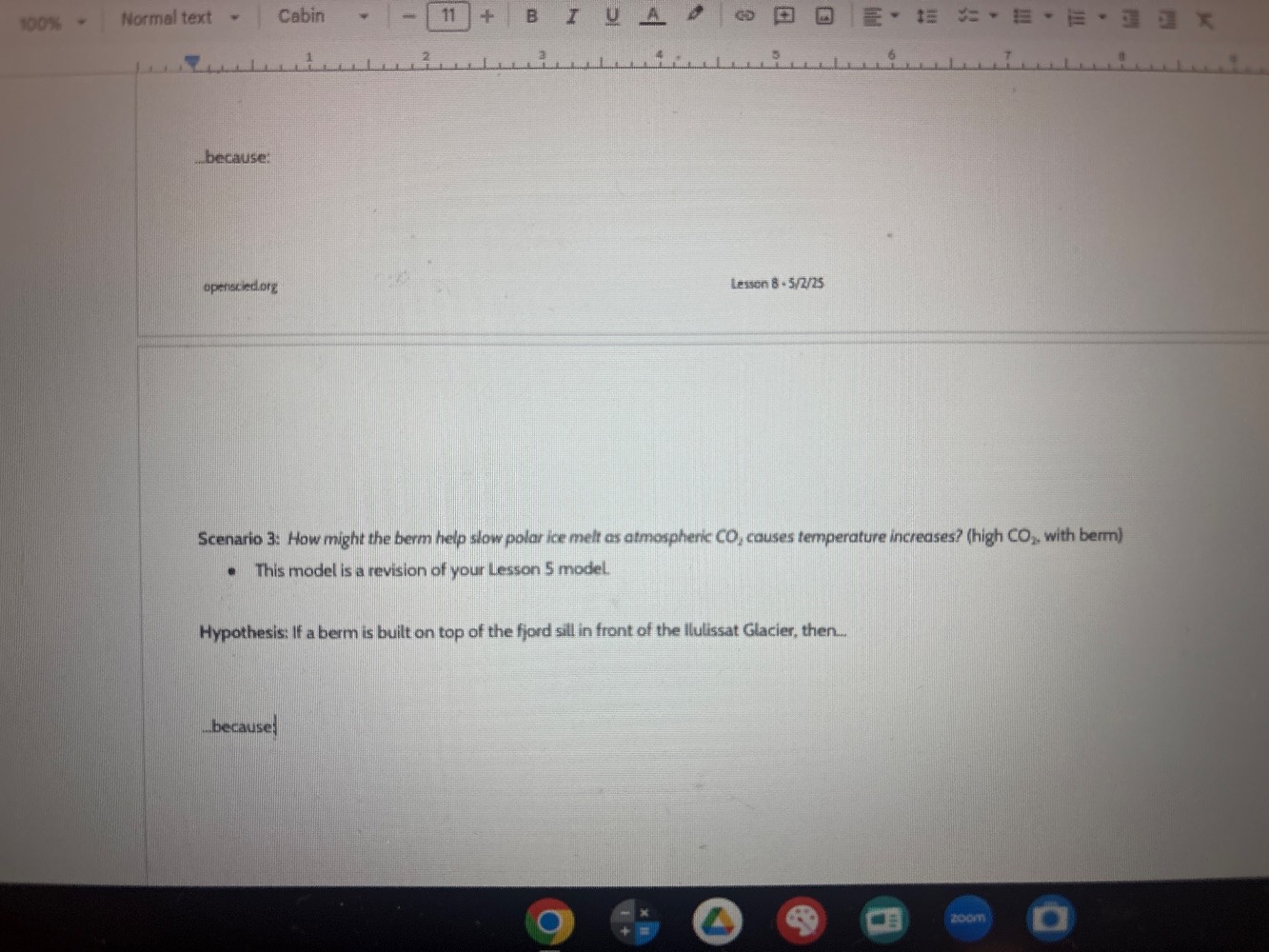
scenario 3: how might the berm help slow polar ice melt as atmospheric co₂ causes temperature increases? (high co₂, with berm)
- this model is a revision of your lesson 5 model.
hypothesis: if a berm is built on top of the fjord sill in front of the ilulissat glacier, then...
..because
To complete the hypothesis, we analyze the role of a berm (a mound/barrier) in the fjord in front of the glacier. The berm can disrupt warm ocean currents (carrying heat from high CO₂ - driven warming) from reaching the glacier's front. By reducing the heat transfer to the glacier, the rate of ice melting slows. So the "because" part explains the mechanism: the berm blocks warm ocean water from flowing toward the glacier, reducing the heat input that would otherwise accelerate ice melt due to atmospheric CO₂ - induced temperature rises.

Snap & solve any problem in the app
Get step-by-step solutions on Sovi AI
Photo-based solutions with guided steps
Explore more problems and detailed explanations
the rate of polar ice (Ilulissat Glacier) melt will decrease because the berm will act as a barrier to block warm ocean currents from reaching the glacier, thereby reducing the amount of heat transferred to the glacier that would otherwise speed up ice melting as atmospheric $\ce{CO_2}$ causes temperature increases.