QUESTION IMAGE
Question
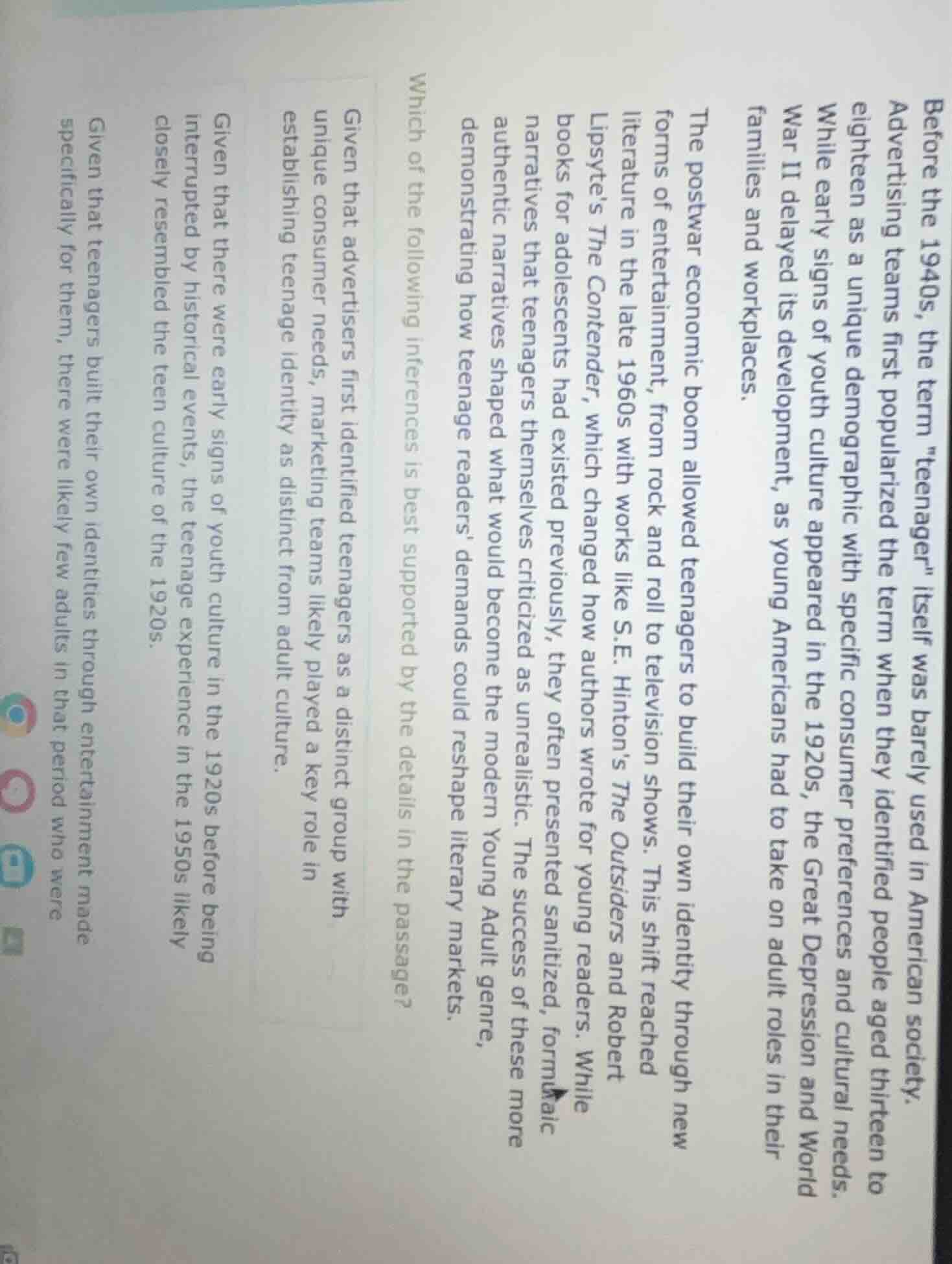
before the 1940s, the term \teenager\ itself was barely used in american society. advertising teams first popularized the term when they identified people aged thirteen to eighteen as a unique demographic with specific consumer preferences and cultural needs. while early signs of youth culture appeared in the 1920s, the great depression and world war ii delayed its development, as young americans had to take on adult roles in their families and workplaces. the postwar economic boom allowed teenagers to build their own identity through new forms of entertainment, from rock and roll to television shows. this shift reached literature in the late 1960s with works like s.e. hinton’s the outsiders and robert lipsyte’s the contender, which changed how authors wrote for young readers. while books for adolescents had existed previously, they often presented sanitized, formulaic narratives that teenagers themselves criticized as unrealistic. the success of these more authentic narratives shaped what would become the modern young adult genre, demonstrating how teenage readers’ demands could reshape literary markets. which of the following inferences is best supported by the details in the passage? given that advertisers first identified teenagers as a distinct group with unique consumer needs, marketing teams likely played a key role in establishing teenage identity as distinct from adult culture. given that there were early signs of youth culture in the 1920s before being interrupted by historical events, the teenage experience in the 1950s likely closely resembled the teen culture of the 1920s. given that teenagers built their own identities through entertainment made specifically for them, there were likely few adults in that period who were
The passage states that advertising teams first popularized the term "teenager" by identifying 13-18 year olds as a unique demographic with specific consumer needs, marking a key step in framing their distinct identity separate from adult culture. The other inferences are not supported: the text says 1920s youth culture was interrupted and not linked to 1950s teen culture; it also notes teens took on adult roles in the 1930s-40s, so there were adults in that period; and the literary shift was driven by teens' rejection of sanitized narratives, not the other way around.

Snap & solve any problem in the app
Get step-by-step solutions on Sovi AI
Photo-based solutions with guided steps
Explore more problems and detailed explanations
Given that advertisers first identified teenagers as a distinct group with unique consumer needs, marketing teams likely played a key role in establishing teenage identity as distinct from adult culture.