QUESTION IMAGE
Question
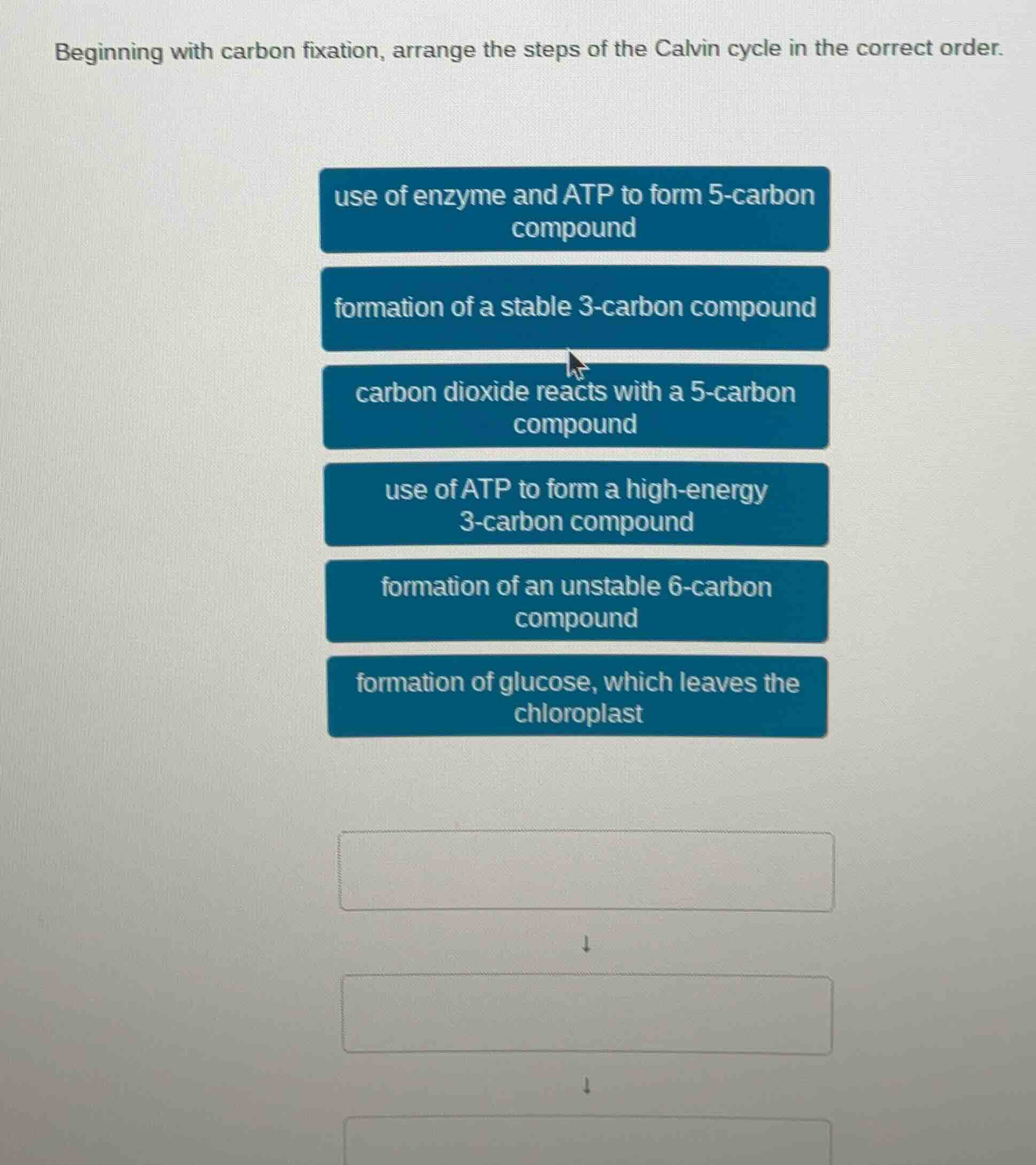
beginning with carbon fixation, arrange the steps of the calvin cycle in the correct order. use of enzyme and atp to form 5 - carbon compound formation of a stable 3 - carbon compound carbon dioxide reacts with a 5 - carbon compound use of atp to form a high - energy 3 - carbon compound formation of an unstable 6 - carbon compound formation of glucose, which leaves the chloroplast
Step1: Recall Calvin Cycle Steps
The Calvin cycle has three main phases: carbon fixation, reduction, and regeneration.
- Carbon Fixation: \(CO_2\) (carbon dioxide) reacts with a 5 - carbon compound (RuBP, ribulose - 1,5 - bisphosphate). So the first step is "carbon dioxide reacts with a 5 - carbon compound".
- Formation of Unstable 6 - C Compound: The reaction between \(CO_2\) and the 5 - C compound forms an unstable 6 - carbon compound. So next is "formation of an unstable 6 - carbon compound".
- Formation of Stable 3 - C Compound: The unstable 6 - C compound splits into two stable 3 - carbon compounds (3 - PGA, 3 - phosphoglycerate). So then "formation of a stable 3 - carbon compound".
- Reduction (High - Energy 3 - C Compound): ATP and NADPH (not mentioned here but ATP is used) are used to convert the 3 - C compound into a high - energy 3 - carbon compound (G3P, glyceraldehyde - 3 - phosphate). So "use of ATP to form a high - energy 3 - carbon compound".
- Regeneration (5 - C Compound): Some G3P is used to regenerate the 5 - carbon compound (RuBP) using ATP and an enzyme. So "use of enzyme and ATP to form 5 - carbon compound".
- Glucose Formation: The remaining G3P is used to form glucose, which leaves the chloroplast. So "formation of glucose, which leaves the chloroplast".

Snap & solve any problem in the app
Get step-by-step solutions on Sovi AI
Photo-based solutions with guided steps
Explore more problems and detailed explanations
- carbon dioxide reacts with a 5 - carbon compound
- formation of an unstable 6 - carbon compound
- formation of a stable 3 - carbon compound
- use of ATP to form a high - energy 3 - carbon compound
- use of enzyme and ATP to form 5 - carbon compound
- formation of glucose, which leaves the chloroplast