QUESTION IMAGE
Question
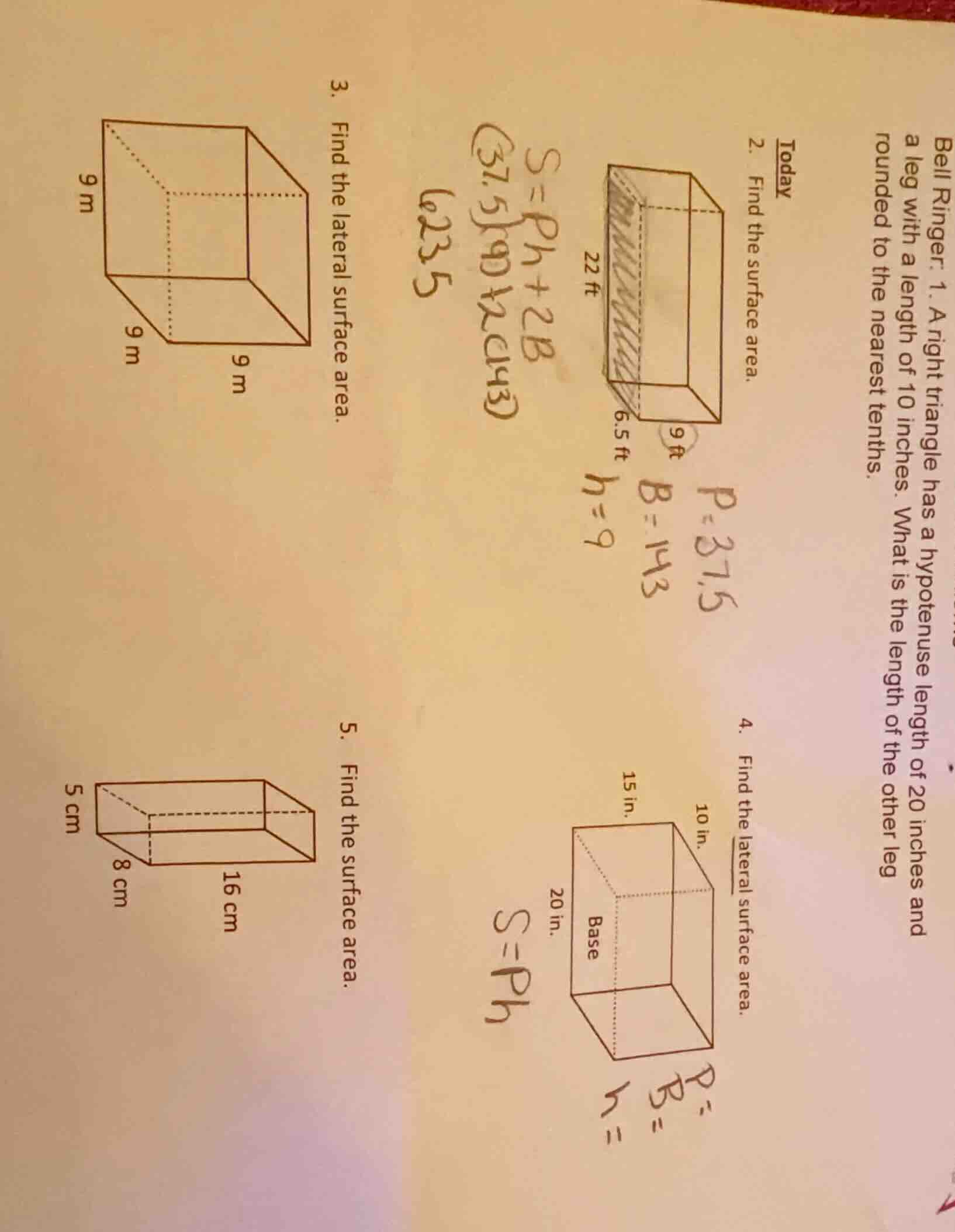
bell ringer: 1. a right triangle has a hypotenuse length of 20 inches and a leg with a length of 10 inches. what is the length of the other leg rounded to the nearest tenths.
today
- find the surface area.
(there is a rectangular prism with dimensions 22 ft, 9 ft, 6.5 ft, and some handwritten notes: p=37.5, b=143, h=9, s=ph+2b, (37.5)(9)+2(143), 623.5)
- find the lateral surface area.
(there is a cube with side length 9 m)
- find the lateral surface area.
(there is a rectangular prism with base, dimensions 20 in, 15 in, 10 in, and handwritten note: s=ph)
- find the surface area.
(there is a rectangular prism with dimensions 16 cm, 8 cm, 5 cm)
Problem 3: Lateral Surface Area of a Cube (9m side)
Step 1: Recall Lateral Surface Area Formula for Cube
For a cube with side length \( s \), the lateral surface area (LSA) is given by \( \text{LSA} = 4s^2 \) (since a cube has 4 lateral faces, each with area \( s^2 \)).
Step 2: Substitute \( s = 9 \, \text{m} \)
Substitute \( s = 9 \) into the formula:
\( \text{LSA} = 4 \times (9)^2 \)
Step 3: Calculate \( 9^2 \) and Multiply
First, \( 9^2 = 81 \). Then, \( 4 \times 81 = 324 \).
Step 1: Recall Lateral Surface Area Formula for Rectangular Prism
For a rectangular prism with length \( l \), width \( w \), and height \( h \), the lateral surface area (LSA) is given by \( \text{LSA} = 2h(l + w) \) (or \( \text{LSA} = Ph \), where \( P \) is the perimeter of the base: \( P = 2(l + w) \)).
Step 2: Identify Dimensions
From the diagram, assume the base has length \( l = 20 \, \text{in} \), width \( w = 15 \, \text{in} \), and height \( h = 10 \, \text{in} \) (or adjust based on labeling; here, \( h = 10 \) as the vertical side).
Step 3: Calculate Perimeter of the Base (\( P \))
\( P = 2(l + w) = 2(20 + 15) = 2(35) = 70 \, \text{in} \).
Step 4: Calculate Lateral Surface Area (\( \text{LSA} = Ph \))
Substitute \( P = 70 \) and \( h = 10 \):
\( \text{LSA} = 70 \times 10 = 700 \).
Step 1: Recall Surface Area Formula for Rectangular Prism
The total surface area (SA) of a rectangular prism is given by \( \text{SA} = 2(lw + lh + wh) \), where \( l = \text{length} \), \( w = \text{width} \), \( h = \text{height} \).
Step 2: Identify Dimensions
From the diagram, \( l = 16 \, \text{cm} \), \( w = 8 \, \text{cm} \), \( h = 5 \, \text{cm} \).
Step 3: Calculate Each Pair of Faces
- Area of \( lw \) faces: \( 2(lw) = 2(16 \times 8) = 2(128) = 256 \)
- Area of \( lh \) faces: \( 2(lh) = 2(16 \times 5) = 2(80) = 160 \)
- Area of \( wh \) faces: \( 2(wh) = 2(8 \times 5) = 2(40) = 80 \)
Step 4: Sum the Areas
Add the three results: \( 256 + 160 + 80 = 496 \).

Snap & solve any problem in the app
Get step-by-step solutions on Sovi AI
Photo-based solutions with guided steps
Explore more problems and detailed explanations
The lateral surface area is \( 324 \, \text{square meters} \) (or \( 324 \, \text{m}^2 \)).