QUESTION IMAGE
Question
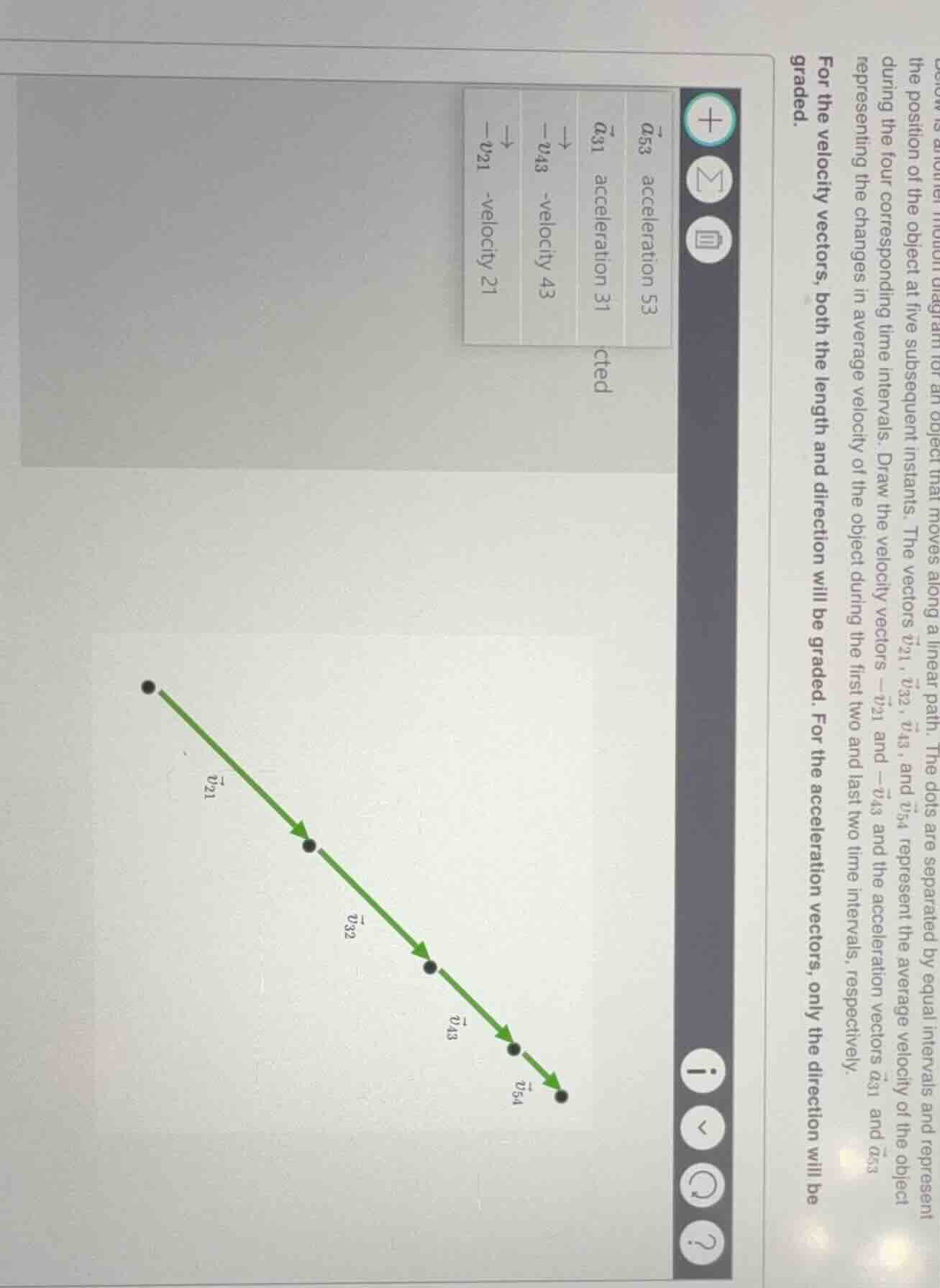
below is another motion diagram for an object that moves along a linear path. the dots are separated by equal intervals and represent the position of the object at five subsequent instants. the vectors (vec{v}_{21}), (vec{v}_{32}), (vec{v}_{43}), and (vec{v}_{54}) represent the average velocity of the object during the four corresponding time intervals. draw the velocity vectors (-vec{v}_{21}) and (-vec{v}_{43}) and the acceleration vectors (vec{a}_{31}) and (vec{a}_{53}) representing the changes in average velocity of the object during the first two and last two time intervals, respectively. for the velocity vectors, both the length and direction will be graded. for the acceleration vectors, only the direction will be graded.
Step1: Analyze Velocity Vectors
The velocity vectors \(\vec{v}_{21}\), \(\vec{v}_{32}\), \(\vec{v}_{43}\), \(\vec{v}_{54}\) are colinear and in the same direction (down - right, as per the diagram). To find \(-\vec{v}_{21}\), we reverse the direction of \(\vec{v}_{21}\). So if \(\vec{v}_{21}\) is going down - right, \(-\vec{v}_{21}\) will go up - left, with the same length as \(\vec{v}_{21}\).
Step2: Analyze \(-\vec{v}_{43}\)
For \(-\vec{v}_{43}\), we reverse the direction of \(\vec{v}_{43}\). Since \(\vec{v}_{43}\) is in the down - right direction, \(-\vec{v}_{43}\) will be in the up - left direction, with the same length as \(\vec{v}_{43}\).
Step3: Analyze Acceleration Vectors (\(\vec{a}_{31}\) and \(\vec{a}_{53}\))
Acceleration is the change in velocity over time. For \(\vec{a}_{31}\), it represents the average acceleration during the time interval from \(t_1\) to \(t_3\). The change in velocity is \(\vec{v}_{32}-\vec{v}_{21}\) (or considering the time interval, the average acceleration direction is determined by the change in velocity vectors). Since all velocity vectors are in the same direction and (from the diagram, assuming uniform motion? Wait, no, the velocity vectors seem to have the same direction and maybe same magnitude? Wait, the diagram shows \(\vec{v}_{21}\), \(\vec{v}_{32}\), \(\vec{v}_{43}\), \(\vec{v}_{54}\) as colinear and same - directed. If the velocity is constant (same magnitude and direction), then the change in velocity \(\Delta\vec{v}=\vec{v}_{final}-\vec{v}_{initial}\) would be zero? But maybe the time intervals are equal. Wait, the problem says "the dots are separated by equal intervals and represent the position of the object at five subsequent instants". So for \(\vec{a}_{31}\), the time interval is from \(t_1\) to \(t_3\), so the change in velocity is \(\vec{v}_{32}-\vec{v}_{21}\) (wait, no, the average velocity during a time interval is \(\frac{\Delta x}{\Delta t}\), but acceleration is \(\frac{\Delta\vec{v}}{\Delta t}\). If the velocity vectors are the same (same magnitude and direction), then \(\Delta\vec{v} = 0\), so acceleration would be zero? But the problem says to draw the direction. Wait, maybe I misinterpret the velocity vectors. Wait, the velocity vectors \(\vec{v}_{21}\), \(\vec{v}_{32}\), etc., are average velocities during the time intervals. Wait, the first velocity vector \(\vec{v}_{21}\) is the average velocity from \(t_1\) to \(t_2\), \(\vec{v}_{32}\) from \(t_2\) to \(t_3\), etc. If all these average velocities are the same (same magnitude and direction), then the change in velocity between \(t_1\) and \(t_3\) (for \(\vec{a}_{31}\)) is \(\vec{v}_{32}-\vec{v}_{21}=0\), so acceleration \(\vec{a}_{31} = 0\)? But that can't be. Wait, maybe the velocity vectors have different magnitudes? Wait, the diagram shows the vectors as colinear, but maybe the length is the same? Wait, the problem says "for the velocity vectors, both the length and direction will be graded. For the acceleration vectors, only the direction will be graded."
Wait, let's re - read the problem: "Draw the velocity vectors \(-\vec{v}_{21}\) and \(-\vec{v}_{43}\) and the acceleration vectors \(\vec{a}_{31}\) and \(\vec{a}_{53}\), representing the changes in average velocity of the object during the first two and last two time intervals, respectively."
So for \(-\vec{v}_{21}\):
- Direction: Opposite to \(\vec{v}_{21}\). If \(\vec{v}_{21}\) is going, say, from the first dot to the second (down - right), then \(-\vec{v}_{21}\) goes from the second dot to the first (up - left), same length.
For \(-\vec{v}_{43}\):…

Snap & solve any problem in the app
Get step-by-step solutions on Sovi AI
Photo-based solutions with guided steps
Explore more problems and detailed explanations
To draw the vectors:
- \(-\vec{v}_{21}\): A vector with the same length as \(\vec{v}_{21}\) but opposite in direction.
- \(-\vec{v}_{43}\): A vector with the same length as \(\vec{v}_{43}\) but opposite in direction.
- \(\vec{a}_{31}\) and \(\vec{a}_{53}\): If the velocity is constant (since dots are equally spaced, \(\Delta x\) and \(\Delta t\) are constant, so velocity is constant), then the change in velocity is zero, so acceleration vectors have magnitude zero. The direction is undefined, but if we assume that for constant velocity, acceleration is zero, we can represent them as vectors with zero length (or indicate that the direction is not applicable as acceleration is zero).
(Note: The actual drawing would involve using the vector - drawing tool provided, reversing the direction for \(-\vec{v}_{21}\) and \(-\vec{v}_{43}\) and drawing zero - length vectors for acceleration if velocity is constant.)