QUESTION IMAGE
Question
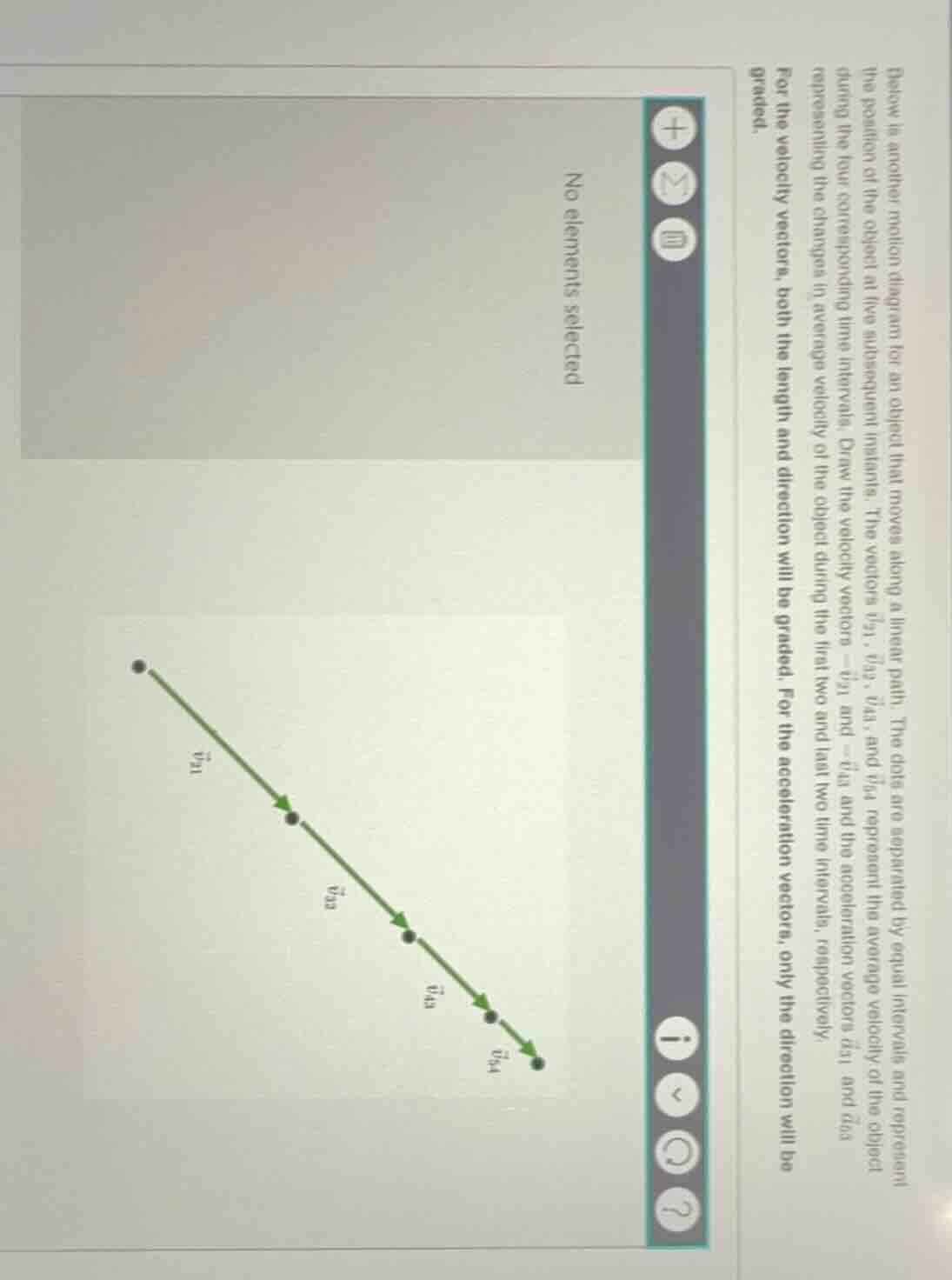
below is another motion diagram for an object that moves along a linear path. the dots are separated by equal intervals and represent the position of the object at five subsequent instants. the vectors \\(\vec{v}_{t1}\\), \\(\vec{v}_{t2}\\), \\(\vec{v}_{t3}\\), and \\(\vec{v}_{t4}\\) represent the average velocity of the object during the four corresponding time intervals. draw the velocity vectors \\(\vec{v}_{t2} - \vec{v}_{t1}\\) and \\(\vec{v}_{t4} - \vec{v}_{t3}\\) and the acceleration vectors \\(\vec{a}_{t1}\\) and \\(\vec{a}_{t3}\\) representing the changes in average velocity of the object during the first two and last two time intervals, respectively. for the velocity vectors, both the length and direction will be graded. for the acceleration vectors, only the direction will be graded.
Step1: Analyze Velocity Vectors
All velocity vectors (\(\vec{v}_{t1}, \vec{v}_{t2}, \vec{v}_{t3}, \vec{v}_{t4}\)) are colinear and have the same direction (since the arrows are along the same line). The lengths seem to be increasing? Wait, no, looking at the diagram, the vectors are along a straight line with consistent direction. Wait, actually, for average velocity change: \(\Delta\vec{v}_1=\vec{v}_{t2}-\vec{v}_{t1}\), \(\Delta\vec{v}_3=\vec{v}_{t4}-\vec{v}_{t3}\). Since all \(\vec{v}\) are in the same direction and if the speed is increasing (lengths of \(\vec{v}\) are increasing? Wait, the dots are spaced? Wait, the problem says equal intervals. Wait, the velocity vectors: let's check the direction. All \(\vec{v}\) are along the same line, same direction. Now, for acceleration, acceleration is \(\vec{a}=\frac{\Delta\vec{v}}{\Delta t}\). Since \(\Delta t\) is constant (equal intervals), the direction of \(\vec{a}\) is the direction of \(\Delta\vec{v}\).
For \(\vec{a}_1\) (first interval: \(t1\) to \(t2\)): \(\Delta\vec{v}_1 = \vec{v}_{t2} - \vec{v}_{t1}\). Since \(\vec{v}_{t2}\) and \(\vec{v}_{t1}\) are in the same direction, and if \(\vec{v}_{t2}\) is longer than \(\vec{v}_{t1}\) (speed increasing), then \(\Delta\vec{v}_1\) is in the same direction as \(\vec{v}\). Wait, but the diagram: the velocity vectors are along a straight line with arrows in the same direction, and the length from \(\vec{v}_{t1}\) to \(\vec{v}_{t4}\) is increasing? Wait, no, the positions of the dots: the first dot (start of \(\vec{v}_{t1}\)), then a dot (end of \(\vec{v}_{t1}\), start of \(\vec{v}_{t2}\)), then another, etc. Wait, maybe the velocity vectors are all in the same direction, and the change in velocity (\(\Delta\vec{v}\)) is in the same direction as the velocity (since speed is increasing). So for \(\vec{a}_1\) (average acceleration for \(t1 - t2\)): \(\vec{a}_1=\frac{\vec{v}_{t2}-\vec{v}_{t1}}{\Delta t}\). Since \(\vec{v}_{t2}\) and \(\vec{v}_{t1}\) are in the same direction, and \(\vec{v}_{t2}\) is longer (speed increasing), \(\Delta\vec{v}_1\) is in the same direction as \(\vec{v}\). Similarly, \(\vec{a}_3=\frac{\vec{v}_{t4}-\vec{v}_{t3}}{\Delta t}\), same direction as \(\vec{v}\).
Step2: Draw \(\vec{a}_1\) and \(\vec{a}_3\)
Since acceleration direction is same as \(\Delta\vec{v}\) direction, and \(\Delta\vec{v}\) for each interval is in the direction of the velocity (because speed is increasing, same direction). So \(\vec{a}_1\) and \(\vec{a}_3\) should be drawn in the same direction as the velocity vectors (along the line of \(\vec{v}\) vectors, same direction as the arrows).

Snap & solve any problem in the app
Get step-by-step solutions on Sovi AI
Photo-based solutions with guided steps
Explore more problems and detailed explanations
To draw \(\boldsymbol{\vec{a}_1}\) (average acceleration for \(t1 - t2\)) and \(\boldsymbol{\vec{a}_3}\) (average acceleration for \(t3 - t4\)):
- Direction of \(\vec{a}_1\): Calculate \(\Delta\vec{v}_1 = \vec{v}_{t2} - \vec{v}_{t1}\). Since \(\vec{v}_{t1}\) and \(\vec{v}_{t2}\) are collinear (same line) and \(\vec{v}_{t2}\) has greater magnitude (speed increasing), \(\Delta\vec{v}_1\) points in the same direction as \(\vec{v}\) vectors (along the line of the velocity arrows).
- Direction of \(\vec{a}_3\): Calculate \(\Delta\vec{v}_3 = \vec{v}_{t4} - \vec{v}_{t3}\). Similarly, \(\vec{v}_{t3}\) and \(\vec{v}_{t4}\) are collinear, and \(\vec{v}_{t4}\) has greater magnitude, so \(\Delta\vec{v}_3\) points in the same direction as \(\vec{v}\) vectors.
Thus, both \(\vec{a}_1\) and \(\vec{a}_3\) are drawn parallel to the velocity vectors (same direction as the arrows in \(\vec{v}_{t1}, \vec{v}_{t2}, \vec{v}_{t3}, \vec{v}_{t4}\)).
(Note: For the velocity change vectors \(\Delta\vec{v}_1\) and \(\Delta\vec{v}_3\), their direction is also the same as \(\vec{a}\) (since \(\vec{a}=\frac{\Delta\vec{v}}{\Delta t}\) and \(\Delta t>0\)), so \(\Delta\vec{v}_1\) and \(\Delta\vec{v}_3\) are parallel to \(\vec{a}_1\) and \(\vec{a}_3\) respectively, in the direction of increasing velocity.)