QUESTION IMAGE
Question
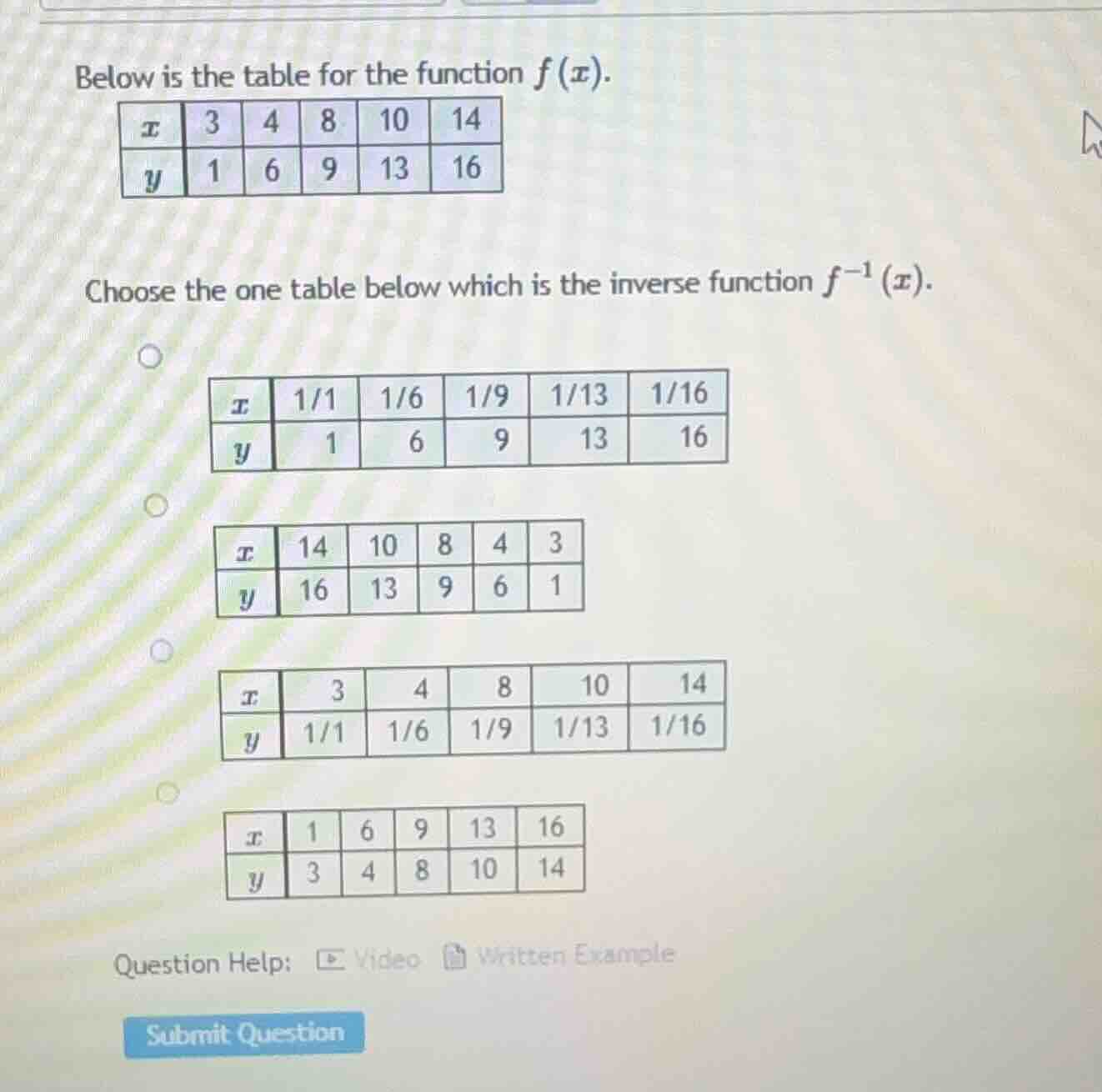
below is the table for the function $f(x)$.
| $x$ | 3 | 4 | 8 | 10 | 14 |
| $y$ | 1 | 6 | 9 | 13 | 16 |
choose the one table below which is the inverse function $f^{-1}(x)$.
- option 1:
| $x$ | $1/1$ | $1/6$ | $1/9$ | $1/13$ | $1/16$ |
| $y$ | 1 | 6 | 9 | 13 | 16 |
- option 2:
| $x$ | 14 | 10 | 8 | 4 | 3 |
| $y$ | 16 | 13 | 9 | 6 | 1 |
- option 3:
| $x$ | 3 | 4 | 8 | 10 | 14 |
| $y$ | $1/1$ | $1/6$ | $1/9$ | $1/13$ | $1/16$ |
- option 4:
| $x$ | 1 | 6 | 9 | 13 | 16 |
| $y$ | 3 | 4 | 8 | 10 | 14 |
question help: video written example
submit question
Step1: Recall inverse function table rule
To find the inverse function \( f^{-1}(x) \) from a table of \( f(x) \), we swap the \( x \)-values (input) and \( y \)-values (output) of \( f(x) \).
For the original function \( f(x) \), the table is:
| \( x \) | 3 | 4 | 8 | 10 | 14 |
| \( y \) | 1 | 6 | 9 | 13 | 16 |
Step2: Swap \( x \) and \( y \) values
So for \( f^{-1}(x) \), the \( x \)-values should be the \( y \)-values of \( f(x) \) and the \( y \)-values should be the \( x \)-values of \( f(x) \).
Let's check each option:
- First option: Incorrect, as it involves reciprocals which is not related to inverse function of a table (swapping is needed, not reciprocal).
- Second option: Incorrect, as it reverses the order of \( x \)-values of \( f(x) \) but does not swap \( x \) and \( y \).
- Third option: Incorrect, as it involves reciprocals which is wrong.
- Fourth option:
| \( x \) | 1 | 6 | 9 | 13 | 16 |
| \( y \) | 3 | 4 | 8 | 10 | 14 |
This swaps the \( x \) and \( y \) values of the original function's table, so it represents \( f^{-1}(x) \).

Snap & solve any problem in the app
Get step-by-step solutions on Sovi AI
Photo-based solutions with guided steps
Explore more problems and detailed explanations
The table for \( f^{-1}(x) \) is the fourth option:
| \( x \) | 1 | 6 | 9 | 13 | 16 | |
| \( y \) | 3 | 4 | 8 | 10 | 14 | (the last table option) |