QUESTION IMAGE
Question
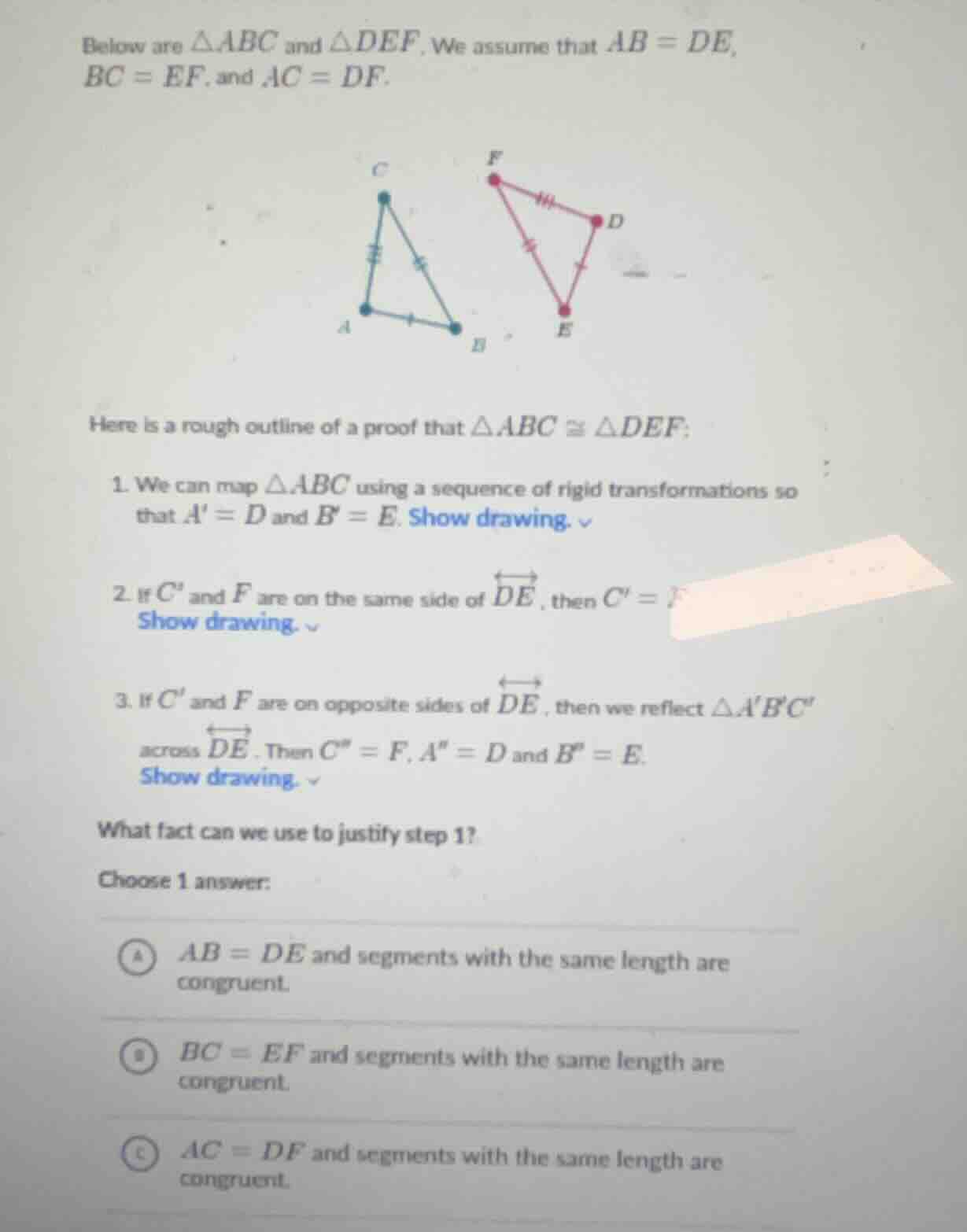
below are $\triangle abc$ and $\triangle def$. we assume that $ab = de$, $bc = ef$, and $ac = df$.
here is a rough outline of a proof that $\triangle abc \cong \triangle def$:
- we can map $\triangle abc$ using a sequence of rigid transformations so that $a = d$ and $b = e$. show drawing.
- if $c$ and $f$ are on the same side of $\overleftrightarrow{de}$, then $c = f$. show drawing.
- if $c$ and $f$ are on opposite sides of $\overleftrightarrow{de}$, then we reflect $\triangle abc$ across $\overleftrightarrow{de}$. then $c = f$, $a = d$ and $b = e$. show drawing.
what fact can we use to justify step 1?
choose 1 answer:
\\(\boldsymbol{\text{a}}\\) $ab = de$ and segments with the same length are congruent.
\\(\boldsymbol{\text{b}}\\) $bc = ef$ and segments with the same length are congruent.
\\(\boldsymbol{\text{c}}\\) $ac = df$ and segments with the same length are congruent.
Step 1 aims to map \( \triangle ABC \) so that \( A' = D \) and \( B' = E \). The given information is \( AB = DE \). Segments with the same length are congruent, and this congruence of \( AB \) and \( DE \) (since \( AB = DE \)) allows us to use rigid transformations to map \( A \) to \( D \) and \( B \) to \( E \) because congruent segments can be mapped onto each other via rigid transformations. Option A refers to \( AB = DE \) and the fact that segments with the same length are congruent, which directly justifies mapping \( A \) to \( D \) and \( B \) to \( E \). Options B and C refer to \( BC = EF \) and \( AC = DF \), which are not related to mapping \( A \) and \( B \) to \( D \) and \( E \) respectively.

Snap & solve any problem in the app
Get step-by-step solutions on Sovi AI
Photo-based solutions with guided steps
Explore more problems and detailed explanations
A. \( AB = DE \) and segments with the same length are congruent.