QUESTION IMAGE
Question
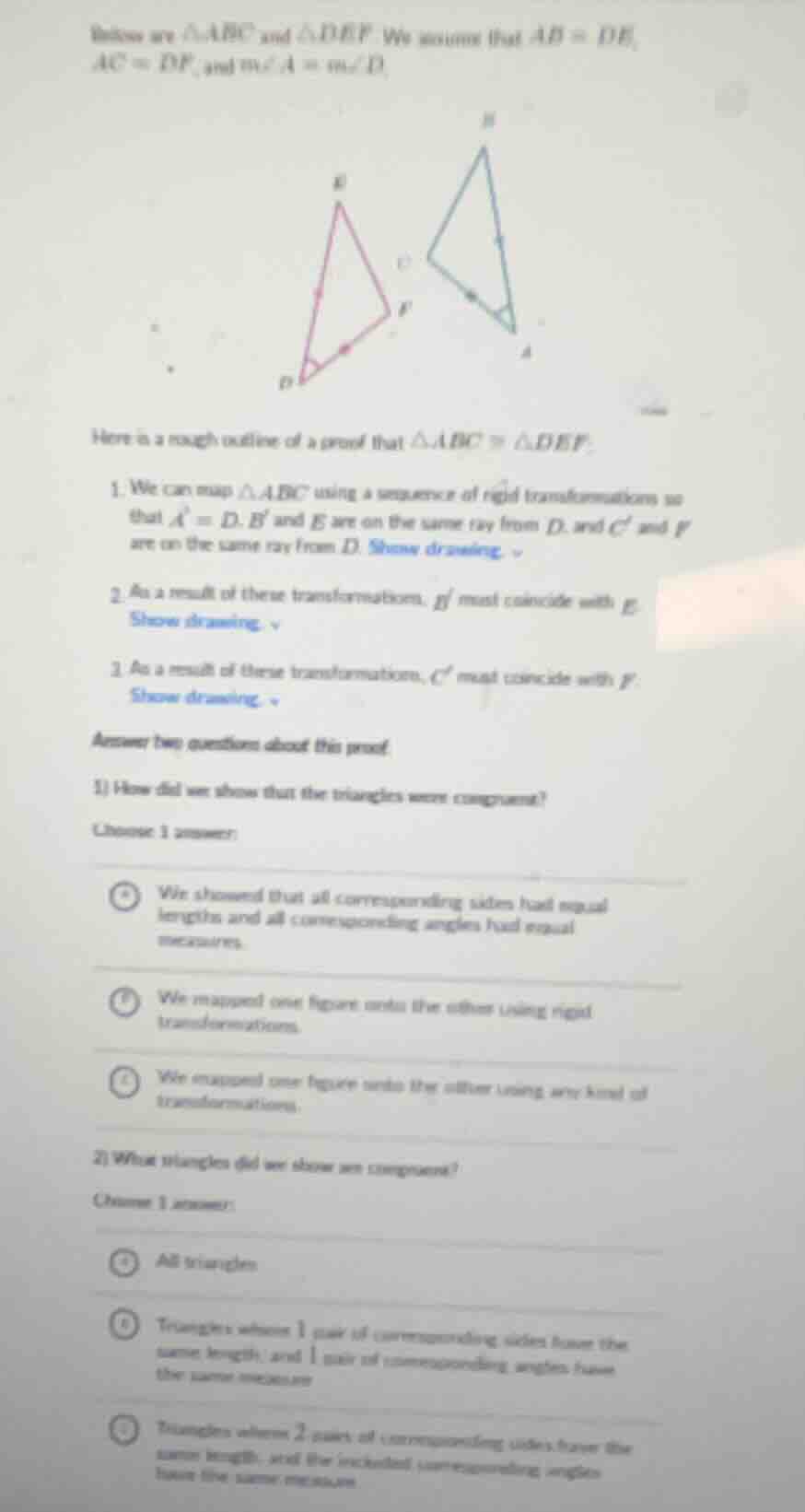
below are $\triangle abc$ and $\triangle def$. we assume that $ab = de$, $ac = df$, and $m\angle a = m\angle d$.
two triangles, $\triangle def$ (red) and $\triangle abc$ (blue), with markings indicating $ab = de$, $ac = df$, and $\angle a = \angle d$
here is a rough outline of a proof that $\triangle abc \cong \triangle def$.
- we can map $\triangle abc$ using a sequence of rigid transformations so that $a = d$, $b$ and $e$ are on the same ray from $d$, and $c$ and $f$ are on the same ray from $d$. show drawing
- as a result of these transformations, $b$ must coincide with $e$. show drawing
- as a result of these transformations, $c$ must coincide with $f$. show drawing
answer two questions about this proof.
- how did we show that the triangles were congruent?
choose 1 answer:
- we showed that all corresponding sides had equal lengths and all corresponding angles had equal measures.
- we mapped one figure onto the other using rigid transformations.
- we mapped one figure onto the other using any kind of transformations.
- what triangles did we show are congruent?
choose 1 answer:
- all triangles
- triangles where 1 pair of corresponding sides have the same length and 1 pair of corresponding angles have the same measure
- triangles where 2 pairs of corresponding sides have the same length, and the included corresponding angles have the same measure
Question 1
To determine how the triangles were shown to be congruent, we analyze the proof steps. The proof uses rigid transformations (translations, rotations, reflections) to map \( \triangle ABC \) to \( \triangle DEF \). Rigid transformations preserve shape and size, so if one triangle can be mapped to another via rigid transformations, they are congruent. The first option is incorrect because the proof doesn't directly show all sides and angles equal but uses transformations. The third option is incorrect because only rigid transformations (not any transformations) preserve congruence. So the correct answer is the second option.
The given information is \( AB = DE \), \( AC = DF \), and \( m\angle A = m\angle D \). This matches the SAS (Side - Angle - Side) congruence criterion, where two sides and the included angle of one triangle are equal to two sides and the included angle of another triangle. The first option is incorrect as we aren't showing all triangles are congruent. The second option describes a situation that doesn't match the given info (it has 1 pair of sides and 1 pair of angles, not the SAS case). The third option correctly describes the triangles with 2 pairs of corresponding sides equal and the included angle equal (which is the case here, as \( \angle A \) is included between \( AB \) and \( AC \), and \( \angle D \) is included between \( DE \) and \( DF \)).

Snap & solve any problem in the app
Get step-by-step solutions on Sovi AI
Photo-based solutions with guided steps
Explore more problems and detailed explanations
B. We mapped one figure onto the other using rigid transformations.