QUESTION IMAGE
Question
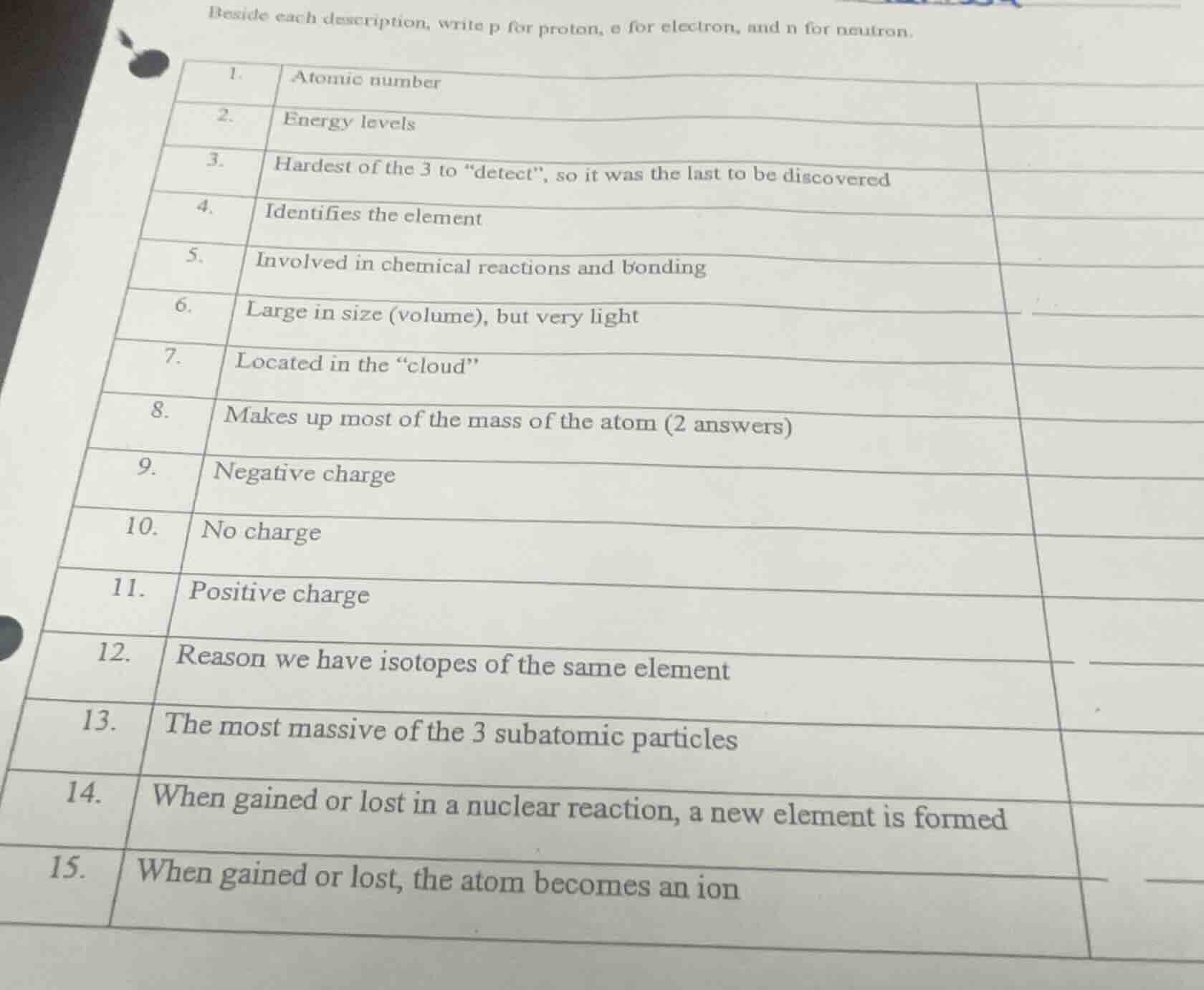
beside each description, write p for proton, e for electron, and n for neutron.
- atomic number
- energy levels
- hardest of the 3 to \detect\, so it was the last to be discovered
- identifies the element
- involved in chemical reactions and bonding
- large in size (volume), but very light
- located in the \cloud\
- makes up most of the mass of the atom (2 answers)
- negative charge
- no charge
- positive charge
- reason we have isotopes of the same element
- the most massive of the 3 subatomic particles
- when gained or lost in a nuclear reaction, a new element is formed
- when gained or lost, the atom becomes an ion
Brief Explanations
Each description is matched to the correct subatomic particle based on core properties of protons (p), electrons (e), and neutrons (n):
- Atomic number equals proton count.
- Electrons occupy energy levels.
- Neutrons, neutral, were last discovered.
- Proton count defines an element.
- Electrons drive reactions and bonding.
- Electron cloud has large volume, low mass.
- Electrons orbit in the electron "cloud".
- Nucleus (protons + neutrons) holds most mass.
- Electrons carry a negative charge.
- Neutrons have no electrical charge.
- Protons carry a positive charge.
- Isotopes differ in neutron count.
- Neutrons are the most massive subatomic particle.
- Changing proton count creates a new element.
- Gaining/losing electrons forms an ion.

Snap & solve any problem in the app
Get step-by-step solutions on Sovi AI
Photo-based solutions with guided steps
Explore more problems and detailed explanations
- p
- e
- n
- p
- e
- e
- e
- p, n
- e
- n
- p
- n
- n
- p
- e