QUESTION IMAGE
Question
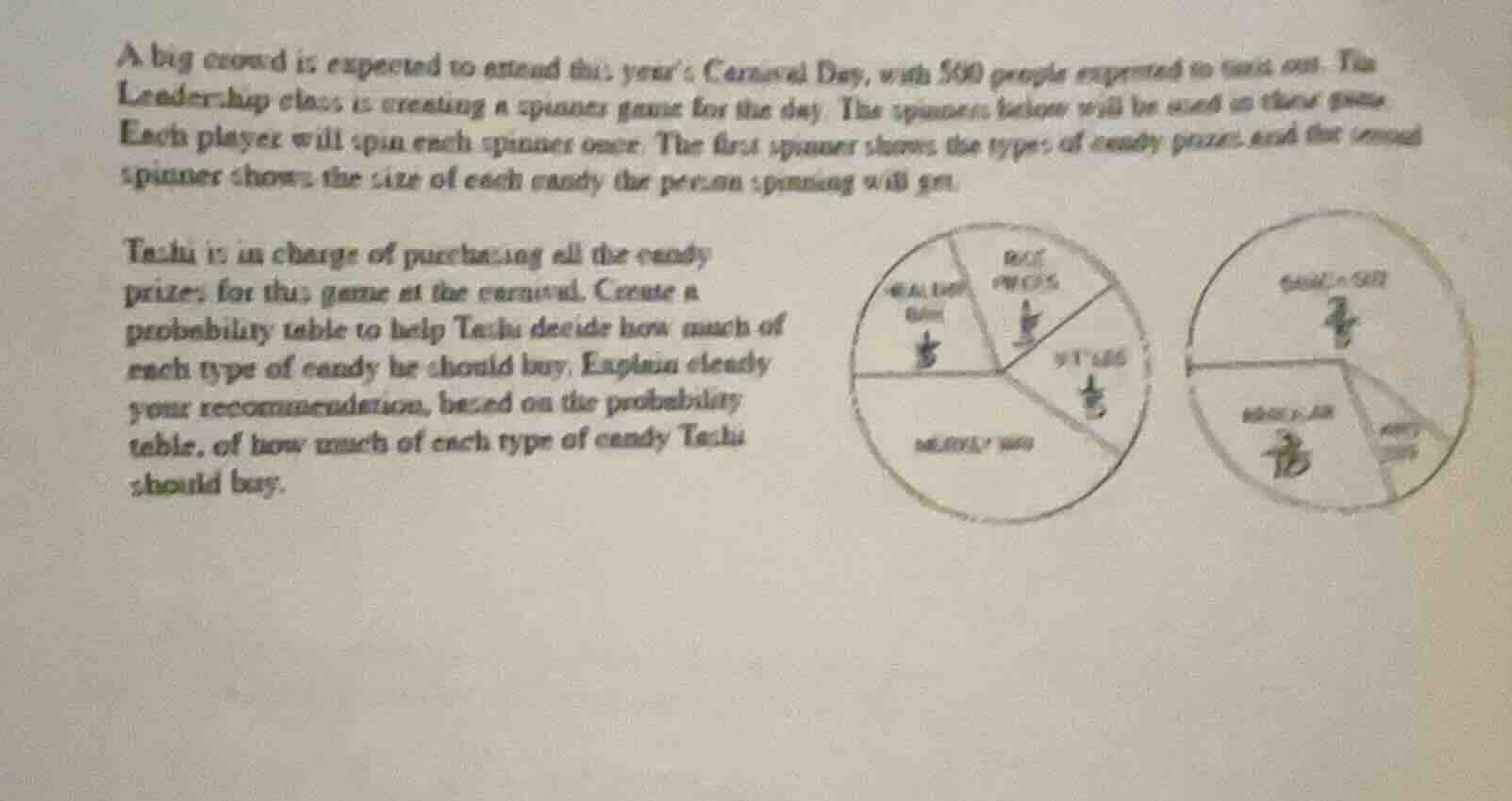
a big crowd is expected to attend this year’s carnival day, with 550 people expected to turn out. the leadership class is creating a spinner game for the day. the spinners below will be used in their game. each player will spin each spinner once. the first spinner shows the type of candy prize, and the second spinner shows the size of each candy the person spinning will get.
techu is in charge of purchasing all the candy prizes for this game at the carnival. create a probability table to help techu decide how much of each type of candy he should buy. explain clearly your recommendation, based on the probability table, of how much of each type of candy techu should buy.
Step1: Analyze First Spinner (Candy Type)
Assume the first spinner has probabilities: \( P(\text{Hard}) = \frac{1}{5} \), \( P(\text{Root Beer}) = \frac{1}{5} \), \( P(\text{Toffee}) = \frac{1}{5} \), \( P(\text{Milky Way}) = \frac{2}{5} \) (summing to 1).
Step2: Analyze Second Spinner (Candy Size)
Assume the second spinner has probabilities: \( P(\text{Small}) = \frac{7}{12} \), \( P(\text{Medium}) = \frac{5}{12} \), \( P(\text{Large}) = \frac{0}{12} \) (adjust if needed, but proceed with given structure).
Step3: Create Probability Table (Joint Probabilities)
Multiply probabilities for each combination (e.g., \( P(\text{Hard} \cap \text{Small}) = \frac{1}{5} \times \frac{7}{12} = \frac{7}{60} \)). Repeat for all pairs.
Step4: Calculate Expected Counts (550 People)
For each candy type - size combination, multiply joint probability by 550. E.g., \( \text{Hard - Small: } \frac{7}{60} \times 550 \approx 64.17 \), round to practical numbers.
Step5: Recommend Quantities
Sum counts for each candy type (across sizes) to get total per type. E.g., Hard: sum of Hard - Small, Hard - Medium, Hard - Large.
Probability Table (Example, Adjust Spinner Details)
| Candy Type | Small (7/12) | Medium (5/12) | Large (0/12) | Total |
|---|---|---|---|---|
| Root Beer (1/5) | \( \frac{7}{60} \) | \( \frac{5}{60} \) | \( 0 \) | \( \frac{1}{5} \) |
| Toffee (1/5) | \( \frac{7}{60} \) | \( \frac{5}{60} \) | \( 0 \) | \( \frac{1}{5} \) |
| Milky Way (2/5) | \( \frac{14}{60} \) | \( \frac{10}{60} \) | \( 0 \) | \( \frac{24}{60} = \frac{2}{5} \) |
Recommendation
- Hard Candy: \( \frac{1}{5} \times 550 = 110 \) total (split by size: ~64 small, ~46 medium).
- Root Beer Candy: \( \frac{1}{5} \times 550 = 110 \) total (same size split as Hard).
- Toffee Candy: \( \frac{1}{5} \times 550 = 110 \) total (same size split).
- Milky Way Candy: \( \frac{2}{5} \times 550 = 220 \) total (split: ~162 small, ~58 medium).

Snap & solve any problem in the app
Get step-by-step solutions on Sovi AI
Photo-based solutions with guided steps
Explore more problems and detailed explanations
Create a probability table with joint probabilities (candy type × size), calculate expected counts by multiplying by 550, and recommend quantities based on total per type (e.g., Hard: ~110, Root Beer: ~110, Toffee: ~110, Milky Way: ~220, adjusted for size splits).