QUESTION IMAGE
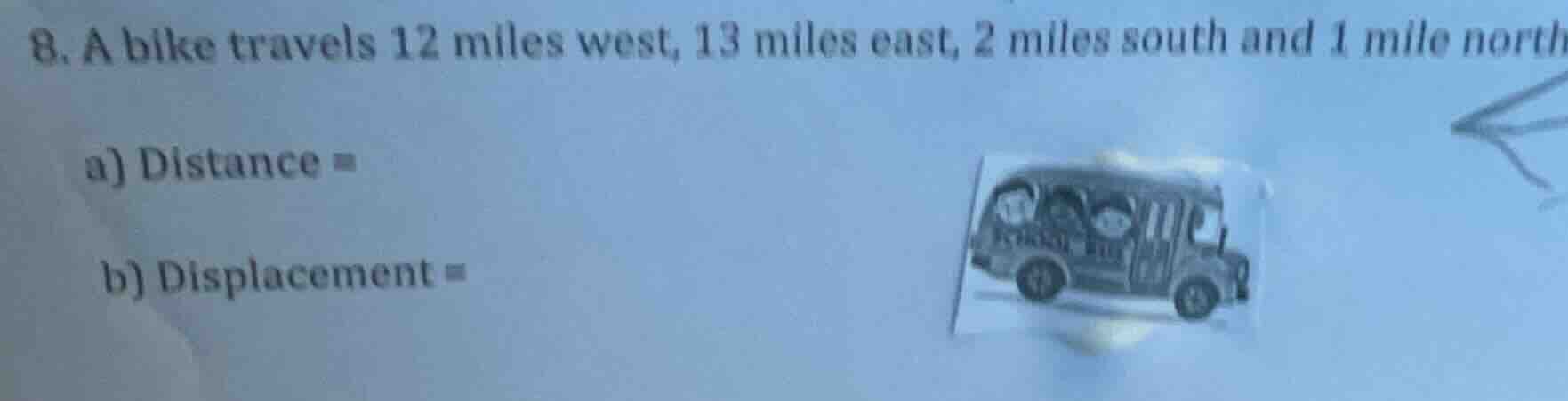
Question
- a bike travels 12 miles west, 13 miles east, 2 miles south and 1 mile north
a) distance =
b) displacement =
Part a) Distance Calculation
Step 1: Understand Distance
Distance is the total length of the path traveled. So we sum up all the individual distances traveled.
The bike travels 12 miles west, 13 miles east, 2 miles south, and 1 mile north. So we add these distances: \(12 + 13 + 2 + 1\)
Step 2: Calculate the Sum
\(12+13 = 25\), \(2 + 1=3\), then \(25+3 = 28\)
Step 1: Analyze Horizontal (East - West) Displacement
Let's take east as positive and west as negative. The bike travels 12 miles west (\(- 12\) miles) and 13 miles east (\(+13\) miles). So horizontal displacement \(x=13 - 12=1\) mile (east direction)
Step 2: Analyze Vertical (North - South) Displacement
Let's take north as positive and south as negative. The bike travels 2 miles south (\(-2\) miles) and 1 mile north (\(+1\) mile). So vertical displacement \(y = 1- 2=- 1\) mile (which means 1 mile south)
Step 3: Calculate Resultant Displacement
Displacement is the straight - line distance from the initial to the final position. We use the Pythagorean theorem: \(d=\sqrt{x^{2}+y^{2}}\), where \(x = 1\) and \(y=- 1\) (the sign indicates direction, but for magnitude we can use absolute values for calculation of the hypotenuse).
\(d=\sqrt{1^{2}+(- 1)^{2}}=\sqrt{1 + 1}=\sqrt{2}\approx1.414\) miles. To find the direction, we can also note that since \(x = 1\) (east) and \(y=-1\) (south), the displacement has a magnitude of \(\sqrt{2}\) miles and is in the southeast direction. But if we just want the magnitude of the displacement (or we can also express it in terms of components, but usually for such problems, the magnitude is asked in a simple way considering the right - triangle formed)
Wait, actually, let's re - check the horizontal and vertical displacements:
Horizontal: 13 east - 12 west = 1 east
Vertical: 1 north - 2 south = - 1 south (1 south)
So the displacement vector has components (1 east, 1 south). The magnitude of displacement is \(\sqrt{(1)^{2}+(1)^{2}}=\sqrt{2}\approx1.41\) miles. But we can also calculate it in a simpler way. Alternatively, if we consider the net east - west and north - south movements:
Net east - west: \(13 - 12=1\) mile east
Net north - south: \(1 - 2=- 1\) mile (1 mile south)
Then the displacement is the hypotenuse of a right triangle with legs of length 1 mile (east) and 1 mile (south). So \(d=\sqrt{1^{2}+1^{2}}=\sqrt{2}\approx1.41\) miles. But maybe we can also think of it as:
The horizontal displacement is 1 mile east, vertical displacement is 1 mile south. So the displacement has a magnitude of \(\sqrt{1 + 1}=\sqrt{2}\approx1.41\) miles. If we want to express it in a more basic way, we can also note that the displacement is \(\sqrt{2}\) miles (or approximately 1.41 miles) at an angle of 45 degrees south of east.
But let's do the calculation again:
Distance traveled in east - west: \(|13 - 12| = 1\) (east)
Distance traveled in north - south: \(|2 - 1|=1\) (south)
Then displacement \(d=\sqrt{1^{2}+1^{2}}=\sqrt{2}\approx1.41\) miles.

Snap & solve any problem in the app
Get step-by-step solutions on Sovi AI
Photo-based solutions with guided steps
Explore more problems and detailed explanations
28 miles