QUESTION IMAGE
Question
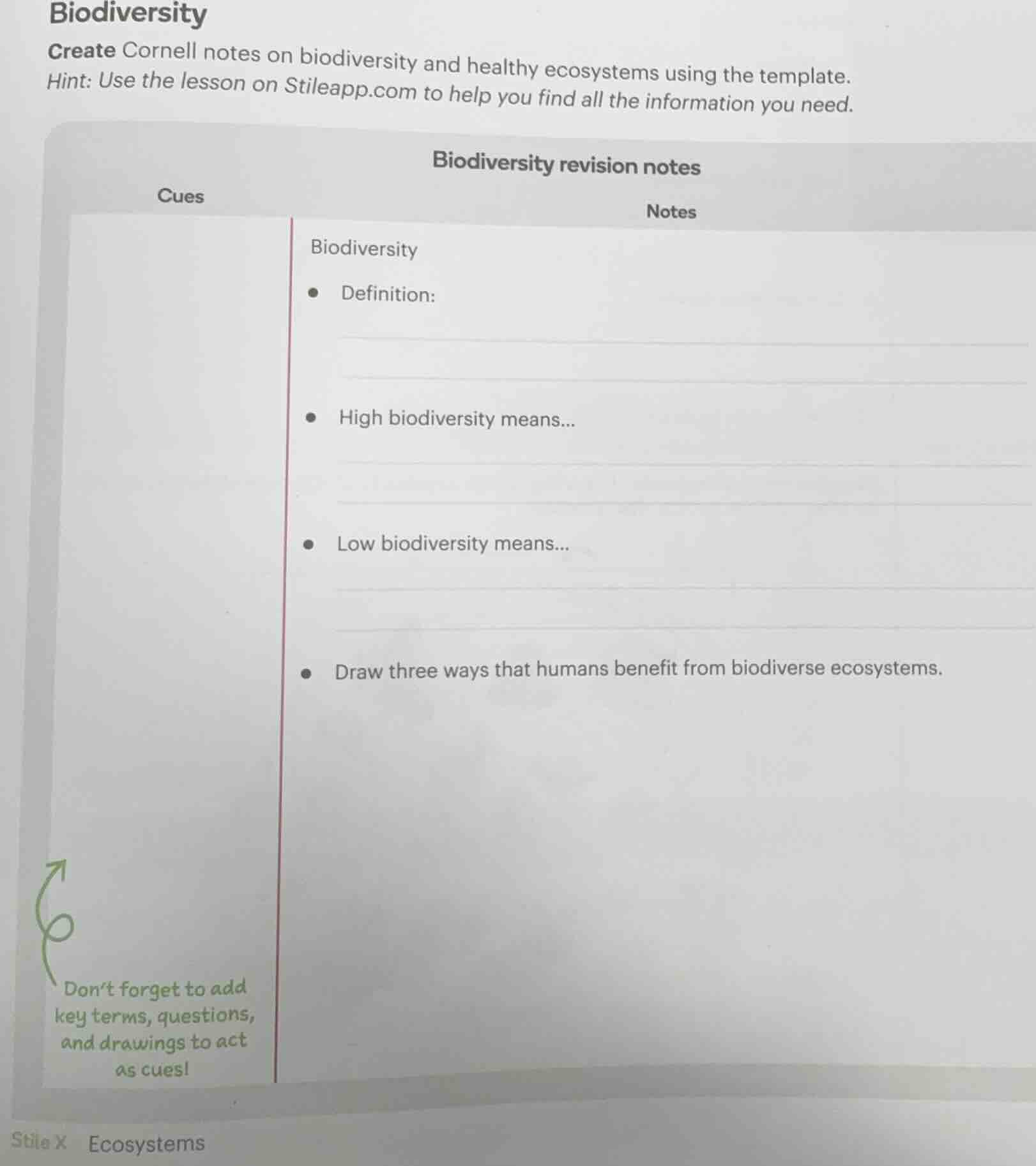
biodiversity
create cornell notes on biodiversity and healthy ecosystems using the template.
hint: use the lesson on stileapp.com to help you find all the information you need.
biodiversity revision notes
cues\tnotes
\tbiodiversity
\t- definition:
\t
\t- high biodiversity means...
\t
\t- low biodiversity means...
\t
\t- draw three ways that humans benefit from biodiverse ecosystems.
dont forget to add
key terms, questions,
and drawings to act
as cues!
stile x ecosystems
Brief Explanations
- Cues section includes key terms/questions to guide recall: Biodiversity Definition, High vs. Low Biodiversity, Ecosystem Services.
- Notes section fills in core details: Biodiversity is the variety of all living organisms in an ecosystem; high biodiversity means a stable, resilient ecosystem with many species; low biodiversity means a fragile ecosystem with few species, vulnerable to collapse. Human benefits include resource provision, natural regulation, and cultural value, represented with simple illustrations.

Snap & solve any problem in the app
Get step-by-step solutions on Sovi AI
Photo-based solutions with guided steps
Explore more problems and detailed explanations
Cues
- Biodiversity Definition?
- High Biodiversity Impacts?
- Low Biodiversity Impacts?
- Human Benefits from Biodiversity?
---
Notes
Biodiversity
- Definition: The total variety of all living organisms (species, genetic, ecosystem diversity) in a given area.
- High biodiversity means... An ecosystem with many different species, complex food webs, and high resilience to disturbances (e.g., wildfires, disease). It supports stable nutrient cycling and resource availability.
- Low biodiversity means... An ecosystem with very few species, simple food webs, and low resilience. It is easily disrupted by small changes, with high risk of collapse if a key species is lost.
- Three human benefits (with drawings):
- Provisioning Services: Drawing of a fruit tree + crop field → Biodiversity provides food, medicine, and raw materials.
- Regulating Services: Drawing of a bee pollinating a flower + a forest → Biodiversity regulates climate, pollinates crops, and purifies water/air.
- Cultural Services: Drawing of a hiker in a forest → Biodiversity supports recreation, spiritual value, and cultural practices.