QUESTION IMAGE
Question
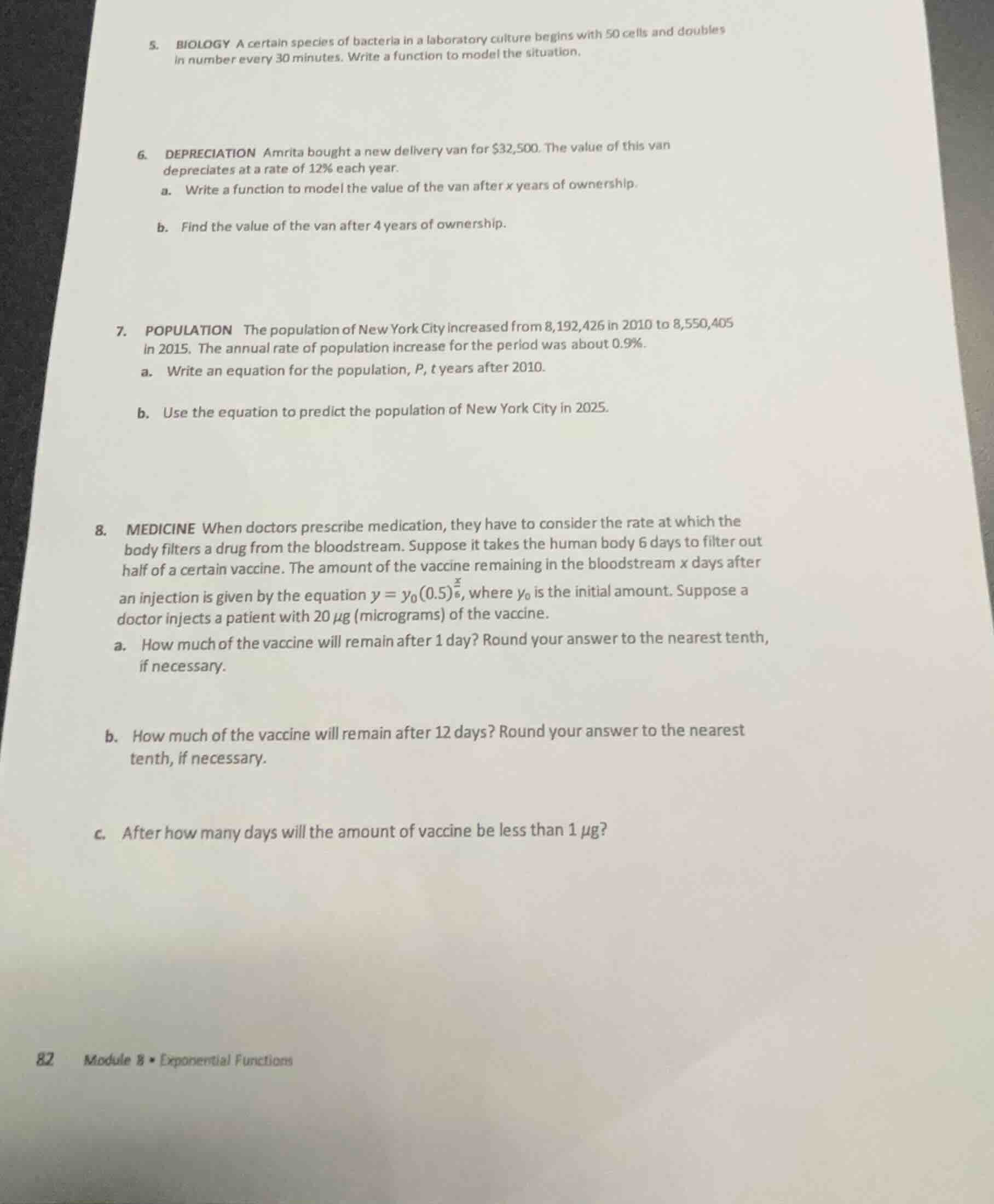
- biology a certain species of bacteria in a laboratory culture begins with 50 cells and doubles in number every 30 minutes. write a function to model the situation.
- depreciation amrita bought a new delivery van for $32,500. the value of this van depreciates at a rate of 12% each year.
a. write a function to model the value of the van after x years of ownership.
b. find the value of the van after 4 years of ownership.
- population the population of new york city increased from 8,192,426 in 2010 to 8,550,405 in 2015. the annual rate of population increase for the period was about 0.9%.
a. write an equation for the population, p, t years after 2010.
b. use the equation to predict the population of new york city in 2025.
- medicine when doctors prescribe medication, they have to consider the rate at which the body filters a drug from the bloodstream. suppose it takes the human body 6 days to filter out half of a certain vaccine. the amount of the vaccine remaining in the bloodstream x days after an injection is given by the equation $y = y_0(0.5)^{\frac{x}{6}}$, where $y_0$ is the initial amount. suppose a doctor injects a patient with 20 μg (micrograms) of the vaccine.
a. how much of the vaccine will remain after 1 day? round your answer to the nearest tenth, if necessary.
b. how much of the vaccine will remain after 12 days? round your answer to the nearest tenth, if necessary.
c. after how many days will the amount of vaccine be less than 1 μg?
82 module 8 • exponential functions
(Problem 5):
Step1: Identify exponential growth form
Exponential growth: $N(t) = N_0 \cdot 2^{\frac{t}{T}}$, where $N_0$=initial count, $T$=doubling time.
Step2: Plug in given values
$N_0=50$, $T=30$ minutes.
$N(t) = 50 \cdot 2^{\frac{t}{30}}$
(Problem 6):
Part a
Step1: Identify depreciation form
Exponential decay: $V(x) = V_0(1-r)^x$, $V_0$=initial value, $r$=decay rate.
Step2: Substitute given values
$V_0=32500$, $r=0.12$.
$V(x) = 32500(1-0.12)^x = 32500(0.88)^x$
Part b
Step1: Substitute $x=4$ into function
$V(4) = 32500(0.88)^4$
Step2: Calculate the value
$(0.88)^4 = 0.88\times0.88\times0.88\times0.88 \approx 0.5997$
$V(4) \approx 32500 \times 0.5997 \approx 19490.25$
(Problem 7):
Part a
Step1: Identify population growth form
Exponential growth: $P(t) = P_0(1+r)^t$, $P_0$=initial population, $r$=growth rate.
Step2: Substitute given values
$P_0=8192426$, $r=0.009$.
$P(t) = 8192426(1+0.009)^t = 8192426(1.009)^t$
Part b
Step1: Find $t$ for 2025
$t = 2025 - 2010 = 15$
Step2: Substitute $t=15$ into function
$P(15) = 8192426(1.009)^{15}$
Step3: Calculate the value
$(1.009)^{15} \approx 1.1435$
$P(15) \approx 8192426 \times 1.1435 \approx 9368039$
(Problem 8):
First, substitute $y_0=20$ into the given formula: $y = 20(0.5)^{\frac{x}{6}}$
Part a
Step1: Substitute $x=1$ into function
$y = 20(0.5)^{\frac{1}{6}}$
Step2: Calculate the value
$(0.5)^{\frac{1}{6}} \approx 0.8909$
$y \approx 20 \times 0.8909 \approx 17.8$
Part b
Step1: Substitute $x=12$ into function
$y = 20(0.5)^{\frac{12}{6}} = 20(0.5)^2$
Step2: Calculate the value
$y = 20 \times 0.25 = 5.0$
Part c
Step1: Set up inequality
$20(0.5)^{\frac{x}{6}} < 1$
Step2: Isolate the exponential term
$(0.5)^{\frac{x}{6}} < \frac{1}{20} = 0.05$
Step3: Take log of both sides
$\frac{x}{6} \log(0.5) < \log(0.05)$
Step4: Solve for $x$
$\frac{x}{6} > \frac{\log(0.05)}{\log(0.5)} \approx \frac{-1.3010}{-0.3010} = 4.32$
$x > 4.32 \times 6 = 25.92$

Snap & solve any problem in the app
Get step-by-step solutions on Sovi AI
Photo-based solutions with guided steps
Explore more problems and detailed explanations
(Problem 5):
$N(t) = 50 \cdot 2^{\frac{t}{30}}$, where $t$ is time in minutes.
---