QUESTION IMAGE
Question
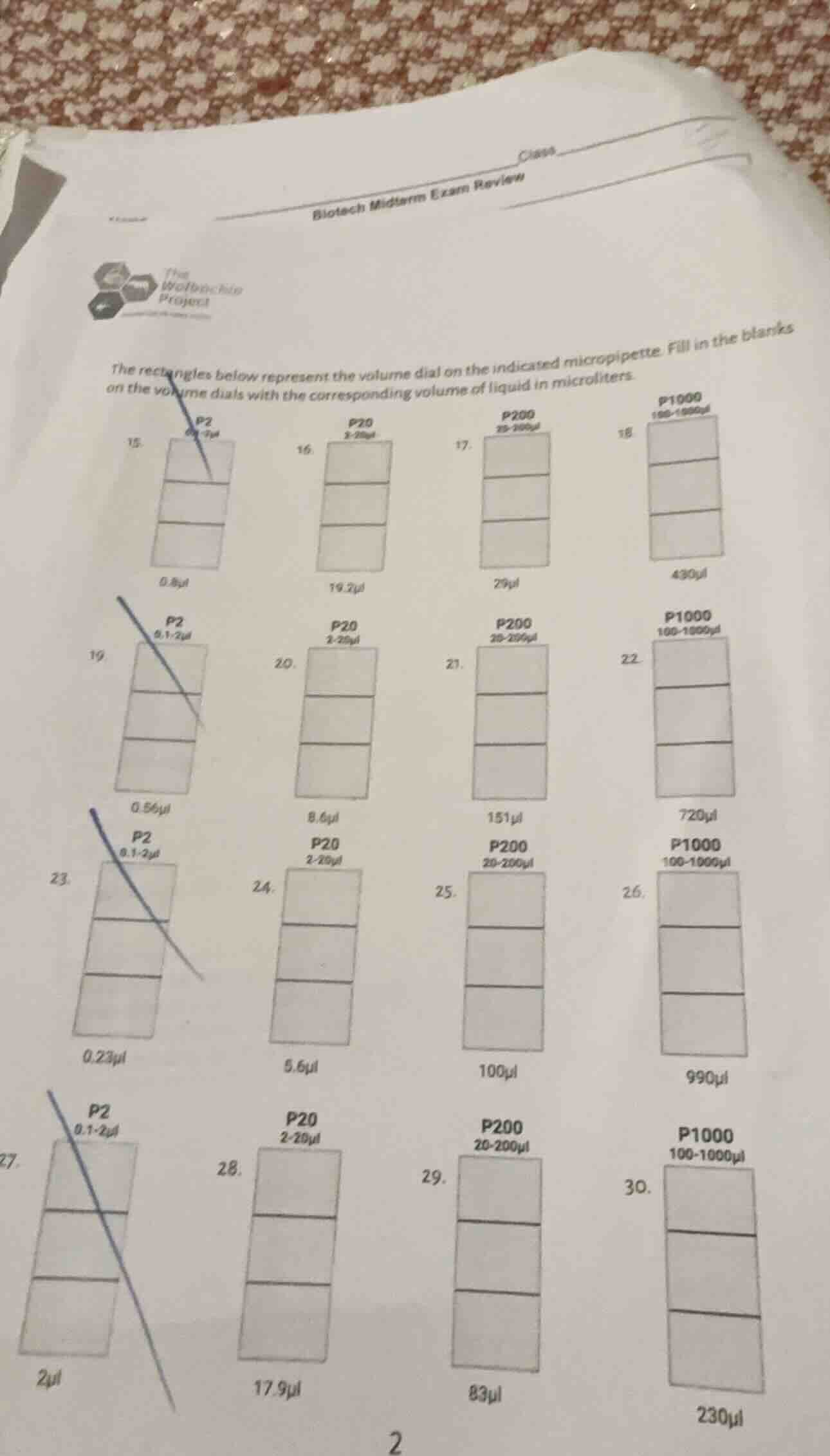
biotech midterm exam review the rectangles below represent the volume dial on the indicated micropipette. fill in the blanks on the volume dials with the corresponding volume of liquid in microliters. 15. p2 0.1 - 2μl 0.8μl 16. p20 2 - 20μl 19.2μl 17. p200 20 - 200μl 29μl 18. p1000 100 - 1000μl 430μl 19. p2 0.1 - 2μl 0.56μl 20. p20 2 - 20μl 8.6μl 21. p200 20 - 200μl 151μl 22. p1000 100 - 1000μl 720μl 23. p2 0.1 - 2μl 0.23μl 24. p20 2 - 20μl 5.6μl 25. p200 20 - 200μl 100μl 26. p1000 100 - 1000μl 990μl 27. p2 0.1 - 2μl 2μl 28. p20 2 - 20μl 17.9μl 29. p200 20 - 200μl 83μl 30. p1000 100 - 1000μl 230μl
To solve for the volume dials of each micropipette, we analyze the range and the given volume to determine the dial settings. Here's the step - by - step for a few examples (we'll take question 15 as an example, and the logic applies to others):
Question 15 (P2, 0 - 2 μl, volume = 0.8 μl)
Step 1: Understand the P2 micropipette range
The P2 micropipette has a range of 0 - 2 μl. The dial has three sections. For a volume of 0.8 μl, we need to set the dial such that the reading corresponds to 0.8.
Step 2: Determine the dial setting
Since the total range is 0 - 2 μl, and we want 0.8 μl. If we consider the three - section dial, we can think of it as dividing the range. The top section (usually the most significant digit for small ranges) would be set to 0 (for the 0 - 1 part of the range in some dial configurations), the middle section to 8 (representing 0.8 in the 0 - 1 μl sub - range), and the bottom section to 0 (or as per the dial's scaling). But more simply, for a P2 pipette, the dial is set so that the volume is read as 0.8. So the dial would have the top part at 0, middle at 8, bottom at 0 (depending on the pipette's dial layout where the middle digit is the tenths place for P2).
Question 16 (P20, 2 - 20 μl, volume = 19.2 μl)
Step 1: Analyze the P20 range
The P20 micropipette has a range of 2 - 20 μl. The dial has three sections, with the top section being the tens place, middle the ones, and bottom the tenths (in some cases).
Step 2: Set the dial
For 19.2 μl, the tens place (top section) is 1, the ones place (middle section) is 9, and the tenths place (bottom section) is 2. So the dial top is 1, middle is 9, bottom is 2.
Question 17 (P200, 20 - 200 μl, volume = 29 μl)
Step 1: Consider the P200 range
The P200 has a range of 20 - 200 μl. The top section is tens, middle is ones, bottom is tenths (but for whole numbers, tenths can be 0).
Step 2: Dial setting
For 29 μl, top section (tens) is 2, middle (ones) is 9, bottom (tenths) is 0. So dial top: 2, middle: 9, bottom: 0.
Question 18 (P1000, 100 - 1000 μl, volume = 430 μl)
Step 1: P1000 range analysis
The P1000 has a range of 100 - 1000 μl. The top section is hundreds, middle is tens, bottom is ones.
Step 2: Dial setting
For 430 μl, top (hundreds) is 4, middle (tens) is 3, bottom (ones) is 0. So dial top: 4, middle: 3, bottom: 0.
Question 19 (P2, 0.1 - 2 μl, volume = 0.56 μl)
Step 1: P2 (0.1 - 2 μl) range
This P2 variant has a range of 0.1 - 2 μl. The dial's middle section is the tenths place and the bottom is the hundredths place (or vice - versa depending on the pipette, but for 0.56, we need 0.5 (tenths) and 0.06 (hundredths)).
Step 2: Dial setting
So the top section (if it's the whole number part, which is 0 here), middle (tenths) is 5, bottom (hundredths) is 6. So dial top: 0, middle: 5, bottom: 6.
Question 20 (P20, 2 - 20 μl, volume = 8.6 μl)
Step 1: P20 range (2 - 20 μl)
Top section: 0 (since 8.6 is less than 10), middle (ones) is 8, bottom (tenths) is 6.
Step 2: Dial setting
Dial top: 0, middle: 8, bottom: 6.
Question 21 (P200, 20 - 200 μl, volume = 151 μl)
Step 1: P200 range (20 - 200 μl)
Top (hundreds - like, but since it's 20 - 200, the top is 1 (for 100 - 200 range), middle (tens) is 5, bottom (ones) is 1.
Step 2: Dial setting
Dial top: 1, middle: 5, bottom: 1.
Question 22 (P1000, 100 - 1000 μl, volume = 720 μl)
Step 1: P1000 range (100 - 1000 μl)
Top (hundreds) is 7, middle (tens) is 2, bottom (ones) is 0.
Step 2: Dial setting
Dial top: 7, middle: 2, bott…

Snap & solve any problem in the app
Get step-by-step solutions on Sovi AI
Photo-based solutions with guided steps
Explore more problems and detailed explanations
To solve for the volume dials of each micropipette, we analyze the range and the given volume to determine the dial settings. Here's the step - by - step for a few examples (we'll take question 15 as an example, and the logic applies to others):
Question 15 (P2, 0 - 2 μl, volume = 0.8 μl)
Step 1: Understand the P2 micropipette range
The P2 micropipette has a range of 0 - 2 μl. The dial has three sections. For a volume of 0.8 μl, we need to set the dial such that the reading corresponds to 0.8.
Step 2: Determine the dial setting
Since the total range is 0 - 2 μl, and we want 0.8 μl. If we consider the three - section dial, we can think of it as dividing the range. The top section (usually the most significant digit for small ranges) would be set to 0 (for the 0 - 1 part of the range in some dial configurations), the middle section to 8 (representing 0.8 in the 0 - 1 μl sub - range), and the bottom section to 0 (or as per the dial's scaling). But more simply, for a P2 pipette, the dial is set so that the volume is read as 0.8. So the dial would have the top part at 0, middle at 8, bottom at 0 (depending on the pipette's dial layout where the middle digit is the tenths place for P2).
Question 16 (P20, 2 - 20 μl, volume = 19.2 μl)
Step 1: Analyze the P20 range
The P20 micropipette has a range of 2 - 20 μl. The dial has three sections, with the top section being the tens place, middle the ones, and bottom the tenths (in some cases).
Step 2: Set the dial
For 19.2 μl, the tens place (top section) is 1, the ones place (middle section) is 9, and the tenths place (bottom section) is 2. So the dial top is 1, middle is 9, bottom is 2.
Question 17 (P200, 20 - 200 μl, volume = 29 μl)
Step 1: Consider the P200 range
The P200 has a range of 20 - 200 μl. The top section is tens, middle is ones, bottom is tenths (but for whole numbers, tenths can be 0).
Step 2: Dial setting
For 29 μl, top section (tens) is 2, middle (ones) is 9, bottom (tenths) is 0. So dial top: 2, middle: 9, bottom: 0.
Question 18 (P1000, 100 - 1000 μl, volume = 430 μl)
Step 1: P1000 range analysis
The P1000 has a range of 100 - 1000 μl. The top section is hundreds, middle is tens, bottom is ones.
Step 2: Dial setting
For 430 μl, top (hundreds) is 4, middle (tens) is 3, bottom (ones) is 0. So dial top: 4, middle: 3, bottom: 0.
Question 19 (P2, 0.1 - 2 μl, volume = 0.56 μl)
Step 1: P2 (0.1 - 2 μl) range
This P2 variant has a range of 0.1 - 2 μl. The dial's middle section is the tenths place and the bottom is the hundredths place (or vice - versa depending on the pipette, but for 0.56, we need 0.5 (tenths) and 0.06 (hundredths)).
Step 2: Dial setting
So the top section (if it's the whole number part, which is 0 here), middle (tenths) is 5, bottom (hundredths) is 6. So dial top: 0, middle: 5, bottom: 6.
Question 20 (P20, 2 - 20 μl, volume = 8.6 μl)
Step 1: P20 range (2 - 20 μl)
Top section: 0 (since 8.6 is less than 10), middle (ones) is 8, bottom (tenths) is 6.
Step 2: Dial setting
Dial top: 0, middle: 8, bottom: 6.
Question 21 (P200, 20 - 200 μl, volume = 151 μl)
Step 1: P200 range (20 - 200 μl)
Top (hundreds - like, but since it's 20 - 200, the top is 1 (for 100 - 200 range), middle (tens) is 5, bottom (ones) is 1.
Step 2: Dial setting
Dial top: 1, middle: 5, bottom: 1.
Question 22 (P1000, 100 - 1000 μl, volume = 720 μl)
Step 1: P1000 range (100 - 1000 μl)
Top (hundreds) is 7, middle (tens) is 2, bottom (ones) is 0.
Step 2: Dial setting
Dial top: 7, middle: 2, bottom: 0.
Question 23 (P2, 0.1 - 2 μl, volume = 0.23 μl)
Step 1: P2 range (0.1 - 2 μl)
Top: 0, middle (tenths) is 2, bottom (hundredths) is 3.
Step 2: Dial setting
Dial top: 0, middle: 2, bottom: 3.
Question 24 (P20, 2 - 20 μl, volume = 5.6 μl)
Step 1: P20 range (2 - 20 μl)
Top: 0, middle (ones) is 5, bottom (tenths) is 6.
Step 2: Dial setting
Dial top: 0, middle: 5, bottom: 6.
Question 25 (P200, 20 - 200 μl, volume = 100 μl)
Step 1: P200 range (20 - 200 μl)
Top: 1, middle: 0, bottom: 0.
Step 2: Dial setting
Dial top: 1, middle: 0, bottom: 0.
Question 26 (P1000, 100 - 1000 μl, volume = 990 μl)
Step 1: P1000 range (100 - 1000 μl)
Top: 9, middle: 9, bottom: 0.
Step 2: Dial setting
Dial top: 9, middle: 9, bottom: 0.
Question 27 (P2, 0.1 - 2 μl, volume = 2 μl)
Step 1: P2 range (0.1 - 2 μl)
Top: 2, middle: 0, bottom: 0 (since it's the maximum volume).
Step 2: Dial setting
Dial top: 2, middle: 0, bottom: 0.
Question 28 (P20, 2 - 20 μl, volume = 17.9 μl)
Step 1: P20 range (2 - 20 μl)
Top: 1, middle: 7, bottom: 9.
Step 2: Dial setting
Dial top: 1, middle: 7, bottom: 9.
Question 29 (P200, 20 - 200 μl, volume = 83 μl)
Step 1: P200 range (20 - 200 μl)
Top: 0 (since 83 is less than 100? No, wait, P200 is 20 - 200, so top is 0 (for 20 - 100? No, better: top (tens) is 8, middle (ones) is 3, bottom: 0. Wait, no, P200 dial: the top section is the tens place (2 - 200, so 20 - 200, so tens: 8 (for 80 - 90), ones: 3, bottom: 0. So dial top: 8, middle: 3, bottom: 0.
Step 2: Dial setting
Dial top: 8, middle: 3, bottom: 0.
Question 30 (P1000, 100 - 1000 μl, volume = 230 μl)
Step 1: P1000 range (100 - 1000 μl)
Top: 2, middle: 3, bottom: 0.
Step 2: Dial setting
Dial top: 2, middle: 3, bottom: 0.
For each question, the dial setting is determined by breaking down the volume into the appropriate digits (tens, ones, tenths, hundredths) based on the micropipette's range (P2: 0 - 2 μl, P20: 2 - 20 μl, P200: 20 - 200 μl, P1000: 100 - 1000 μl) and assigning them to the three sections of the dial.
If we take question 15 as a representative, the dial setting for P2 (0 - 2 μl) with volume 0.8 μl is: top section 0, middle section 8, bottom section 0 (depending on the pipette's dial layout where the middle digit is the tenths place for P2).
The answers for each question (dial settings) are as follows:
- Top: 0, Middle: 8, Bottom: 0
- Top: 1, Middle: 9, Bottom: 2
- Top: 2, Middle: 9, Bottom: 0
- Top: 4, Middle: 3, Bottom: 0
- Top: 0, Middle: 5, Bottom: 6
- Top: 0, Middle: 8, Bottom: 6
- Top: 1, Middle: 5, Bottom: 1
- Top: 7, Middle: 2, Bottom: 0
- Top: 0, Middle: 2, Bottom: 3
- Top: 0, Middle: 5, Bottom: 6
- Top: 1, Middle: 0, Bottom: 0
- Top: 9, Middle: 9, Bottom: 0
- Top: 2, Middle: 0, Bottom: 0
- Top: 1, Middle: 7, Bottom: 9
- Top: 8, Middle: 3, Bottom: 0
- Top: 2, Middle: 3, Bottom: 0
(Note: The exact dial section labels (top, middle, bottom) may vary slightly depending on the specific micropipette model, but the digit values for the volume are as calculated above.)