QUESTION IMAGE
Question
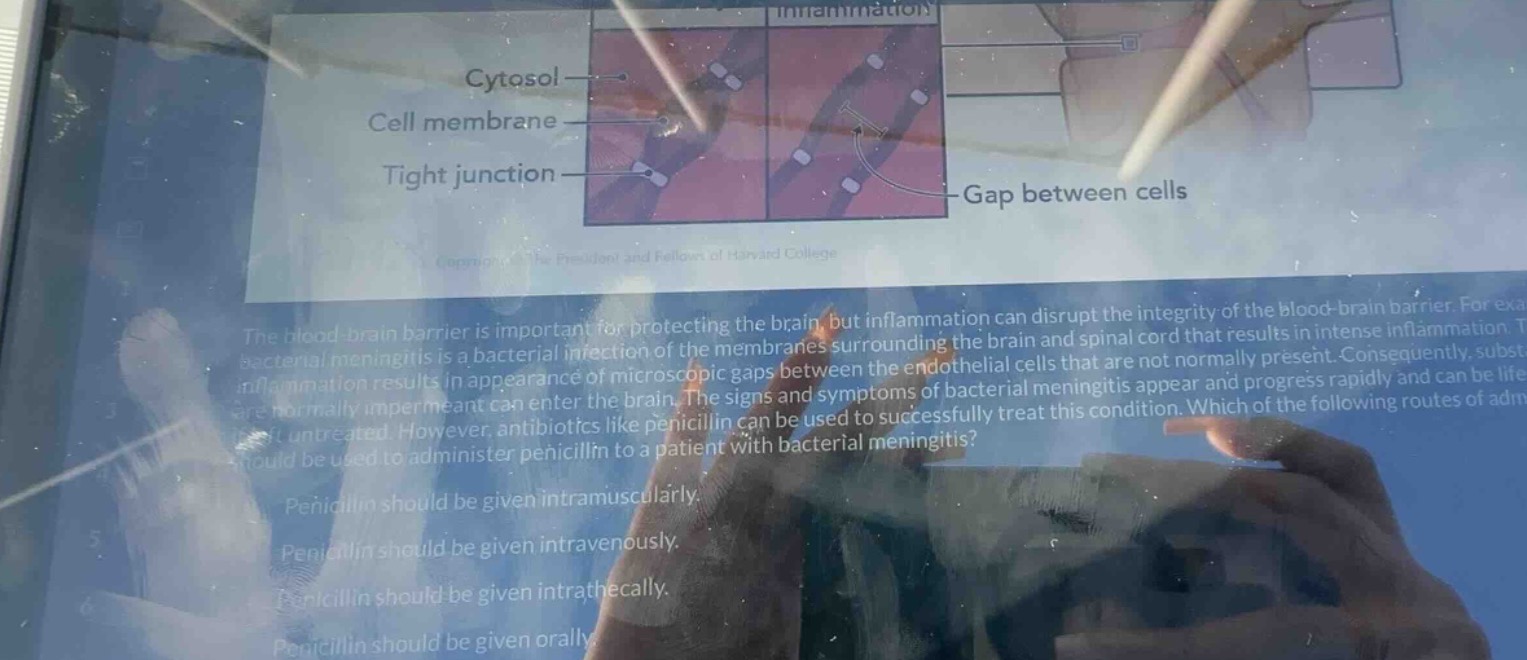
the blood - brain barrier is important for protecting the brain, but inflammation can disrupt the integrity of the blood - brain barrier. for exabacterial meningitis is a bacterial infection of the membranes surrounding the brain and spinal cord that results in intense inflammation. tinflammation results in appearance of microscopic gaps between the endothelial cells that are not normally present. consequently, substare normally impermeant can enter the brain. the signs and symptoms of bacterial meningitis appear and progress rapidly and can be lifeif untreated. however, antibiotics like penicillin can be used to successfully treat this condition. which of the following routes of admshould be used to administer penicillin to a patient with bacterial meningitis?penicillin should be given intramuscularly.penicillin should be given intravenously.penicillin should be given intrathecally.penicillin should be given orally.
Bacterial meningitis involves inflammation disrupting the blood - brain barrier, but the blood - brain barrier still restricts many substances. Oral administration has issues with absorption and first - pass metabolism, and intramuscular/intravenous may not get penicillin to the brain effectively. Intrathecal administration (directly into the cerebrospinal fluid) bypasses the blood - brain barrier and delivers penicillin to the site of infection (membranes around brain and spinal cord).

Snap & solve any problem in the app
Get step-by-step solutions on Sovi AI
Photo-based solutions with guided steps
Explore more problems and detailed explanations
Penicillin should be given intrathecally.