QUESTION IMAGE
Question
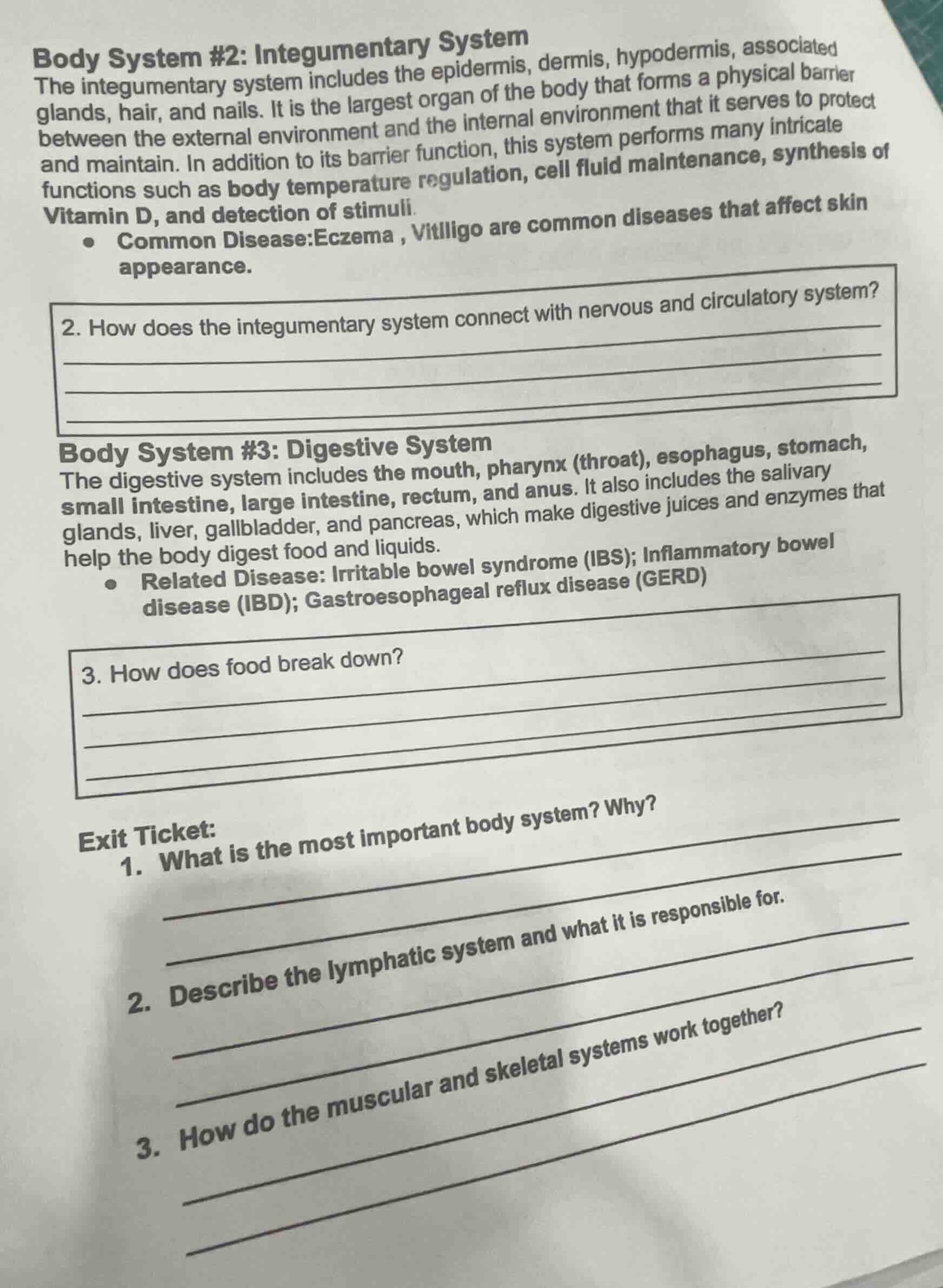
body system #2: integumentary system
the integumentary system includes the epidermis, dermis, hypodermis, associated
glands, hair, and nails. it is the largest organ of the body that forms a physical barrier
between the external environment and the internal environment that it serves to protect
and maintain. in addition to its barrier function, this system performs many intricate
functions such as body temperature regulation, cell fluid maintenance, synthesis of
vitamin d, and detection of stimuli.
- common disease:eczema, vitlligo are common diseases that affect skin
appearance.
- how does the integumentary system connect with nervous and circulatory system?
body system #3: digestive system
the digestive system includes the mouth, pharynx (throat), esophagus, stomach,
small intestine, large intestine, rectum, and anus. it also includes the salivary
glands, liver, gallbladder, and pancreas, which make digestive juices and enzymes that
help the body digest food and liquids.
- related disease: irritable bowel syndrome (ibs); inflammatory bowel
disease (ibd); gastroesophageal reflux disease (gerd)
- how does food break down?
exit ticket:
- what is the most important body system? why?
- describe the lymphatic system and what it is responsible for.
- how do the muscular and skeletal systems work together?
For Question 2 (Integumentary System Connections):
- With Nervous System: The integumentary system has sensory receptors (like touch, pain, temperature receptors) in the dermis that send signals to the nervous system. The nervous system also controls sweat gland activity and blood vessel dilation/constriction in the skin for temperature regulation.
- With Circulatory System: Blood vessels in the dermis supply nutrients to skin cells, carry away waste, and adjust blood flow to the skin to regulate body temperature (e.g., increasing flow to release heat, decreasing flow to retain heat).
For Question 3 (Food Breakdown):
Food breakdown happens via mechanical and chemical digestion:
- Mechanical Digestion: Physical breakdown of food (chewing in the mouth, churning in the stomach) to increase surface area.
- Chemical Digestion: Enzymes and acids break down large molecules into absorbable nutrients: salivary amylase breaks down carbs in the mouth; stomach acid and pepsin break down proteins; pancreatic enzymes and bile break down fats, carbs, and proteins in the small intestine.
For Exit Ticket Question 1:
There is no single "most important" system, but the nervous system is a strong candidate: it coordinates and regulates the function of all other body systems, processes sensory input, and controls voluntary/involuntary actions, allowing the body to respond to internal and external changes. All systems rely on its signaling to maintain homeostasis.
For Exit Ticket Question 2:
The lymphatic system is a network of vessels, nodes, organs (spleen, thymus, tonsils), and lymph fluid. It is responsible for: absorbing and transporting dietary fats from the small intestine, filtering pathogens and waste via lymph nodes, producing and circulating immune cells (lymphocytes) to fight infection, and maintaining fluid balance by returning excess interstitial fluid to the bloodstream.
For Exit Ticket Question 3:
The muscular and skeletal systems work together (the musculoskeletal system) to enable movement: skeletal muscles are attached to bones via tendons; when muscles contract, they pull on bones, causing them to move at joints. Additionally, muscles stabilize joints, and bones provide a rigid structure for muscles to act on, while also protecting internal organs.

Snap & solve any problem in the app
Get step-by-step solutions on Sovi AI
Photo-based solutions with guided steps
Explore more problems and detailed explanations
- Question 2 (Integumentary Connections):
- With the nervous system: Sensory receptors in the skin send touch, pain, and temperature signals to the nervous system; the nervous system controls skin functions like sweating and blood flow for temperature regulation.
- With the circulatory system: Blood vessels in the skin supply nutrients to skin cells, remove waste, and adjust blood flow to regulate body temperature.
- Question 3 (Food Breakdown):
Food breaks down through mechanical digestion (chewing, stomach churning to physically reduce food size) and chemical digestion (enzymes/acids break large molecules into absorbable nutrients: salivary amylase for carbs, stomach acid/pepsin for proteins, pancreatic enzymes/bile for fats, carbs, and proteins in the small intestine).
- Exit Ticket Question 1:
There is no universally agreed-upon "most important" body system, but the nervous system is a top candidate. It coordinates and regulates all other body systems, processes sensory input, controls voluntary and involuntary actions, and maintains homeostasis by signaling between systems.
- Exit Ticket Question 2:
The lymphatic system is a network of vessels, nodes, and organs (spleen, thymus, tonsils) with lymph fluid. It absorbs dietary fats, filters pathogens/waste via lymph nodes, produces immune cells to fight infection, and returns excess body fluid to the bloodstream.
- Exit Ticket Question 3:
Skeletal muscles attach to bones via tendons; when muscles contract, they pull on bones to create movement at joints. Muscles also stabilize joints, while bones provide a rigid structure for muscles to act on and protect internal organs.