QUESTION IMAGE
Question
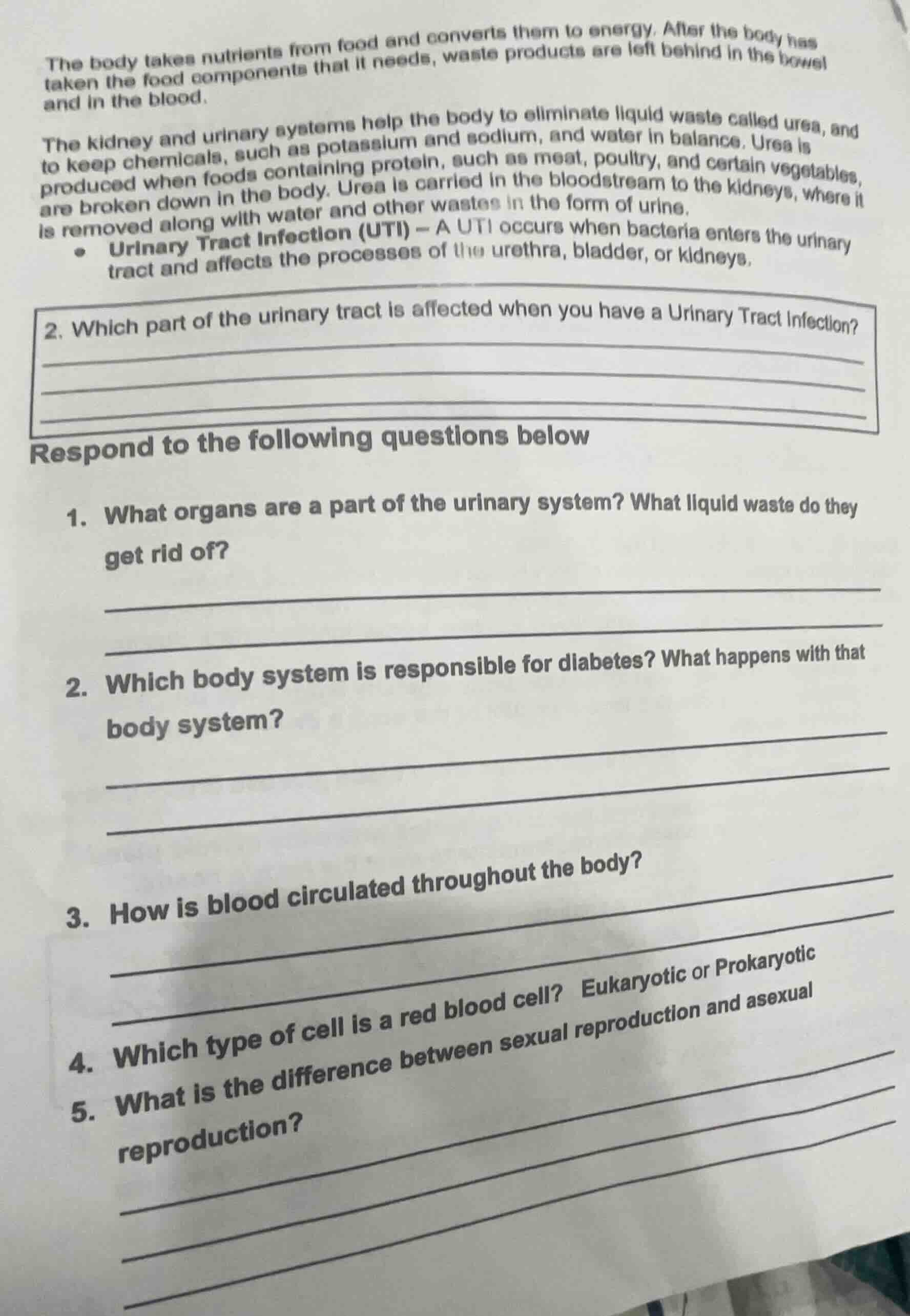
the body takes nutrients from food and converts them to energy. after the body has taken the food components that it needs, waste products are left behind in the bowel and in the blood.
the kidney and urinary systems help the body to eliminate liquid waste called urea, and to keep chemicals, such as potassium and sodium, and water in balance. urea is produced when foods containing protein, such as meat, poultry, and certain vegetables, are broken down in the body. urea is carried in the bloodstream to the kidneys, where it is removed along with water and other wastes in the form of urine.
- urinary tract infection (uti) – a uti occurs when bacteria enters the urinary tract and affects the processes of the urethra, bladder, or kidneys.
- which part of the urinary tract is affected when you have a urinary tract infection?
respond to the following questions below
- what organs are a part of the urinary system? what liquid waste do they get rid of?
- which body system is responsible for diabetes? what happens with that body system?
- how is blood circulated throughout the body?
- which type of cell is a red blood cell? eukaryotic or prokaryotic
- what is the difference between sexual reproduction and asexual reproduction?
For the UTI question:
The text explicitly states which urinary tract parts are affected by a UTI.
For question 1:
The text identifies the key organ of the urinary system and the liquid waste it eliminates, with standard knowledge filling out the full urinary system organs.
For question 2:
Diabetes is linked to the endocrine system, specifically issues with insulin production/response.
For question 3:
Blood circulation relies on the heart as the pump, moving blood through vessels to deliver nutrients and oxygen.
For question 4:
Red blood cells are eukaryotic cells (they originate from eukaryotic stem cells, even though mature ones lack a nucleus).
For question 5:
The core difference between sexual and asexual reproduction is the involvement of gametes and genetic diversity.

Snap & solve any problem in the app
Get step-by-step solutions on Sovi AI
Photo-based solutions with guided steps
Explore more problems and detailed explanations
- (Boxed UTI question): The urethra, bladder, or kidneys
- (Respond to questions below):
- The urinary system includes the kidneys, ureters, bladder, and urethra. They eliminate liquid waste in the form of urine (which contains urea, water, and other wastes).
- The endocrine system (specifically the pancreas) is responsible for diabetes. In this system, the pancreas either does not produce enough insulin (Type 1) or the body's cells do not respond properly to insulin (Type 2), leading to high blood glucose levels.
- Blood is circulated by the heart, which pumps oxygen-rich blood from the lungs out through arteries to all body tissues. Deoxygenated blood returns to the heart through veins, then is sent to the lungs to pick up oxygen again, repeating the cycle.
- A red blood cell is a eukaryotic cell.
- Sexual reproduction involves two parent organisms, requires the fusion of gametes (sex cells), and produces offspring with a unique combination of genetic material from both parents. Asexual reproduction involves only one parent, no gamete fusion, and produces genetically identical offspring (clones) of the parent.