QUESTION IMAGE
Question
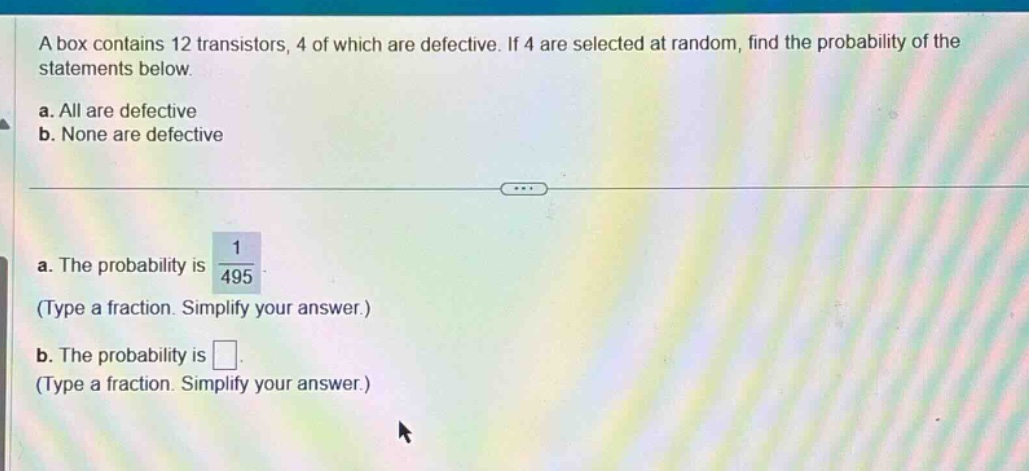
a box contains 12 transistors, 4 of which are defective. if 4 are selected at random, find the probability of the statements below.
a. all are defective
b. none are defective
a. the probability is \\(\frac{1}{495}\\)
(type a fraction. simplify your answer.)
b. the probability is \\(square\\)
(type a fraction. simplify your answer.)
Step1: Calculate total number of ways to select 4 transistors from 12.
The formula for combinations is \( C(n, k)=\frac{n!}{k!(n - k)!} \), where \( n = 12 \) and \( k = 4 \).
\[
C(12, 4)=\frac{12!}{4!(12 - 4)!}=\frac{12!}{4!8!}=\frac{12\times11\times10\times9}{4\times3\times2\times1}=495
\]
Step2: Calculate number of ways to select 4 non - defective transistors.
There are \( 12-4 = 8 \) non - defective transistors. We want to select 4 from these 8. Using the combination formula with \( n = 8 \) and \( k = 4 \).
\[
C(8, 4)=\frac{8!}{4!(8 - 4)!}=\frac{8!}{4!4!}=\frac{8\times7\times6\times5}{4\times3\times2\times1}=70
\]
Step3: Calculate the probability.
The probability that none are defective is the number of favorable outcomes (selecting 4 non - defective) divided by the number of total outcomes (selecting 4 from 12). So the probability \( P=\frac{C(8, 4)}{C(12, 4)}=\frac{70}{495}=\frac{14}{99} \) (simplifying by dividing numerator and denominator by 5).

Snap & solve any problem in the app
Get step-by-step solutions on Sovi AI
Photo-based solutions with guided steps
Explore more problems and detailed explanations
\(\frac{14}{99}\)