QUESTION IMAGE
Question
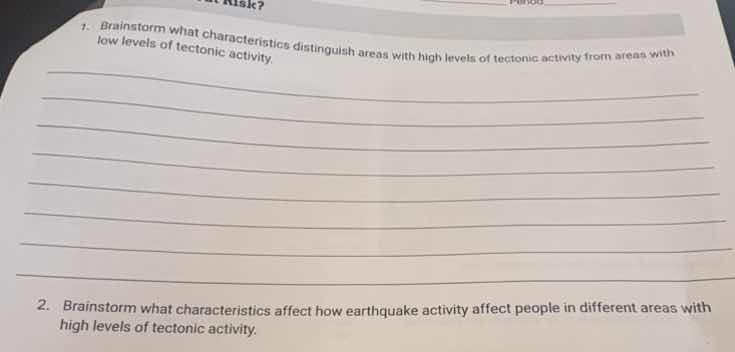
- brainstorm what characteristics distinguish areas with high levels of tectonic activity from areas with low levels of tectonic activity
- brainstorm what characteristics affect how earthquake activity affect people in different areas with high levels of tectonic activity.
Brief Explanations
For question 1: High tectonic activity areas are defined by frequent seismic/volcanic events, proximity to plate boundaries, and visible surface deformation. Low activity areas have rare earthquakes/volcanoes, lie far from plate edges, and stable crust.
For question 2: Factors include population density, building infrastructure quality, early warning systems, emergency preparedness, local geology (e.g., soil type amplifying shaking), and access to post-disaster resources.

Snap & solve any problem in the app
Get step-by-step solutions on Sovi AI
Photo-based solutions with guided steps
Explore more problems and detailed explanations
- High tectonic activity area characteristics:
- Frequent earthquakes, volcanic eruptions, or aftershocks
- Located near tectonic plate boundaries (divergent, convergent, transform)
- Visible surface features: fault lines, folded rock, volcanic landforms
- Regular ground deformation (measured via GPS or satellite)
- High seismic hazard mapping ratings
Low tectonic activity area characteristics:
- Rare or no recorded major earthquakes/volcanic activity
- Located in the interior of tectonic plates (stable cratons)
- Minimal visible crustal deformation or faulting
- Low seismic hazard mapping ratings
- Geologically stable, ancient bedrock formations
- Characteristics affecting earthquake impact on people in high tectonic activity areas:
- Population density (more people = higher potential casualties)
- Building construction standards (earthquake-resistant vs. non-resistant structures)
- Availability of early warning systems
- Community emergency preparedness (drills, emergency kits, evacuation plans)
- Local geology (soft soils amplify shaking; bedrock reduces it)
- Access to emergency services and medical care
- Infrastructure resilience (roads, bridges, power/water systems)
- Socioeconomic status (resources for recovery, insurance access)