QUESTION IMAGE
Question
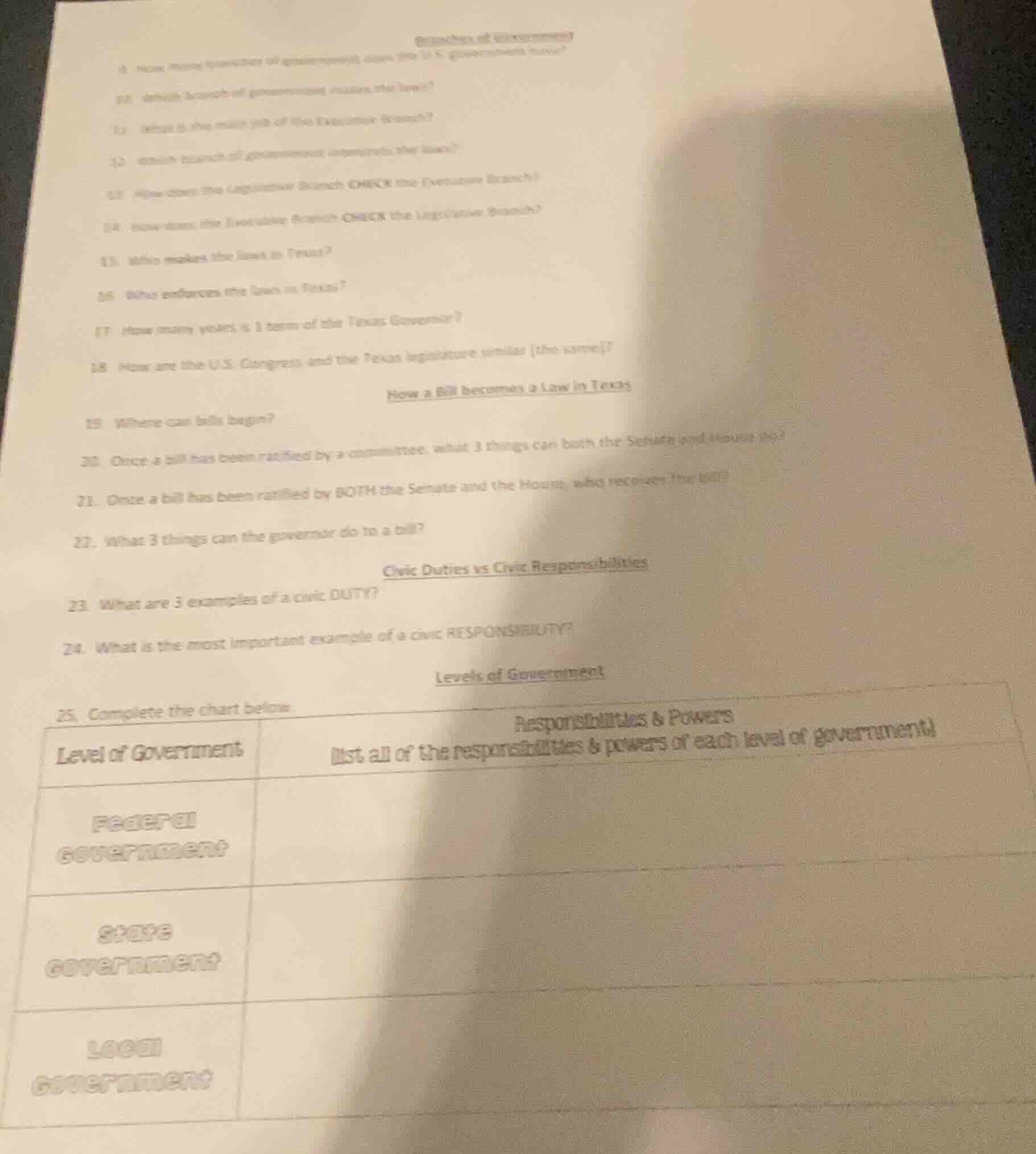
branches of government
- how many branches of government does the u.s. government have?
- which branch of government makes the laws?
- what is the main job of the executive branch?
- which branch of government enforces the laws?
- how does the legislative branch check the executive branch?
- how does the executive branch check the legislative branch?
- who makes the laws in texas?
- who enforces the laws in texas?
- how many years is 1 term of the texas governor?
- how are the u.s. congress and the texas legislature similar the same?
how a bill becomes a law in texas
- where can bills begin?
- once a bill has been ratified by a committee, what 3 things can both the senate and house do?
- once a bill has been ratified by both the senate and the house, who receives the bill?
- what 3 things can the governor do to a bill?
civic duties vs civic responsibilities
- what are 3 examples of a civic duty?
- what is the most important example of a civic responsibility?
levels of government
- complete the chart below.
level of government | responsibilities & powers (list all of the responsibilities & powers of each level of government)
federal government |
state government |
local government |

Snap & solve any problem in the app
Get step-by-step solutions on Sovi AI
Photo-based solutions with guided steps
Explore more problems and detailed explanations
- The U.S. government has 3 branches: Legislative, Executive, and Judicial.
- The Legislative Branch makes the laws.
- The main job of the Executive Branch is to enforce and carry out the laws.
- The Judicial Branch interprets the laws.
- The Legislative Branch can check the Executive Branch by overriding vetoes, impeaching and removing officials, and controlling funding.
- The Executive Branch can check the Legislative Branch by vetoing bills, calling special sessions, and using executive orders.
- The Texas Legislature (Texas Senate and Texas House of Representatives) makes the laws in Texas.
- The Governor of Texas and state executive agencies enforce the laws in Texas.
- A term of the Texas Governor is 4 years.
- Both are bicameral (have two chambers: Senate and House of Representatives) and are responsible for making laws.
- Bills can begin in either the Texas House of Representatives or the Texas Senate.
- They can amend the bill, debate the bill, and vote on the bill.
- The governor receives the bill.
- The governor can sign the bill into law, veto the bill, or allow it to become law without signing it.
- Examples: Paying taxes, serving on a jury, obeying laws.
- Voting (or participating in the democratic process).
- Federal Government: Print money, declare war, regulate interstate and foreign trade, establish post offices, create federal courts.
State Government: Regulate intrastate trade, establish local governments, conduct elections, provide public education, regulate marriage and divorce.
Local Government: Manage local schools, maintain local roads and parks, provide police and fire protection, manage local zoning, collect local taxes.