QUESTION IMAGE
Question
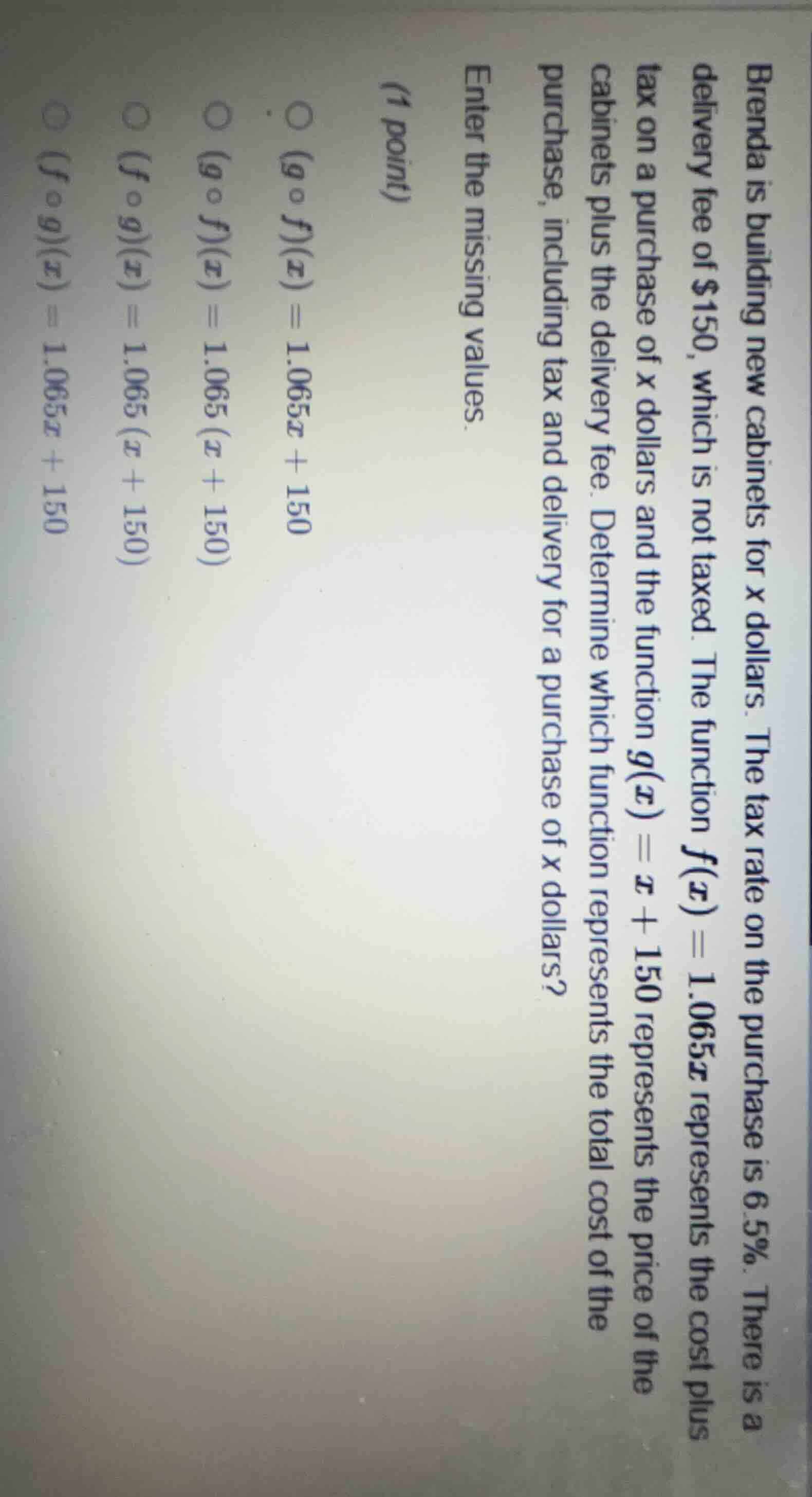
brenda is building new cabinets for x dollars. the tax rate on the purchase is 6.5%. there is a delivery fee of $150, which is not taxed. the function ( f(x) = 1.065x ) represents the cost plus tax on a purchase of x dollars and the function ( g(x) = x + 150 ) represents the price of the cabinets plus the delivery fee. determine which function represents the total cost of the purchase, including tax and delivery for a purchase of x dollars? enter the missing values. (1 point) ( (g circ f)(x) = 1.065x + 150 ) ( (g circ f)(x) = 1.065(x + 150) ) ( (f circ g)(x) = 1.065(x + 150) ) ( (f circ g)(x) = 1.065x + 150 )
Step1: Understand the functions
We have two functions: \( g(x)=x + 150 \) (price of cabinets plus delivery fee) and \( f(x)=1.065x \) (cost plus tax on a purchase). We need to find the composition that represents the total cost including tax and delivery. The total cost should first add the delivery fee to the cabinet price (using \( g(x) \)) and then apply the tax (using \( f(x) \)). So we need to find \( (f\circ g)(x) \), which means \( f(g(x)) \).
Step2: Compute \( f(g(x)) \)
Substitute \( g(x) \) into \( f(x) \). Since \( g(x)=x + 150 \), we replace \( x \) in \( f(x) \) with \( x + 150 \). So \( f(g(x))=f(x + 150)=1.065(x + 150) \).

Snap & solve any problem in the app
Get step-by-step solutions on Sovi AI
Photo-based solutions with guided steps
Explore more problems and detailed explanations
\( (f \circ g)(x) = 1.065(x + 150) \) (corresponding to the option \( (f \circ g)(x) = 1.065(x + 150) \))