QUESTION IMAGE
Question
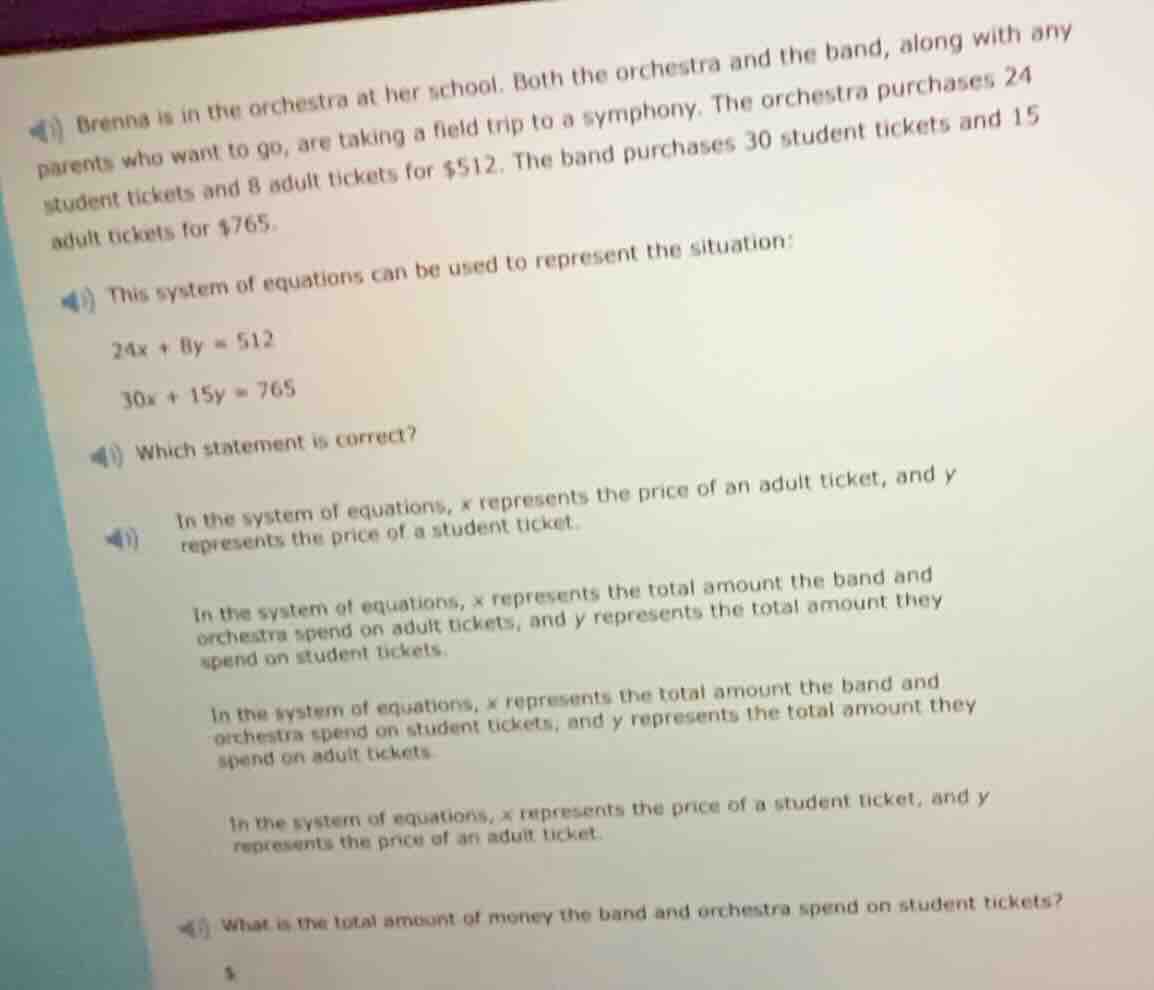
brenna is in the orchestra at her school. both the orchestra and the band, along with any parents who want to go, are taking a field trip to a symphony. the orchestra purchases 24 student tickets and 8 adult tickets for $512. the band purchases 30 student tickets and 15 adult tickets for $765. this system of equations can be used to represent the situation: $24x + 8y = 512$ $30x + 15y = 765$ which statement is correct? in the system of equations, x represents the price of an adult ticket, and y represents the price of a student ticket. in the system of equations, x represents the total amount the band and orchestra spend on adult tickets, and y represents the total amount they spend on student tickets. in the system of equations, x represents the total amount the band and orchestra spend on student tickets, and y represents the total amount they spend on adult tickets. in the system of equations, x represents the price of a student ticket, and y represents the price of an adult ticket. what is the total amount of money the band and orchestra spend on student tickets?
Part 1: Analyzing the System of Equations Variables
To determine what \( x \) and \( y \) represent, we analyze the context. The orchestra buys 24 student tickets and 8 adult tickets, and the band buys 30 student tickets and 15 adult tickets. The equations are \( 24x + 8y = 512 \) (orchestra's total cost) and \( 30x + 15y = 765 \) (band's total cost). In a ticket - pricing context, the number of tickets multiplied by the price per ticket gives the total cost. So, if \( x \) is multiplied by the number of student tickets (24 for orchestra, 30 for band) and \( y \) is multiplied by the number of adult tickets (8 for orchestra, 15 for band), then \( x \) represents the price of a student ticket and \( y \) represents the price of an adult ticket.
Let's analyze the other options:
- Option 1: If \( x \) were the price of an adult ticket, it should be multiplied by the number of adult tickets, but in the equations, \( x \) is multiplied by the number of student tickets (24, 30), so this is incorrect.
- Option 2: \( x \) is multiplied by the number of student tickets, not the total amount spent on adult tickets, so this is incorrect.
- Option 3: \( x \) is multiplied by the number of student tickets, not the total amount spent on student tickets (the total amount spent on student tickets would be \( 24x+30x\)), so this is incorrect.
So the correct statement is "In the system of equations, \( x \) represents the price of a student ticket, and \( y \) represents the price of an adult ticket."
Part 2: Solving for the Total Amount Spent on Student Tickets
First, we solve the system of equations \(
\)
We can simplify the first equation by dividing through by 8: \( 3x + y=64 \), so \( y = 64 - 3x \)
Substitute \( y = 64 - 3x \) into the second equation \( 30x+15y = 765 \)
\( 30x+15(64 - 3x)=765 \)
Step 1: Expand the equation
\( 30x+960 - 45x=765 \)
Step 2: Combine like terms
\( - 15x=765 - 960=-195 \)
Step 3: Solve for \( x \)
\( x=\frac{- 195}{-15}=13 \)
The number of student tickets bought by orchestra is 24 and by band is 30. The total number of student tickets is \( 24 + 30=54 \)
The price per student ticket \( x = 13 \)
The total amount spent on student tickets is \( 54\times13 = 702 \)
Step 1: Solve the system of equations to find \( x \) (price of student ticket)
First, simplify the first equation \( 24x + 8y = 512\) by dividing by 8: \(3x + y=64\), so \(y = 64 - 3x\). Substitute into the second equation \(30x+15y = 765\): \(30x + 15(64 - 3x)=765\). Expand: \(30x+960 - 45x=765\). Combine like terms: \(-15x=-195\). Solve for \(x\): \(x = 13\).
Step 2: Calculate the total number of student tickets
The orchestra buys 24 student tickets and the band buys 30 student tickets. Total student tickets \(=24 + 30=54\).
Step 3: Calculate the total amount spent on student tickets
Total amount \(=54\times x\). Since \(x = 13\), total amount \(=54\times13 = 702\).

Snap & solve any problem in the app
Get step-by-step solutions on Sovi AI
Photo-based solutions with guided steps
Explore more problems and detailed explanations
s
- For the "Which statement is correct?" question: