QUESTION IMAGE
Question
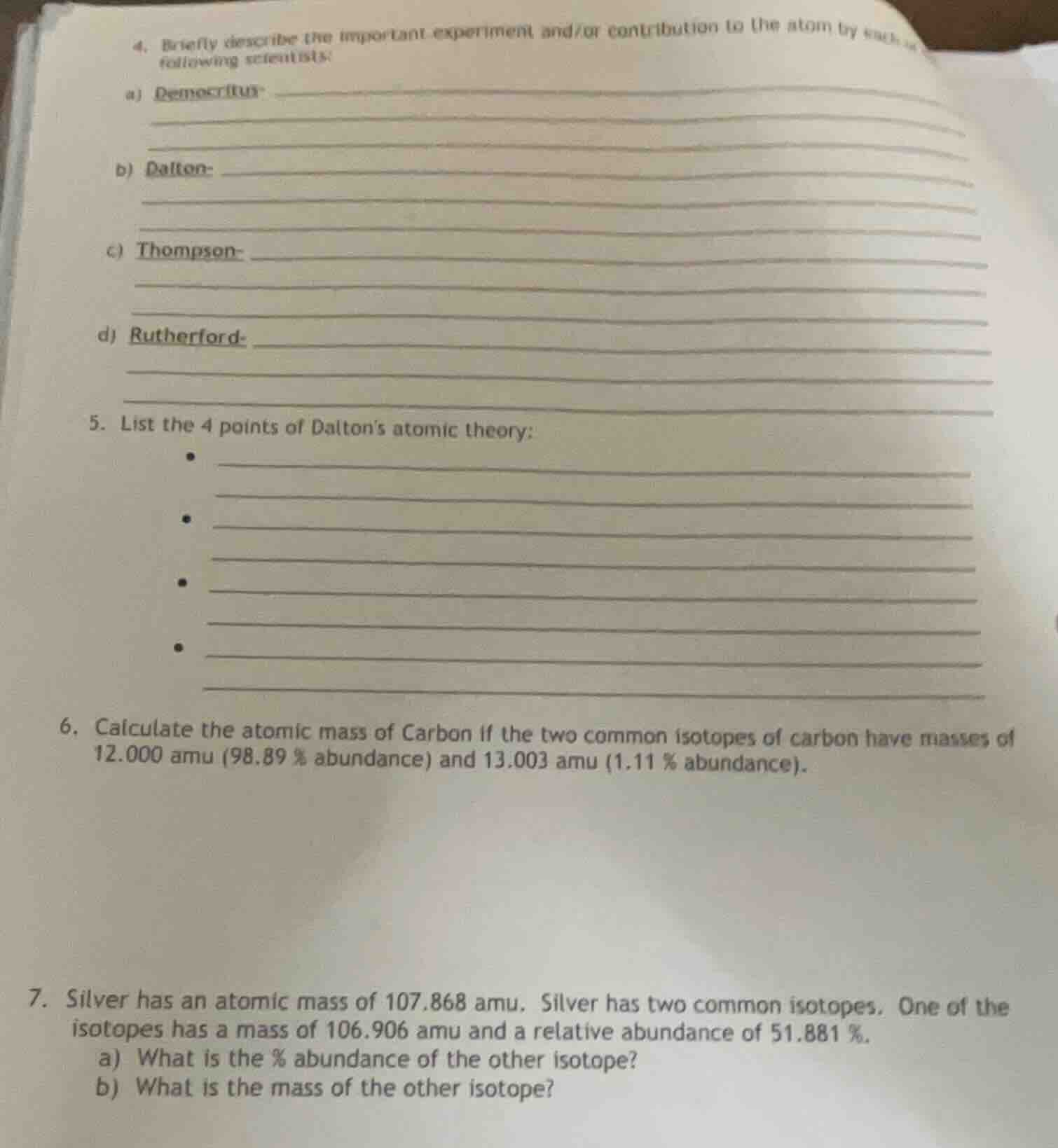
- briefly describe the important experiment and/or contribution to the atom by each of the following scientists:
a) democritus
b) dalton:
c) thompson:
d) rutherford:
- list the 4 points of daltons atomic theory:
- calculate the atomic mass of carbon if the two common isotopes of carbon have masses of 12.000 amu (98.89 % abundance) and 13.003 amu (1.11 % abundance).
- silver has an atomic mass of 107.868 amu. silver has two common isotopes. one of the isotopes has a mass of 106.906 amu and a relative abundance of 51.881 %.
a) what is the % abundance of the other isotope?
b) what is the mass of the other isotope?
Step 1: Democritus' atomic contribution
Proposed the first atomic model: stated all matter is made of indivisible, indestructible tiny particles called "atomos" (atoms), with different properties based on shape/size.
Step 2: Dalton's atomic contribution
Developed the first scientific atomic theory, formalizing atomic concepts based on experimental evidence.
Step 3: Thompson's atomic contribution
Discovered electrons via cathode ray experiments; proposed the "plum pudding" atomic model, where negatively charged electrons are embedded in a positively charged sphere.
Step 4: Rutherford's atomic contribution
Conducted the gold foil experiment, which proved atoms have a dense, positively charged central nucleus, with electrons orbiting it.
Step 5: List Dalton's 4 atomic theory points
- All matter is composed of indivisible atoms.
- Atoms of the same element are identical in mass and properties; atoms of different elements differ.
- Atoms combine in simple whole-number ratios to form compounds.
- Atoms are neither created nor destroyed in chemical reactions (conservation of mass).
Step 6: Calculate carbon's atomic mass
First, convert percentages to decimals, then multiply each isotope mass by its abundance, sum the results.
$\text{Atomic Mass} = (12.000 \times 0.9889) + (13.003 \times 0.0111)$
$\text{Atomic Mass} = 11.8668 + 0.1443 = 12.0111$
Step 7: Find silver's other isotope abundance
Total isotope abundance = 100%, subtract the known abundance.
$\text{Abundance} = 100\% - 51.881\% = 48.119\%$
Step 8: Find silver's other isotope mass
Let $x$ = mass of the unknown isotope. Use the atomic mass formula, solve for $x$.
$107.868 = (106.906 \times 0.51881) + (x \times 0.48119)$
$107.868 = 55.464 + 0.48119x$
$0.48119x = 107.868 - 55.464 = 52.404$
$x = \frac{52.404}{0.48119} = 108.905$

Snap & solve any problem in the app
Get step-by-step solutions on Sovi AI
Photo-based solutions with guided steps
Explore more problems and detailed explanations
Question 4
a) Democritus: First proposed that all matter is made of indivisible, indestructible particles called atoms (named "atomos").
b) Dalton: Developed the first scientific atomic theory, establishing foundational rules for atomic behavior and composition.
c) Thompson: Discovered electrons using cathode ray experiments; proposed the plum pudding atomic model.
d) Rutherford: Used the gold foil experiment to prove atoms have a dense, positively charged central nucleus with orbiting electrons.
Question 5
- All matter is made of indivisible atoms.
- Atoms of the same element are identical; different elements have unique atoms.
- Atoms combine in whole-number ratios to form compounds.
- Atoms are not created/destroyed in chemical reactions.
Question 6
12.01 amu (rounded to 4 significant figures)
Question 7
a) 48.119%
b) 108.905 amu