QUESTION IMAGE
Question
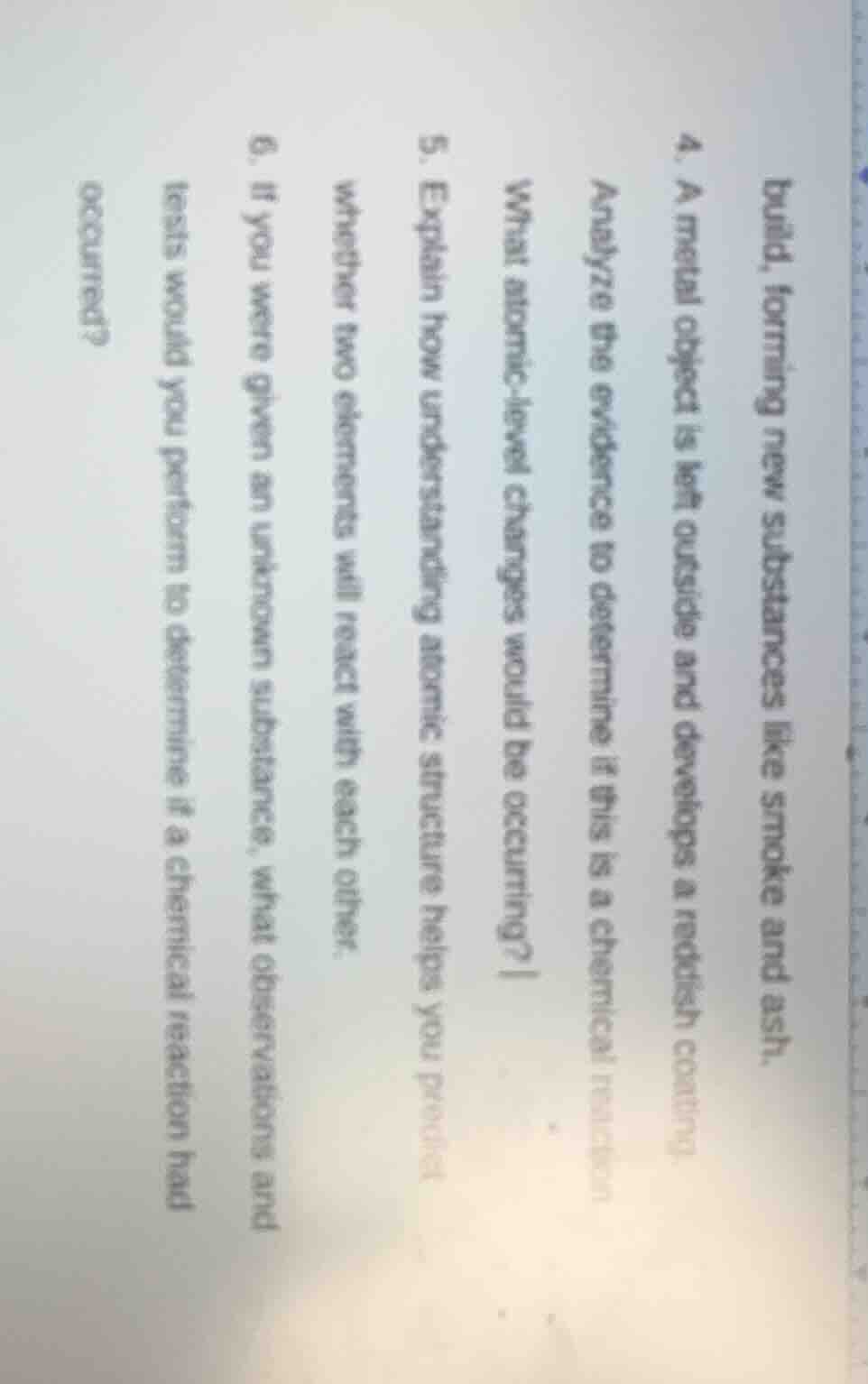
build, forming new substances like smoke and ash.
- a metal object is left outside and develops a reddish coating. analyze the evidence to determine if this is a chemical reaction. what atomic - level changes would be occurring?
- explain how understanding atomic structure helps you predict whether two elements will react with each other.
- if you were given an unknown substance, what observations and tests would you perform to determine if a chemical reaction had occurred?
Brief Explanations
Question 4:
- The reddish coating (rust, e.g., $\text{Fe}_2\text{O}_3$ for iron) is a new substance, so it is a chemical reaction. At the atomic level, metal atoms lose electrons (oxidation) to form positive ions, which combine with oxygen atoms from the air to form the ionic oxide coating.
Question 5:
- An element's reactivity depends on its valence electrons (outer shell electrons) and atomic radius. Elements with incomplete valence shells (e.g., group 1/2 metals with 1-2 valence electrons, group 17 nonmetals with 7 valence electrons) tend to react to fill their shells. Smaller atomic radius (for metals) means easier electron loss; larger radius (for nonmetals) means easier electron gain. This helps predict if two elements will transfer/share electrons to form compounds.
Question 6:
- First, observe for visible signs: color change, gas production, precipitate formation. Then, perform tests: measure properties (melting point, boiling point, solubility) of the original and final material—if they differ, a new substance formed. Test for pH changes, or use chemical tests (e.g., flame tests for metal ions) to identify new chemical species. Compare the chemical composition of the starting and ending materials using techniques like spectroscopy if available.

Snap & solve any problem in the app
Get step-by-step solutions on Sovi AI
Photo-based solutions with guided steps
Explore more problems and detailed explanations
- For Question 4:
- This is a chemical reaction; atomic-level changes include oxidation of metal atoms.
- For Question 5:
- Atomic structure (valence electrons, atomic radius) predicts reactivity.
- For Question 6:
- Observe for new substances; test properties like pH, melting point.