QUESTION IMAGE
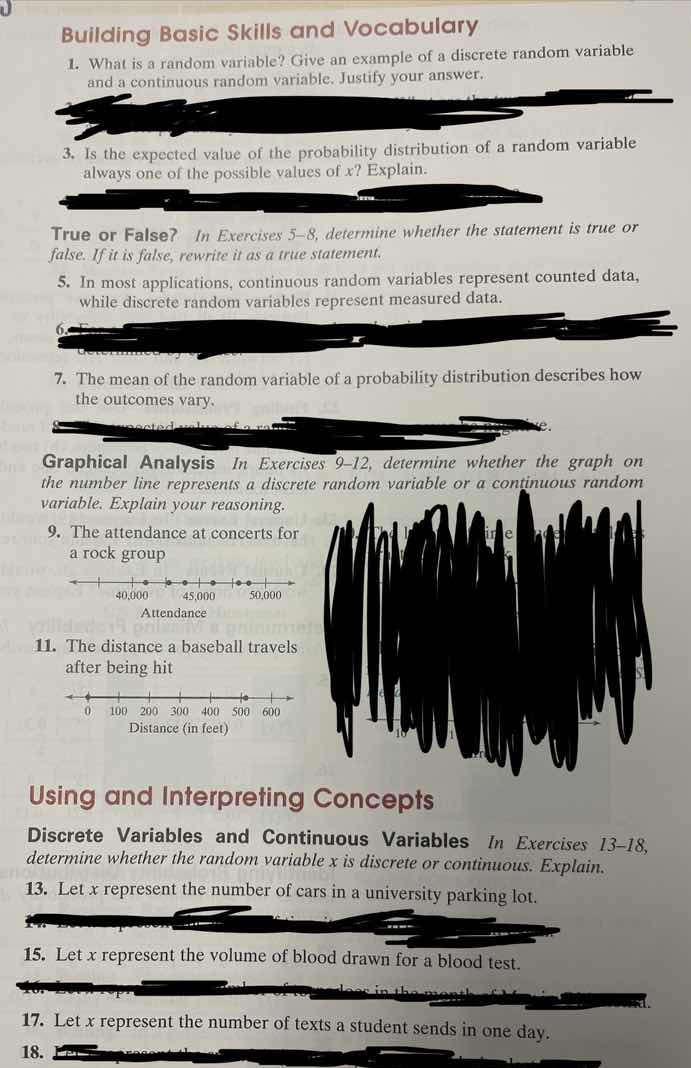
Question
building basic skills and vocabulary
- what is a random variable? give an example of a discrete random variable
and a continuous random variable. justify your answer.
- is the expected value of the probability distribution of a random variable
always one of the possible values of ( x )? explain.
true or false? in exercises 5–8, determine whether the statement is true or
false. if it is false, rewrite it as a true statement.
- in most applications, continuous random variables represent counted data,
while discrete random variables represent measured data.
- the mean of the random variable of a probability distribution describes how
the outcomes vary.
graphical analysis in exercises 9–12, determine whether the graph on
the number line represents a discrete random variable or a continuous random
variable. explain your reasoning.
- the attendance at concerts for
a rock group
- the distance a baseball travels
after being hit
using and interpreting concepts
discrete variables and continuous variables in exercises 13–18,
determine whether the random variable ( x ) is discrete or continuous. explain.
- let ( x ) represent the number of cars in a university parking lot.
- let ( x ) represent the volume of blood drawn for a blood test.
- let ( x ) represent the number of texts a student sends in one day.
18.
- A random variable assigns numbers to experiment outcomes. Discrete variables have countable values; continuous variables have infinite, measurable values.
- The expected value is a weighted average, not always a possible outcome.
- Discrete variables represent counted data; continuous represent measured data.
- The mean measures central tendency, not outcome variation.
- Concert attendance is countable, so discrete.
- Baseball travel distance is measurable, so continuous.
- Number of cars is countable, so discrete.
- Blood volume is measurable, so continuous.
- Number of texts is countable, so discrete.

Snap & solve any problem in the app
Get step-by-step solutions on Sovi AI
Photo-based solutions with guided steps
Explore more problems and detailed explanations
- Random variable definition: A variable whose value is determined by the outcome of a random experiment.
- Discrete example: Number of heads in 3 coin flips (countable values: 0,1,2,3).
- Continuous example: Height of a randomly selected person (can take any value in a range, e.g., 150.2 cm, 175.5 cm).
- No, the expected value is not always a possible value of $x$.
- Explanation: It is a weighted average of all possible values. For example, rolling a fair 6-sided die, the expected value is $\frac{1+2+3+4+5+6}{6}=3.5$, which is not a possible outcome of the die roll.
- False.
- Corrected statement: In most applications, discrete random variables represent counted data, while continuous random variables represent measured data.
- False.
- Explanation: The mean of a random variable describes the central tendency (average outcome), while the variance or standard deviation describes how outcomes vary.
- Discrete random variable.
- Reasoning: Concert attendance is a countable number (you cannot have a fraction of a person in attendance).
- Continuous random variable.
- Reasoning: The distance a baseball travels can take any value within a range (e.g., 325.7 feet, 410.2 feet) and is measured, not counted.
- Discrete random variable.
- Reasoning: The number of cars is a countable value (you cannot have a fraction of a car in the parking lot).
- Continuous random variable.
- Reasoning: Volume of blood is a measurable quantity that can take any value in a range (e.g., 5.2 mL, 7.8 mL).
- Discrete random variable.
- Reasoning: The number of texts is a countable value (you cannot send a fraction of a text).