QUESTION IMAGE
Question
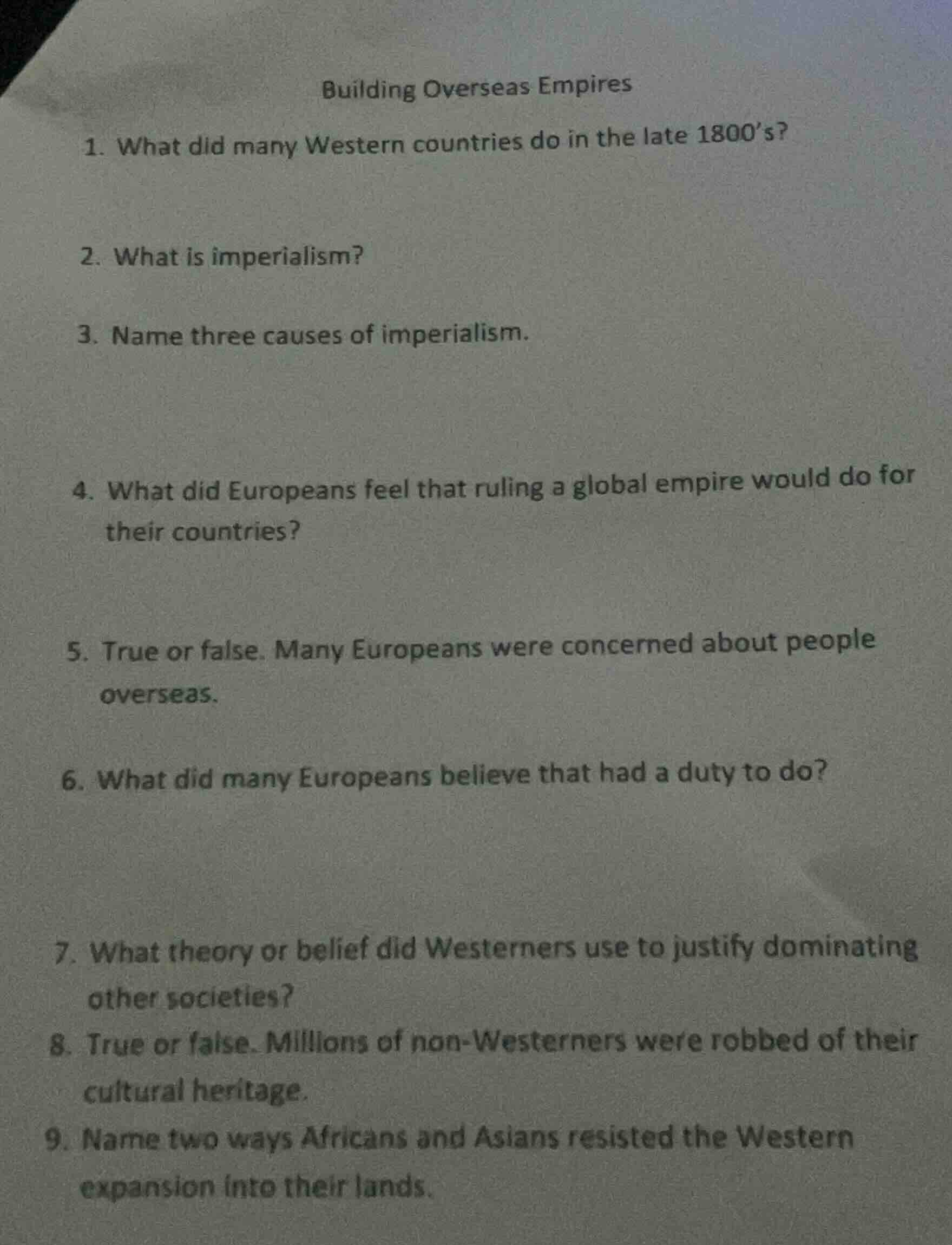
building overseas empires
- what did many western countries do in the late 1800’s?
- what is imperialism?
- name three causes of imperialism.
- what did europeans feel that ruling a global empire would do for their countries?
- true or false. many europeans were concerned about people overseas.
- what did many europeans believe that had a duty to do?
- what theory or belief did westerners use to justify dominating other societies?
- true or false. millions of non - westerners were robbed of their cultural heritage.
- name two ways africans and asians resisted the western expansion into their lands.
Question 1
In the late 1800s, many Western countries engaged in imperialism, which involved establishing overseas empires through colonization, annexation, or economic domination of other regions (especially in Africa and Asia) to gain resources, markets, and power.
Imperialism is a policy (often by a powerful nation) of extending control over other territories, peoples, or nations—through colonization, economic influence, or military force—to gain political, economic, or social dominance, often exploiting the colonized for resources, labor, or markets.
Three causes of imperialism include: 1) Economic: Need for raw materials (e.g., rubber, minerals) and new markets (to sell goods) as industrialization grew. 2) Political: Rivalry between Western powers to expand territory and demonstrate national strength. 3) Ideological: Belief in cultural/social superiority (e.g., "civilizing mission") and desire to spread Western values/religion.

Snap & solve any problem in the app
Get step-by-step solutions on Sovi AI
Photo-based solutions with guided steps
Explore more problems and detailed explanations
Many Western countries engaged in imperialism, establishing overseas empires by colonizing, annexing, or economically dominating regions (e.g., Africa, Asia) to gain resources, markets, and power.