QUESTION IMAGE
Question
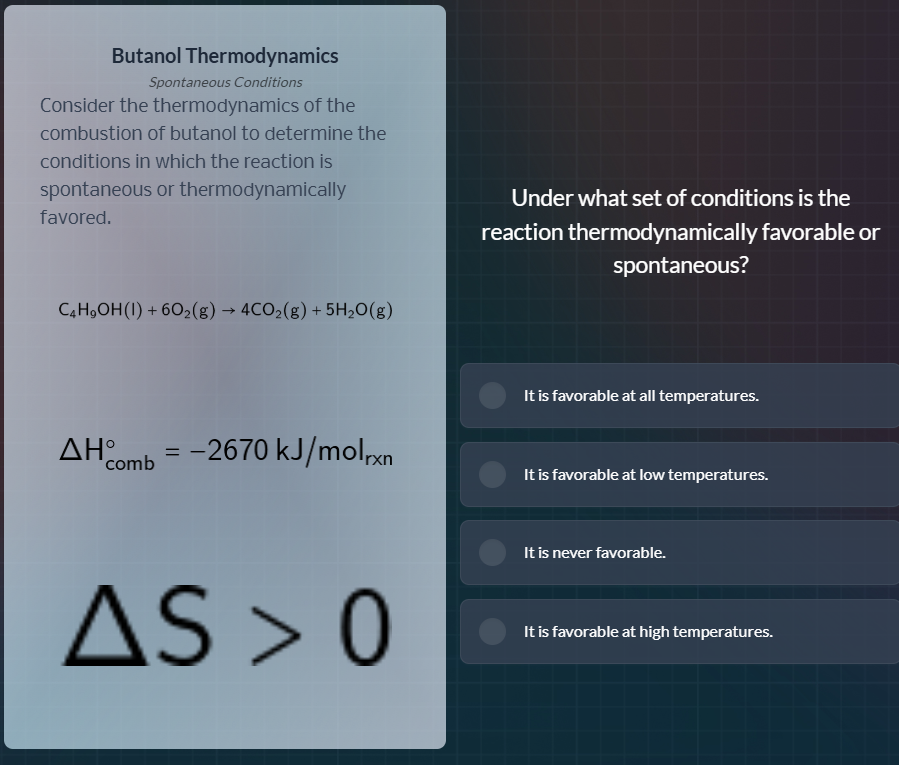
butanol thermodynamics
spontaneous conditions
consider the thermodynamics of the
combustion of butanol to determine the
conditions in which the reaction is
spontaneous or thermodynamically
favored.
\ce{c4h9oh(l) + 6o2(g) -> 4co2(g) + 5h2o(g)}
$\delta h^\circ_{\text{comb}} = -2670\\ \text{kj/mol}_{\text{rxn}}$
$\delta s > 0$
under what set of conditions is the
reaction thermodynamically favorable or
spontaneous?
- it is favorable at all temperatures.
- it is favorable at low temperatures.
- it is never favorable.
- it is favorable at high temperatures.
To determine the spontaneity of a reaction, we use the Gibbs free energy equation: $\Delta G = \Delta H - T\Delta S$. For a reaction to be spontaneous, $\Delta G < 0$.
Given:
- $\Delta H^\circ_{\text{comb}} = -2670 \, \text{kJ/mol}_{\text{rxn}}$ (negative, exothermic).
- $\Delta S > 0$ (positive, increase in disorder).
Substitute into $\Delta G$:
$\Delta G = \text{(negative)} - T(\text{positive})$.
Since $\Delta H$ is negative and $\Delta S$ is positive, the term $-T\Delta S$ will be negative (because $T$ is always positive in Kelvin, and we subtract a positive value multiplied by $T$). Thus, $\Delta G$ will be negative (spontaneous) for all temperatures (because both contributions to $\Delta G$ favor spontaneity: negative $\Delta H$ and positive $\Delta S$).

Snap & solve any problem in the app
Get step-by-step solutions on Sovi AI
Photo-based solutions with guided steps
Explore more problems and detailed explanations
It is favorable at all temperatures.